
Is the sharply lowered Adidas Forecast just a bump in the turnaround story or the start of a longer de-rating?
Adidas AG: Why the Market Punished a Seemingly Positive Update
On the surface, the latest numbers from Adidas look like a classic turnaround story: EBIT up around 54%, earnings per share jumping roughly 75%, and a dividend increased to EUR 2.80 per share. Yet the stock is firmly under pressure, sliding about 7% in Frankfurt trading to around EUR 136.65, after having already lost more than 40% from its spring peak above EUR 240. For U.S. and global investors, the key takeaway is that the market is no longer rewarding backward-looking strength but is laser-focused on the Adidas Forecast for the next 12–24 months.
The company now targets an operating result of about EUR 2.3 billion for 2026, implying an operating margin of roughly 8.6%. Both metrics fall short of earlier midterm ambitions and of the analyst consensus, which had expected about EUR 2.7 billion in operating profit. That delta of roughly EUR 400 million is large enough to reset valuation assumptions and earnings models across the Street, even though Adidas is still signaling rising profits and higher shareholder payouts.
The share price drop also needs to be seen against a broader equity backdrop. While the DAX has managed modest gains over the past year, Adidas has markedly underperformed. By contrast, U.S. indices like the S&P 500 and NASDAQ have been driven by mega-cap tech winners such as NVIDIA, which highlight how unforgiving the market can be with slower-growing consumer names that disappoint on guidance.
Adidas Forecast vs. Expectations: How Big Is the Guidance Miss?
The central problem for sentiment is the gap between the new Adidas Forecast and what the sell side had built into their models. Management’s outlook for roughly EUR 2.3 billion in operating profit in 2026 is roughly 15% below the EUR 2.7 billion many analysts expected. In percentage terms, this is not a minor trim; it is a meaningful reset that suggests pressure from currencies, tariffs, and possibly slower top-line or margin normalization than investors hoped.
Adidas also projects an operating margin of about 8.6%, which is below the company’s own prior medium-term guidance. For a premium global sportswear brand, investors often look for double-digit margin potential, especially when comparing to U.S.-listed peers. The lower margin trajectory raises questions about structural profitability, cost inflation, and the pricing power of the brand, particularly in North America and Greater China.
At the same time, the company emphasizes that profits and shareholder returns should still grow. The higher dividend and the signaling of larger payouts are positives, but they cannot fully offset the disappointment around the Adidas Forecast. For long-only global funds benchmarked to indices like MSCI World or MSCI Europe, the revised guidance likely triggers model downgrades, which in turn can lead to de-rating and reduced index weight over time.
Several European brokers, including houses like Deutsche Bank and UBS, have in the past flagged the sensitivity of Adidas earnings to FX and tariff developments. Recent commentary in the market highlights that the current profit outlook is also weighed down by exactly these effects, along with persistent uncertainty in some regions. This combination makes many analysts cautious about aggressively raising price targets in the near term, and some may move ratings toward more neutral stances until visibility improves.
Adidas AG Under Technical Pressure: What the Chart Signals
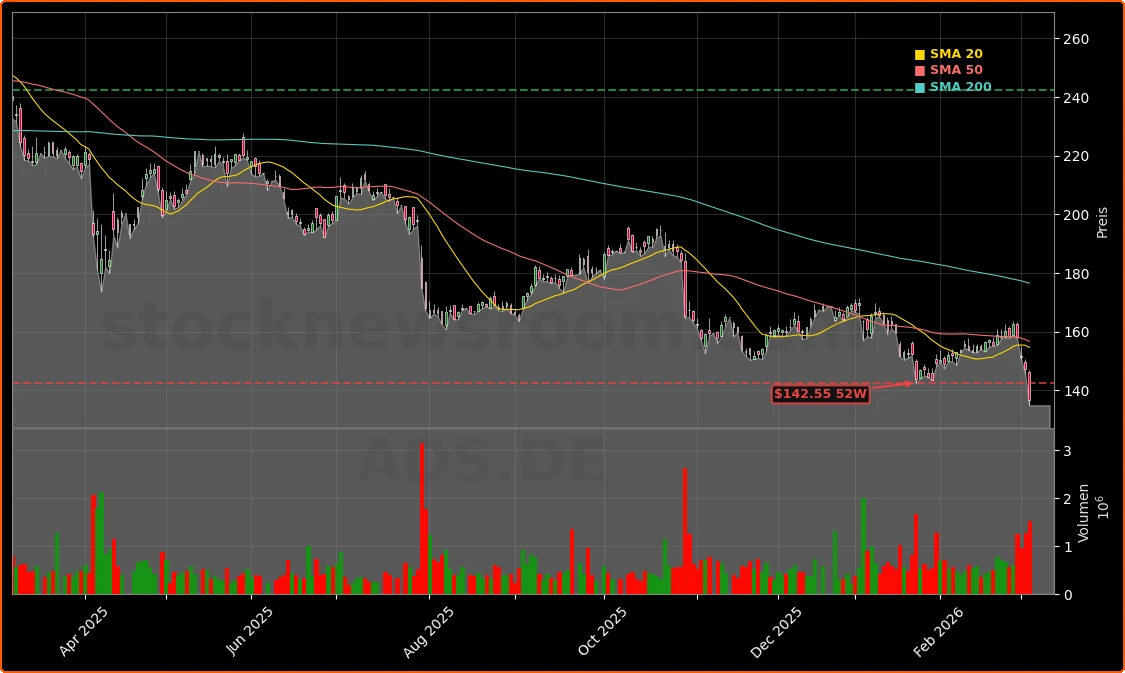
From a technical analysis perspective, Adidas currently trades in a clearly defined downtrend. The stock has fallen from a high above EUR 240 in the spring to the current area around EUR 136, a decline of over 42% within twelve months, while the DAX has slightly appreciated. Every recent rally attempt has been sold into, and short-lived rebounds have quickly given way to new waves of selling. For U.S. investors used to following momentum patterns on NYSE and NASDAQ, this is a classic case of a fallen leader struggling to find a floor.
The price now sits significantly below the 200-day moving average, which stands around EUR 176. The roughly 22% discount to this key trend line underscores the strength of the ongoing downtrend. Even more concerning, the 200-day average itself has started to slope gently downward, confirming that the longer-term trend has turned negative rather than this being a mere correction. There is, so far, no convincing sign of bottom formation in either price action or momentum indicators.
Short-term models indicate a potential trading corridor between roughly EUR 127 and EUR 174 over the next four weeks, with a central expectation pointing to about a 10% rebound from current levels. In practice, that means volatility is likely to remain elevated, and sharp counter-rallies are possible, particularly if macro data or sector news turns more favorable. However, for investors with a 12–24 month view, the dominant signal remains a stock struggling to regain institutional confidence.
For U.S.-based active managers, this kind of chart profile often leads to a barbell approach: some are tempted to buy into extreme pessimism, while others prefer to wait for a clear break above key resistance levels (for example, a sustained move back over EUR 176) before re-rating the name. Until that kind of confirmation occurs, Adidas risks remaining in the penalty box compared with momentum-rich consumer names and the large-cap tech complex led by companies like Apple.
Adidas AG Leadership: Does the Gulden Extension Change the Investment Case?
One important strategic development is the extension of CEO Bjørn Gulden’s contract through 2030. Leadership continuity is often a significant factor for long-term investors, particularly after a turnaround phase. Gulden is widely credited with stabilizing the business after the Yeezy/Kanye West fallout and steering Adidas back to revenue growth. Recent reporting points to a “turnaround year” in which revenue grew about 12% to nearly $25 billion, underlining that the top line is moving in the right direction again.
From a governance and strategic clarity standpoint, this extension sends a strong signal: the board believes in Gulden’s course and wants to ensure continuity during the next strategic phase. In theory, this should be supportive for long-term valuation, as it reduces uncertainty around management changes and strategic pivots. For U.S. institutional investors, who often prioritize stable, credible management teams when allocating to non-U.S. equities, this is a clear plus.
Nevertheless, the immediate market reaction shows that leadership continuity cannot fully offset a weaker Adidas Forecast. Investors are effectively saying: Gulden’s track record is solid, but the numbers now carry more weight than the narrative. The lingering doubts center on whether Adidas can structurally lift margins and regain lost share in critical markets, particularly North America, without over-reliance on promotional activity.
Analyst commentary from major banks such as Morgan Stanley and JPMorgan in recent quarters has often emphasized that Adidas remains a “show-me” story: the brand equity is strong, but execution and regional performance need to be consistently better over several seasons. The extension of Gulden’s contract keeps the strategic captain on deck, yet the pressure to deliver on profitability and margin expansion remains intense.
Adidas Forecast in the Context of Nike and Puma: How Competitive Is the Outlook?
No analysis of the Adidas Forecast is complete without looking at peers. In the U.S. market, Nike remains the primary benchmark. Nike, listed on the NYSE, is widely followed by Wall Street and tends to command a premium multiple due to its scale, innovation track record, and historically higher margins. When U.S. investors compare the roughly 8.6% operating margin outlook at Adidas to Nike’s long-run double-digit margin profile, the valuation gap can appear justified, especially if Adidas is perceived as having lower pricing power.
At the same time, the European rivalry with Puma remains strategically important. Recent developments, including the appointment of former Adidas sales chief Arthur Hoeld as Puma’s new CEO, underscore how intense the competition has become. Puma’s board reshuffle, motivated by differing views on strategy execution, signals that both German brands are in transition, fighting for positioning across performance and lifestyle segments.
Media reports from early 2025 highlight how the historic Adidas–Puma rivalry still shapes the global sportswear landscape, especially in Europe and emerging markets. For portfolio managers who allocate across global consumer discretionary, this rivalry means that market share shifts and regional growth trends can be swift, and execution risk is high. If Puma manages to leverage Hoeld’s insights into Adidas’s commercial playbook, the competitive pressure on margins and marketing spend could increase further.
Meanwhile, in the U.S. equity universe, investors often compare Adidas’s growth prospects not only with Nike but also with fast-growing athleisure and direct-to-consumer brands, some of which are listed on the NYSE or NASDAQ. Against this backdrop, a conservative Adidas Forecast may push some growth-oriented funds to favor higher-beta names in the sector, while value-oriented managers might see an opportunity if valuation compresses further.
Valuation, Risk, and Portfolio Role: Is the Stock a Buy After the Drop?
With Adidas trading near EUR 136.65 and sitting close to the bottom of its 12‑month range, the natural question for investors from Wall Street to London is whether this is a buying opportunity or a value trap. The stock’s de-rating relative to both the DAX and global indices reflects a loss of confidence in medium-term profit growth, but it also means that a portion of the bad news is already reflected in the price.
On a fundamental basis, investors will focus on the relationship between the updated Adidas Forecast and the current valuation multiples. If consensus earnings estimates are revised down in line with the new EUR 2.3 billion operating profit target, the forward P/E and EV/EBIT multiples could still be elevated versus peers like Nike if the market doubts Adidas’s ability to close the margin gap. Conversely, if management can demonstrate that 8.6% operating margin is a conservative stepping stone rather than a ceiling, there could be upside once sentiment normalizes.
Prominent equity research houses such as Goldman Sachs and RBC Capital Markets have historically taken a nuanced view of European consumer names like Adidas, balancing brand strength against cyclical headwinds and FX risks. It would not be surprising to see some of these banks adjust their Adidas price targets downward in the wake of the new guidance while retaining ratings such as “Neutral” or “Sector Perform” to reflect both downside risks and potential for a rebound if execution improves.
Risk-wise, investors should keep several factors in mind: exposure to tariffs and trade tensions, FX volatility impacting dollar- and yuan-denominated sales, reliance on fashion cycles, and the ongoing transition in wholesale and direct-to-consumer channels. On the positive side, a globally recognized brand, a strengthening balance sheet after the Yeezy clean-up, rising dividends, and long-term leadership clarity under Gulden offer a foundation for a multi-year recovery, provided execution does not falter.
The new Adidas Forecast underscores a classic market dilemma: strong recent execution meets a guidance reset that forces investors to rethink what they are willing to pay for the brand’s long-term potential.
— StockNewsroom.com Analysis Desk
Conclusion
For diversified U.S. portfolios, Adidas can serve as a satellite position within the consumer discretionary sleeve, offering geographic and currency diversification beyond U.S.-listed peers. However, given the current downtrend and the cautious Adidas Forecast, many investors may prefer a staged entry strategy—starting with a small position and adding on clear signs of margin traction or a technical trend reversal, rather than attempting to call the exact bottom.
Further Reading
- Adidas AG (ADS.DE) Quote and Profile (Yahoo Finance)
- Adidas seals turnaround year with strong quarterly sales — after Kanye disaster (New York Post)
- Adidas vs. Puma: how a sibling split in a small German town gave birth to a longstanding rivalry (Invezz)