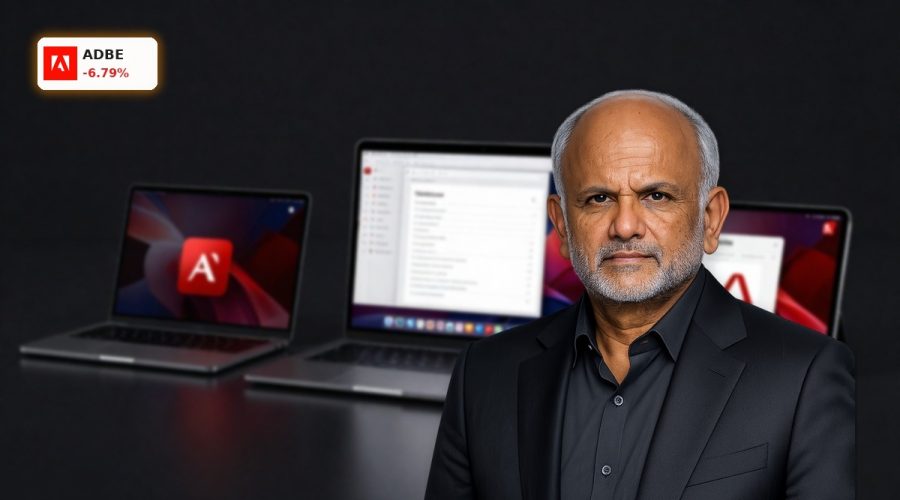
Is the Adobe CEO Change just a passing headline or the catalyst for a deeper reset in how investors value this software giant?
How did markets react to Adobe’s news?
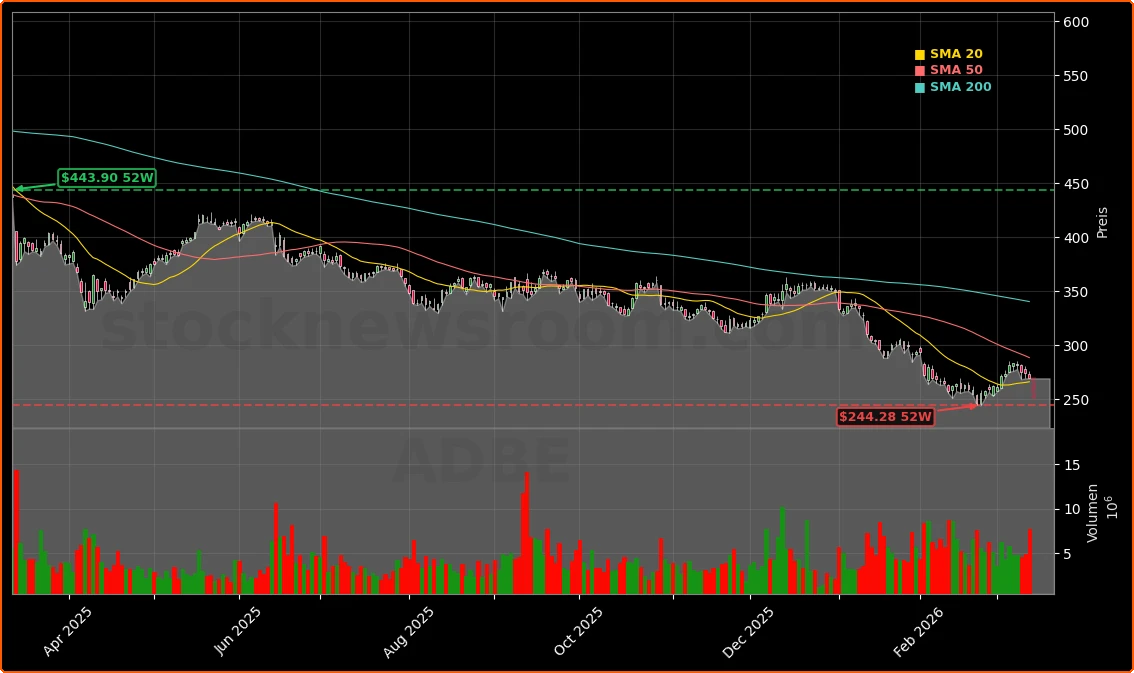
Adobe shares closed Thursday at $269.78, down 1.43% on the day, and slid another roughly 6.8% after hours to around $251.46 as traders responded to the Adobe CEO Change and the company’s outlook. The stock is now down more than 20% year to date and remains over 60% below its 2021 record high, underperforming the S&P 500, which is off only modestly in 2026. The reaction illustrates how skittish Wall Street remains on large-cap software after a multi‑year rerating and amid worries that generative AI could compress margins or erode long‑standing product moats.
Short interest has been elevated in recent weeks, with bearish traders betting against the name as part of a broader rotation out of traditional software. Options activity before earnings pointed to rising call buying, hinting at expectations for a potential short squeeze if results surprised to the upside. Instead, the Adobe CEO Change and only slightly better‑than‑expected guidance gave bears new ammunition, at least in the short term.
What do Adobe’s Q1 numbers show?
Fundamentally, the quarter was solid. For its fiscal first quarter ended February 27, Adobe reported adjusted EPS of $6.06, ahead of Wall Street estimates around $5.87–$5.88. Revenue reached $6.40 billion, topping consensus of about $6.28 billion and growing roughly 12% year over year. Subscription revenue for creative and marketing professionals climbed to $4.39 billion, also up about 12% and slightly above analyst expectations.
Management highlighted that AI‑first annualized recurring revenue more than tripled versus a year ago, underscoring that the company is successfully monetizing new Firefly, Photoshop, Acrobat and Express capabilities rather than simply defending them against low‑cost competitors such as Canva or smartphone editing tools. Adobe also expanded partnerships, including deeper integration of Acrobat, Express and Photoshop into OpenAI’s ChatGPT, and an extended relationship with advertising major WPP, aiming to keep its tools central to marketing and content workflows.
Despite these records, remaining performance obligations (backlog) came in at about $22.22 billion, slightly below what some on Wall Street had penciled in. That, combined with a conservative tone on the macro environment and spending decisions at enterprise customers, contributed to the post‑earnings selloff.
Why did the Adobe CEO Change unsettle investors?
The Adobe CEO Change involves one of the longest‑tenured leaders in big tech. Shantanu Narayen, 62, joined Adobe in the late 1980s and has served as CEO since 2007. Over 18 years at the helm, he steered the company from packaged software licenses to the subscription‑based Creative Cloud and then deeper into cloud‑delivered marketing and analytics. During his tenure, Adobe’s share price increased more than sixfold, comfortably outpacing the S&P 500.
Adobe said Narayen will transition out of the CEO role once a successor is appointed, while remaining as chair of the board. Lead independent director Frank Calderoni will chair a special committee overseeing the search, which will consider both internal and external candidates. Narayen emphasized in a memo to employees that he plans to support the next leader from the board, mirroring how co‑founders John Warnock and Charles Geschke backed him during his early years as chief.
For investors, the timing of the Adobe CEO Change is critical. The company is in the middle of a high‑stakes pivot to generative AI, is still digesting the costly $1 billion breakup fee tied to its abandoned Figma acquisition, and faces rising legal and regulatory scrutiny, including trademark litigation over its Firefly Foundry branding. Leadership uncertainty during such a strategic transition naturally pressures the multiple, even when day‑to‑day operations remain strong.
How does Adobe stack up in the AI and software race?
On the competitive front, Adobe is trying to convince Wall Street it can be a structural winner in AI rather than a casualty. While design and creative workflows are increasingly touched by AI models from NVIDIA‑powered cloud platforms and rival startups, Adobe argues its combination of proprietary content libraries, long‑standing enterprise relationships and integrated tools allows it to build secure, rights‑aware AI that large companies can trust. That pitch is designed to differentiate Adobe from more consumer‑centric offerings and to reassure risk‑averse clients who may be cautious about using generic AI models for commercial work.
At the same time, the stock trades in a market that has rewarded clear AI leaders like NVIDIA and punished slower‑moving software franchises. Investors have also watched peers such as Apple and Tesla ride AI narratives in hardware and auto, while many cloud‑software vendors are still proving that AI can drive incremental revenue rather than just defensive R&D spending. With software as a sector lagging high‑flying chip names on the NASDAQ, the Adobe CEO Change increases the burden on management to clearly articulate the next growth leg.
On the sell‑side, firms such as TD Cowen have responded by trimming price targets while maintaining neutral or hold stances, reflecting confidence in Adobe’s franchise but caution around growth durability and valuation amid AI turbulence. The mixed posture mirrors sentiment across enterprise software, where investors are demanding cleaner beats and more aggressive AI roadmaps to re‑rate the group.
Is Adobe’s guidance enough to rebuild confidence?
For fiscal Q2, Adobe guided to adjusted EPS of $5.80–$5.85 on revenue of $6.43–$6.48 billion. Both ranges are modestly above or in line with Street expectations, with revenue at the lower end just matching consensus. In other words, the outlook is positive but not explosive, leaving little room for error in a market that has turned far more selective.
From a portfolio perspective, the risk‑reward now revolves around whether the Adobe CEO Change becomes a short‑term overhang or a catalyst for a refreshed narrative. If the board can install a credible successor with a strong AI track record and the company continues to show mid‑teens or better growth in subscription and AI‑related ARR, the current drawdown could attract long‑term growth investors. Conversely, any missteps in succession, regulation or AI execution could keep Adobe trading at a discount to its historical multiples and to faster‑growing cloud peers.
Adobe delivered record Q1 results with AI-first ARR more than tripling year over year and subscription revenue growing 13 percent.
— Shantanu Narayen, outgoing Adobe CEO and Chair
Conclusion
For now, Adobe remains a cornerstone franchise in digital media and marketing software, even as competition intensifies and leadership transitions. The Adobe CEO Change, record Q1 numbers and cautious but above‑consensus guidance together mark an inflection point; the next few quarters and the choice of Narayen’s successor will determine whether the stock can reclaim its former leadership status on the NASDAQ and within U.S. tech portfolios.
Further Reading
- Adobe Inc. (ADBE) Stock Price, News & History (Yahoo Finance)
- Adobe CEO Shantanu Narayen says he will step down as CEO after successor has been named (CNBC)
- Adobe beats Q1 estimates but shares slide on weak profit outlook, CEO transition news (Proactive Investors)
- Adobe Earnings May Not Help the Stock Bounce Back—Even If They’re Good (Barron’s)