
Can the Adobe CEO Transition and record Q1 results overcome Wall Street’s AI fears and a brutal sell-off in the stock?
How is Adobe trading after earnings?
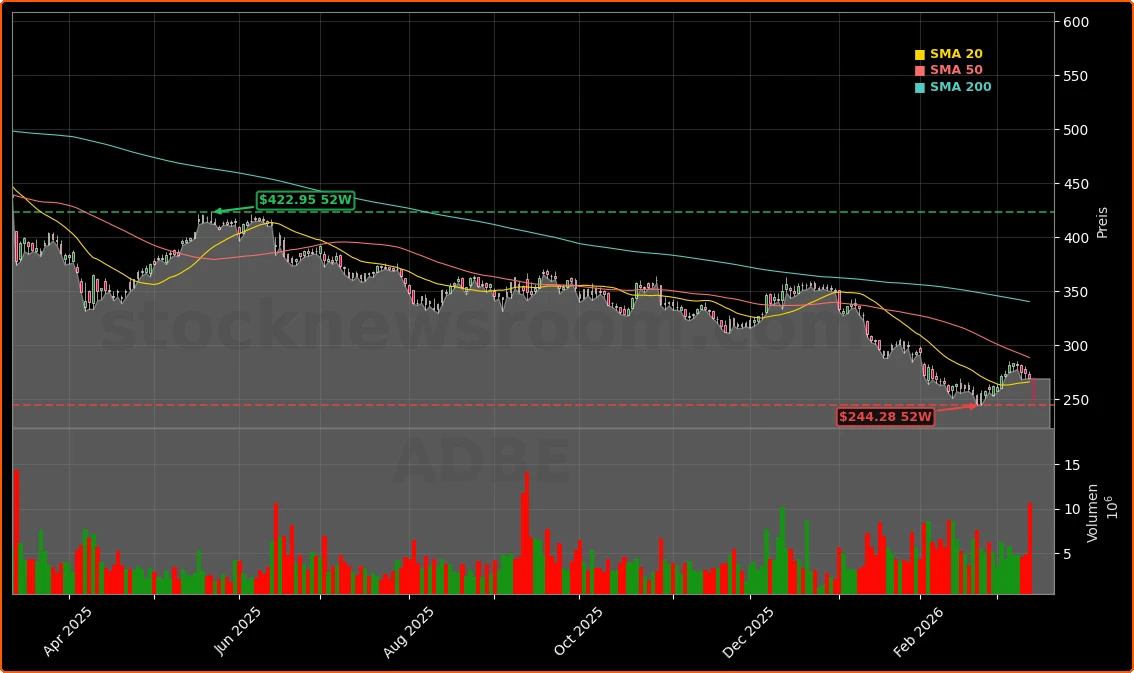
On Friday morning in Europe, Adobe Inc. shares changed hands at about $269.78, down roughly 1.4% from the prior close of $248.97 in U.S. trading, while pre‑market indications on Wall Street around $246.88 pointed to another drop of more than 8%. The stock is now close to a three‑year low and down about 23% year to date, badly underperforming the Nasdaq and S&P 500 as investors question whether generative AI will erode the company’s long‑term pricing power.
The sell‑off accelerated despite a lack of negative surprises in the quarter itself. What spooked investors was timing: the Adobe CEO Transition lands just as fears of a broader “SaaSpocalypse” hang over high‑multiple software names that look vulnerable to AI‑driven disruption. That puts Adobe in the same market penalty box as other application‑software names, even though its business trends look healthier than the stock price suggests.
What did Adobe deliver in Q1 2026?
Fiscal Q1 2026 was operationally one of Adobe’s strongest quarters on record. Revenue rose 12% year over year to $6.40 billion, an acceleration from 10% growth in the prior quarter and a new Q1 high. Subscription revenue grew even faster at 13% to $6.17 billion, underlining the strength of the company’s core recurring model. Total ending annualized recurring revenue reached $26.06 billion, up about 11% despite a steeper‑than‑planned decline in the legacy standalone stock‑content business, now roughly a $450 million run‑rate segment.
Profitability remained robust. GAAP earnings per share climbed 11% to $4.60, while non‑GAAP EPS jumped 19% to $6.06, handily beating Wall Street expectations. GAAP operating margin came in at 37.8%, with non‑GAAP margin at an impressive 47.4%. Operating cash flow hit a Q1 record of $2.96 billion, reinforcing Adobe’s position as one of the cash‑rich anchors of the software complex alongside names like Apple and NVIDIA.
Guidance also came in ahead of consensus. For fiscal Q2, management is targeting revenue of $6.43–$6.48 billion and non‑GAAP EPS of $5.80–$5.85, slightly topping prior Street estimates. The outlook excludes any impact from the pending acquisition of Semrush, expected to close this quarter, and assumes a non‑GAAP operating margin around 44.5%.
Is AI a threat or tailwind for Adobe?
Behind the headline Adobe CEO Transition, management stressed that AI is becoming more of a growth driver than a risk. ARR from AI‑first offerings more than tripled year over year, supported by rapid adoption of Firefly generative models and Acrobat AI Assistant. Across Creative Cloud, Acrobat, Express, and Firefly, monthly active users exceeded 850 million, up 17% year over year, with freemium creative MAUs growing 50% to more than 80 million.
Acrobat and Express each posted roughly 20% MAU growth, and Express is now used by 99% of Fortune 500 companies. On the enterprise side, Adobe Experience Platform and related apps delivered subscription growth above 30%, processing more than 35 trillion segment evaluations and 70 billion profile activations per day. The GenStudio family grew ARR by more than 30%, reflecting rising demand for end‑to‑end content supply‑chain solutions at large brands from Revlon to Target and WPP.
There are trade‑offs. Management acknowledged that the aggressive freemium push for creative and AI‑first tools temporarily dampens ARR, creating a lag between user growth and full monetization. Combined with the faster‑than‑expected shift away from traditional stock products, that contributed to slightly softer ARR than some analysts had modeled. Still, firms like JPMorgan remain constructive, arguing that Adobe has “planted the seeds” for its next AI‑driven growth phase.
What does the Adobe CEO Transition change?
The Adobe CEO Transition marks the end of an era. Shantanu Narayen has led Adobe Inc. since 2007, overseeing the move from boxed software to Creative Cloud subscriptions and lifting annual revenue roughly sixfold to around $24 billion. He will stay on as chair of the board while a committee led by lead independent director Frank Calderoni evaluates internal and external CEO candidates.
For investors, the concern is less about Narayen’s performance and more about succession risk at a delicate strategic moment. The company is digesting the failed Figma acquisition, for which it paid a $1 billion break‑up fee, and is fighting for mindshare against a wave of generative‑AI‑native startups, as well as incumbents like Tesla in design‑automation experiments and Apple in on‑device creative tools. Market watchers note that the leadership vacuum could raise questions around capital allocation, M&A appetite, and how aggressively Adobe leans into AI investment versus margin preservation.
As we accelerate AI-powered capabilities across creativity, productivity and customer experience orchestration, Adobe is well positioned for continued profitable growth.
— Dan Durn, Chief Financial Officer of Adobe Inc.
Conclusion
At the same time, Adobe is signaling confidence through the buyback. The company repurchased 8.1 million shares in the quarter, up from 7.2 million in Q4, with $3.89 billion still authorized under a $25 billion program. With the stock now trading near a forward P/E of roughly 15 — half its long‑term average multiple above 30 — bullish voices on Wall Street argue that much of the execution and AI risk is already priced in.
Further Reading
- Adobe Inc. (ADBE) Stock Price & Data (Yahoo Finance)
- Adobe Delivers Record Q1 2026 Results (Adobe Newsroom)
- Shantanu Narayen to Transition from CEO Role (Adobe Newsroom)
- Adobe’s Revenue Accelerates: Is the Stock a Buy? (The Motley Fool)
- Adobe (ADBE) Q1 Earnings vs. Estimates (Zacks Investment Research)