Can Advanced Micro Devices AI Servers turn today’s data center momentum into a long-term cash machine that justifies the latest price surge?
AMD as an AI infrastructure play for Wall Street portfolios
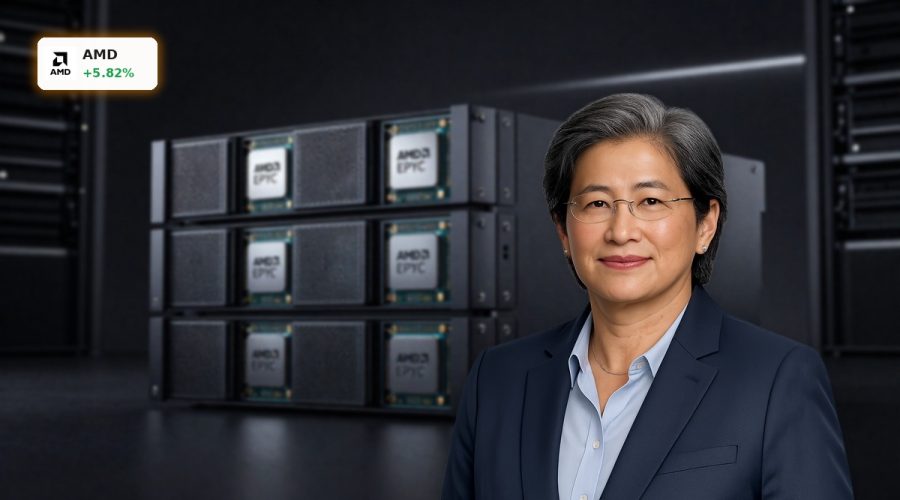
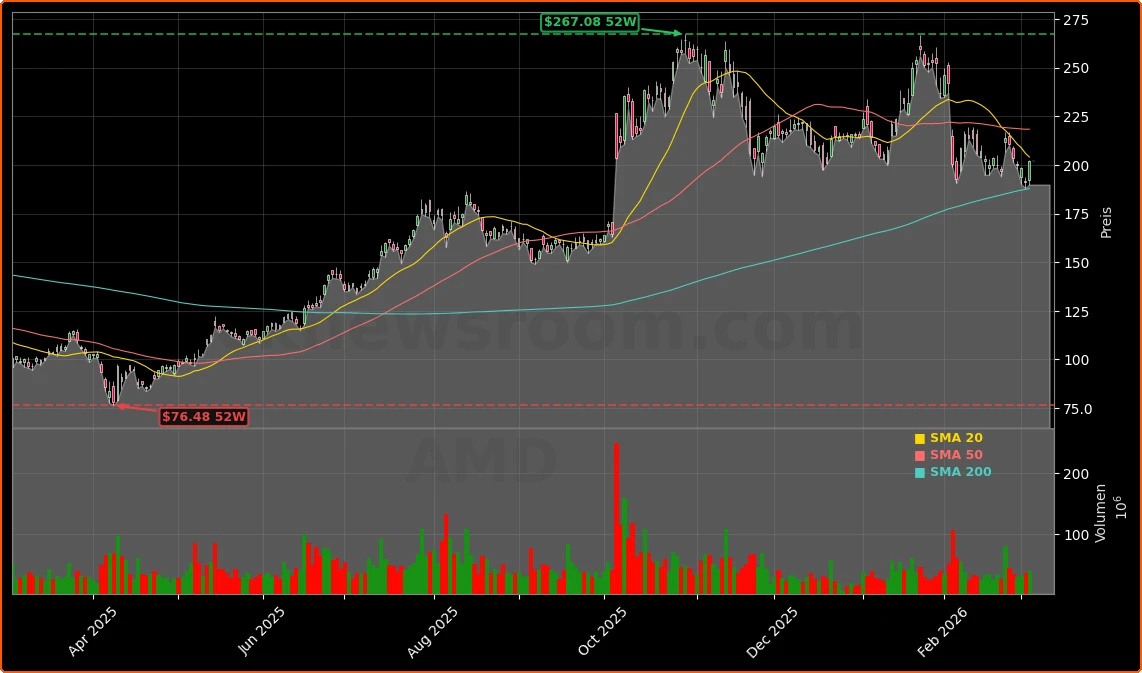
AMD shares closed the latest session at $202.07, up 5.8% on the day and slightly higher in after‑hours trading. The move keeps AMD among the top AI beneficiaries within the NASDAQ and S&P 500, even after an extended run in large‑cap semiconductor names. For US investors who rotated from NVIDIA into AMD over the past few quarters, the core thesis has been that AMD could capture meaningful share in AI accelerators and data center CPUs, while the broader market was still pricing it primarily as a PC and gaming chip vendor.
That shift is now visible in the numbers. AMD’s revenue grew 34% year over year in the latest reported quarter, led by the data center segment. Management has emphasized that AI‑related products — especially EPYC server CPUs and Instinct GPUs that power Advanced Micro Devices AI Servers — are the main growth drivers, not traditional consoles or PC processors. Free cash flow surged 129% last year, reflecting both higher margins and an improving mix toward complex AI systems sold to hyperscale customers.
Wall Street analysts are starting to frame AMD less as a cyclical chip name and more as a structural AI infrastructure supplier. Piper Sandler and Jefferies have reiterated bullish views on the stock after a large multi‑year AI GPU deal with Meta Platforms that could generate around $100 billion in revenue across five years. Several institutional investors, including Wisconsin Capital Management, Laffer Tengler Investments and Insigneo Advisory Services, have recently increased their positions, contributing to institutional ownership above 70%.
Advanced Micro Devices AI Servers: how strong is the data center engine?
The crux of the bull case is that Advanced Micro Devices AI Servers become a recurring platform rather than a one‑off product cycle. AMD’s data center portfolio now spans EPYC server CPUs, Instinct data center GPUs, Pensando data processing units and an expanding software stack via ROCm. Together, these components form complete AI servers targeted at hyperscalers, cloud service providers and emerging AI‑as‑a‑service platforms.
On the CPU side, AMD’s EPYC family continues to gain share in x86 servers, primarily due to core density and energy efficiency advantages over legacy incumbents. In the newest generation, EPYC 9005 chips are being paired directly with Instinct accelerators inside specialized AI server designs. Those servers target large language model training and inference, recommendation engines and other data‑intensive AI workloads that dominate AI capex budgets.
The GPU side is where the market focus is most intense. AMD’s Instinct accelerators are increasingly seen as the main alternative to NVIDIA’s data center GPUs. AMD has already secured major GPU supply deals with Oracle, OpenAI and Meta Platforms. The Meta agreement in particular is viewed as a landmark: Piper Sandler estimates the contract could be worth roughly $100 billion over five years, and Jefferies compares it in scope to AMD’s earlier work with OpenAI. If execution remains on track, these hyperscale wins may give Advanced Micro Devices AI Servers critical reference customers to drive further adoption by other cloud and enterprise buyers.
Importantly for valuation, analysts expect AMD’s free cash flow to expand from about $5.5 billion in 2025 to roughly $19 billion by 2028, driven mainly by higher‑margin AI system sales. At the current price, the stock trades near 18 times 2028 free cash flow estimates, implying further upside if the AI data center cycle lasts longer or grows faster than currently modeled.
Akash Systems, MiTAC and the innovation edge in AI server hardware
A key differentiator for Advanced Micro Devices AI Servers is how partners are integrating AMD silicon into advanced cooling and system‑level designs. Akash Systems recently announced what it calls the world’s first AI servers using its Diamond Cooling technology together with AMD Instinct MI350X GPUs and MiTAC Computing’s server platforms. Diamond Cooling has already been used in space applications, and in AI data centers it can reduce GPU and high‑bandwidth memory (HBM) temperatures by up to 10°C. That thermal headroom allows operators to push performance and density higher within the same power envelope, a critical constraint in hyperscale and colocation facilities.
The MiTAC servers supporting these platforms employ dual 5th‑generation AMD EPYC 9005 CPUs, AMD Pensando Pollara 400 AI network interface cards and the latest AMD ROCm software stack. This tight integration across compute, networking and software points toward a broader strategy: AMD is working with OEM and ODM partners to deliver complete, validated Advanced Micro Devices AI Servers that can go directly into cloud and enterprise racks, rather than only selling standalone chips.
For US‑based investors, this ecosystem build‑out matters because it supports a recurring revenue model tied to entire AI racks and clusters. It also strengthens AMD’s position in the “discerning phase” of AI investment highlighted by some market commentators, where customers prioritize total system performance, energy efficiency and real‑world ROI over raw benchmark numbers alone. As data centers hit power and cooling limits, servers that offer higher effective performance per watt — supported by Diamond Cooling and efficient EPYC CPUs — could command premium pricing and share gains.
Meta, OpenAI and hyperscale demand: durable or peak cycle?
The recently disclosed multi‑year GPU supply deal with Meta Platforms sits at the center of current bullishness. The agreement is expected to supply Meta’s rapidly expanding AI infrastructure, including recommendation systems, generative AI assistants and content moderation models. Piper Sandler’s projection of roughly $100 billion of revenue over five years underscores how central a few hyperscale clients could be to AMD’s top line.
AMD had already landed major datacenter deals with Oracle and OpenAI, building credibility as a dependable second source to NVIDIA. For investors, the question is less whether demand for AI compute exists and more how it will be split among suppliers and which platforms will achieve software ecosystem lock‑in. AMD is pushing ROCm as an open software alternative, and partners such as Micron Technology are aligning high‑bandwidth memory roadmaps with both AMD and its competitors, suggesting that the supply chain is preparing for multi‑vendor AI clusters.
Gartner expects global AI spending to reach roughly $2.5 trillion by 2026, with a significant portion tied to cloud infrastructure, AI servers and accelerators. If AMD can maintain even a mid‑teens percentage share of AI server and accelerator shipments, the Meta and OpenAI deals may be only the first wave of a multiyear demand curve. However, investors should recognize concentration risk: a slowdown or architectural shift by just one or two hyperscalers could materially affect revenue trajectories, particularly in the 2027–2028 timeframe when many analysts model peak free cash flow.
Competition with NVIDIA, Intel and ecosystem risks
Any analysis of Advanced Micro Devices AI Servers has to be framed against competition. NVIDIA still commands the dominant position in AI accelerators, with a mature CUDA software stack and a broad ecosystem of libraries, frameworks and developer tools. Many investors see NVIDIA as the default choice for mission‑critical AI training. AMD remains a fast‑growing but clearly smaller player in this niche, even as it gains hardware design wins.
Intel is also attempting a comeback in AI and data center compute through its Gaudi accelerators and updated Xeon platforms. At the same time, specialized startups and large cloud providers are increasingly investing in custom silicon. These dynamics could compress margins over time if Advanced Micro Devices AI Servers are forced to compete primarily on price, or if leading AI frameworks remain heavily CUDA‑centric despite AMD’s work on ROCm compatibility.
There are also macro and regulatory risks. A recent commentary on the sector described an “AI great divide” where investors are becoming much more selective, rewarding companies with integrated, proven AI stacks and punishing those with execution or ecosystem gaps. Concerns about export restrictions on high‑end AI accelerators to certain countries, weakness in legacy gaming hardware and a lack of full‑stack dominance versus NVIDIA all contribute to occasional volatility in AMD’s share price. UBS remains constructive on the long‑term AI opportunity, but some price targets have been revised lower in the near term as investors rebalance expectations.
From a US equity perspective, these risks mean AMD is unlikely to trade like a low‑beta, defensive compounder. Instead, it is a high‑beta levered play on AI infrastructure spending, where execution on Advanced Micro Devices AI Servers, software maturity and regulatory navigation will determine if the company closes the valuation gap with AI leaders or falls back into more cyclical patterns.
Valuation, analyst calls and where the stock fits in a portfolio
On valuation, AMD looks expensive versus traditional semiconductors but attractive against its AI growth profile. One prominent equity research note recently upgraded AMD with the argument that the stock trades at a forward P/E roughly 55% below the broader semiconductor sector median and about 45% below its own five‑year average. The same forecast sees normalized earnings per share reaching around $11 in fiscal 2027 and applies a 30x multiple, yielding a price target near $330 — roughly 67% upside from current levels by late 2026.
Other Wall Street houses echo that optimism. Piper Sandler and Jefferies both reiterated their bullish stance after the Meta deal, seeing the agreement as a strong validation of Advanced Micro Devices AI Servers and Instinct GPUs. MarketBeat data points to a “Moderate Buy” consensus among analysts, with an average price target around $290. Several institutions — including Wisconsin Capital Management, Laffer Tengler Investments and Insigneo Advisory Services — have either initiated or expanded positions, even as insider selling by CEO Lisa Su and others creates short‑term headline pressure.
For diversified US portfolios, AMD now tends to be grouped alongside AI leaders, large‑cap growth names and key NASDAQ components such as Apple and Tesla. The position size that is appropriate depends on risk tolerance. Investors with a higher risk appetite and a multi‑year time horizon might justify an overweight allocation, betting that AI spending and Advanced Micro Devices AI Servers sustain double‑digit compound growth. More conservative investors may prefer AMD as a satellite position, complementing broader S&P 500 exposure and balancing it with more established AI infrastructure names.
One practical way to frame the decision is through scenario analysis. In a bull case, AMD captures a larger slice of AI server and accelerator share, hits or exceeds the projected $19 billion in free cash flow by 2028 and re‑rates to a peer‑like multiple, driving substantial upside. In a base case, it grows strongly but faces more pricing and ecosystem pressure, producing mid‑teens annualized returns from today’s price. In a bear case, export controls, competitive setbacks and a slower AI investment cycle cause Advanced Micro Devices AI Servers to underperform expectations, leaving the stock vulnerable to multiple compression from current levels.
Conclusion
For now, the balance of evidence favors a constructive stance. Data center revenue growth is outpacing the rest of the business, large hyperscale contracts provide multi‑year visibility, and advanced system designs like the Akash–MiTAC Diamond Cooling servers highlight continued innovation. If AI infrastructure spending indeed reaches the multi‑trillion‑dollar range projected for the next few years, Advanced Micro Devices AI Servers appear well positioned to capture a meaningful share — but investors need to remain disciplined, monitor ecosystem developments and size positions in line with their risk profile.
Further Reading
- Advanced Micro Devices, Inc. (AMD) Stock Price, Quote & News (Yahoo Finance)
- Piper Sandler and Jefferies stay bullish on Advanced Micro Devices after Meta deal (Insider Monkey)
- Advanced Micro Devices Inc stock moved up by 3.75% on Mar 4: drivers behind the movement (TradingKey)
- AMD is just getting started (rating upgrade) (Seeking Alpha)