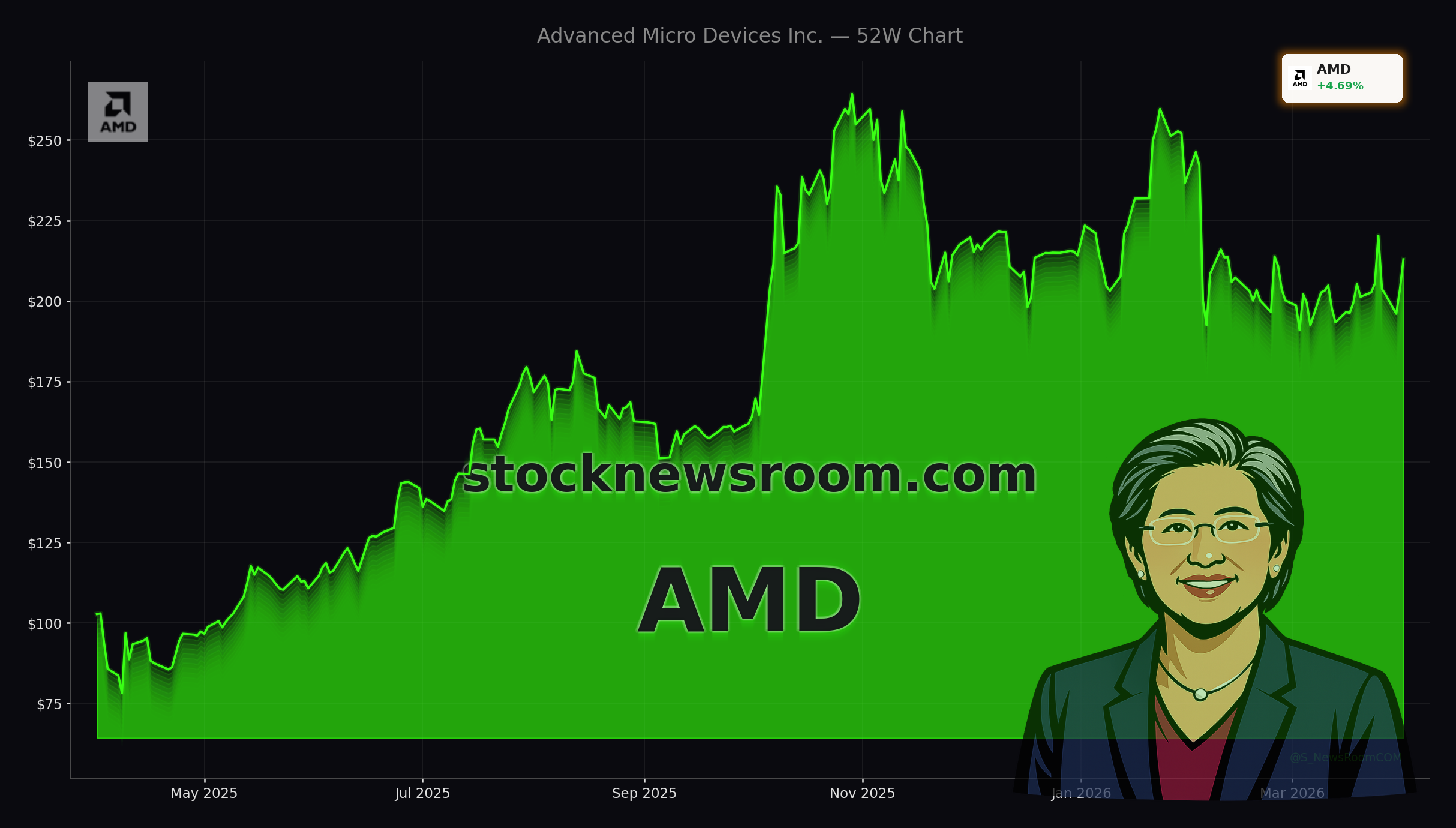

Is the latest Advanced Micro Devices Forecast signaling a durable AI-driven rally or just another crowded hedge fund trade?

How is Advanced Micro Devices shaping AI market sentiment?
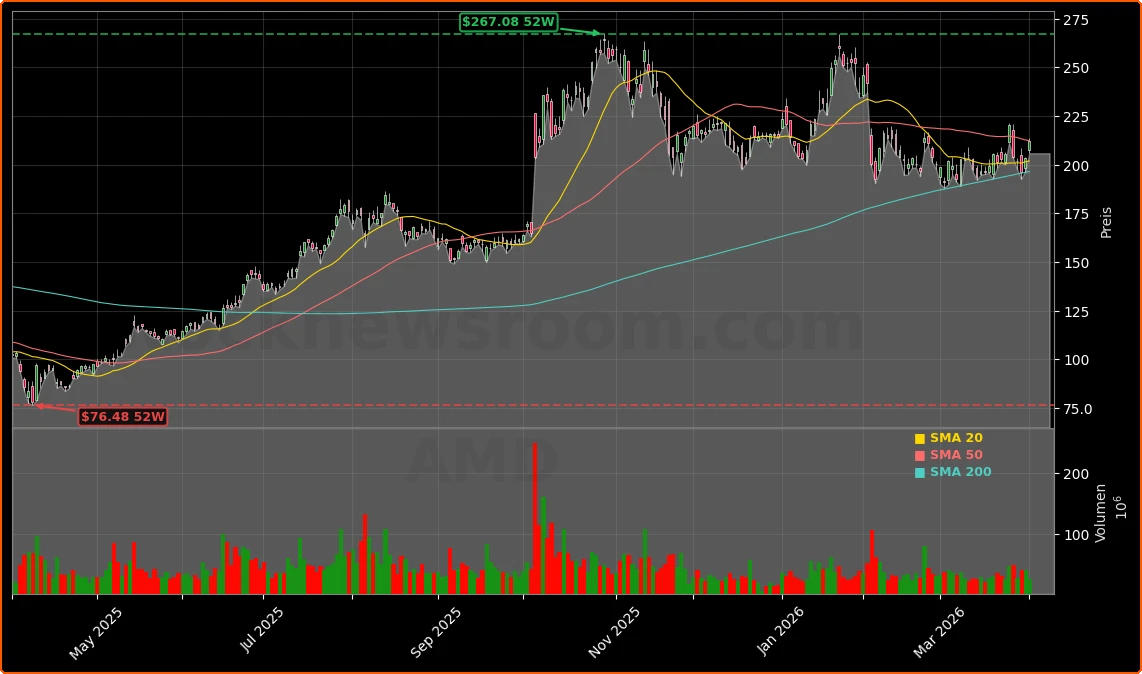
Advanced Micro Devices, Inc. (AMD) is trading near the upper half of its recent $195–$221 channel, gaining 4.2% to $211.97 as of Wednesday’s close on the NASDAQ. Chipmakers are again powering the NASDAQ and S&P 500, with AI‑infrastructure names rebounding in tandem. A stronger bid in AMD follows renewed enthusiasm for data‑center demand and a more constructive Advanced Micro Devices Forecast from several Wall Street firms.
Institutional interest continues to build. Highline Wealth Partners, Gunderson Capital Management and Three Seasons Wealth all sharply increased AMD positions in Q4 2025, making the stock a top‑25 holding or better for those managers. Hedge fund powerhouse D. E. Shaw executed one of the most striking moves, boosting its AMD stake by roughly 1,917% in Q4, from 350,000 shares to more than 7 million, after previously trimming the name aggressively through 2023–2025. That kind of reversal is feeding the narrative that AMD’s risk‑reward versus NVIDIA has become more attractive.
At the same time, some high‑profile investors are taking profits. Cathie Wood’s ARK complex has been selling AMD in recent weeks, unloading more than 57,000 shares as part of a broader derisking in high‑growth semis and AI stocks. These opposing flows underscore how polarized the near‑term Advanced Micro Devices Forecast has become across Wall Street.
What does the Advanced Micro Devices Forecast say about AI market share?
Fresh industry data from China’s AI accelerator card market highlights both AMD’s progress and its challenges. In 2025, total accelerator shipments by Nvidia, AMD and local Chinese vendors reached roughly 4 million units. AMD shipped around 160,000 cards, capturing about a 4% share in China’s AI accelerator market. While still modest relative to NVIDIA, this footprint shows AMD is securing at least a toehold even in a geopolitically sensitive region.
Globally, many hedge funds are positioning on the assumption that AMD’s AI accelerator share can climb from an estimated 9% in 2025 to 15%–20% over the next few years. If that scenario plays out, some managers argue that today’s roughly 11x sales multiple leaves room for a re‑rating closer to Nvidia’s much richer valuation. That long‑term Advanced Micro Devices Forecast is anchored not only in GPUs like the MI450 and upcoming Helios platform, but also in server CPUs where AMD continues to chip away at Intel’s share.
Management has articulated a path toward roughly 50% server CPU revenue share by the end of 2026, driven by the 6th Gen EPYC launch expected in late 2026. That roadmap, combined with AI GPU gains, is why many AI‑focused ETFs now carry AMD as a core holding alongside mega‑caps such as Apple and Microsoft. In one AI infrastructure ETF, AMD already represents about 3.35% of assets.
How are banks and analysts adjusting their AMD outlook?
The most eye‑catching near‑term catalyst for the Advanced Micro Devices Forecast is Wells Fargo’s decision to add AMD to its Tactical Ideas List for Q2 2026. The bank argues the stock has been oversold near the bottom of its recent trading range and assigns an Overweight rating with a bullish price style around $345, implying substantial upside from current levels. Technically, Wells Fargo wants to see AMD reclaim the $220 area first, a level it has struggled to hold since February.
Other firms are more restrained but still constructive. RBC Capital Markets maintains a “Sector Perform” rating and a $230 price target, pointing to expected volume ramps from OpenAI and Meta in the second half of 2026 and reaffirming that the MI450/Helios roadmap remains on track. Bernstein’s Stacy Rasgon is more cautious, reiterating a “Hold” rating and a $235 target while urging investors to wait for clearer evidence that AMD’s AI demand is true product pull rather than a result of supply constraints at competitors or the rise of Arm‑based agentic AI chips.
Consensus remains broadly positive despite these reservations. Roughly 80% of covering analysts rate AMD a Buy, with average price targets clustered around $290–$300, implying around 40%–50% upside from today’s price. That backdrop supports a moderately bullish Advanced Micro Devices Forecast on Wall Street, even as insider selling and sector volatility keep many investors on edge.
What short‑term risks could derail the AI bull case?
Even as AMD rides the AI wave, there are clear risks. Gaming revenue has shown signs of slowing, and recent insider selling totaling roughly $50 million has raised eyebrows among retail traders. ARK’s profit‑taking adds another layer of doubt for momentum‑oriented investors who remember prior peaks in high‑beta tech.
On the competitive front, Intel is surging after unveiling a $14.2 billion fab deal and pushing hard into foundry services, while Arm‑based designs threaten to disrupt parts of the AI accelerator and CPU stack. If Arm’s agentic AI chips gain traction faster than expected, or if Intel executes flawlessly on its dual design‑and‑manufacturing strategy, AMD’s path to 15%–20% AI market share could prove more challenging.
Still, institutional ownership above 70%, repeated earnings beats (recent EPS of $1.53 on $10.27 billion in revenue) and deep exposure to secular AI and data‑center trends keep AMD firmly in the core‑growth bucket for many U.S. portfolios. For investors benchmarking against the NASDAQ and S&P 500, the stock remains one of the cleanest ways to play the non‑Tesla side of the AI infrastructure boom.
Related Coverage: What else should AMD investors read?
For a deeper dive into the competitive dynamics around data‑center accelerators, readers can review this analysis of Advanced Micro Devices AI chips and their recent 6.6% rally as Arm steps into the market, which explores how new entrants could influence pricing power and margins. Investors tracking the broader AI ecosystem should also consider how hyperscale spending shapes chip demand; this piece on Microsoft’s $145 billion AI investments and accompanying stock slump provides useful context on how front‑loaded capex can temporarily pressure tech valuations while laying groundwork for future growth.
In summary, the current Advanced Micro Devices Forecast balances strong institutional buying, a growing AI footprint and supportive analyst targets against visible competitive and valuation risks. For U.S. investors willing to stomach volatility, AMD remains a high‑beta vehicle for secular AI and data‑center trends. The next earnings report and any updates on MI450/Helios and server CPU share will be critical in confirming whether today’s Advanced Micro Devices Forecast still underestimates the company’s long‑term potential.