Are Alibaba’s brutal profit declines a temporary sacrifice for AI dominance, or a warning sign that the turnaround is slipping away?

How did Alibaba Earnings shock Wall Street?
Alibaba Group Holding Limited reported December-quarter revenue of roughly 284.8 billion yuan (about $41.3 billion), up just 2% year over year and below analyst expectations near 290–291 billion yuan. Adjusted earnings per share fell to about $1.01, far short of Wall Street’s $1.73 consensus, marking one of the steepest quarterly profit disappointments for the company since 2024.
Net income attributable to ordinary shareholders plunged about 66%–67% to roughly 15.6–16.3 billion yuan, while operating income fell 74%. Adjusted EBITA tumbled 57% to 23.4 billion yuan, with the margin sinking 12 percentage points to around 8%. Operating cash flow dropped nearly 50% and free cash flow swung from a positive 13.7 billion yuan a year ago to a roughly 21.8 billion yuan outflow, underscoring how aggressively Alibaba is spending to reposition its business.
US-listed shares reflected the disappointment immediately. Alibaba stock fell 5%–8% in pre-market trading and extended losses during the regular NYSE session, at one point sliding more than 7% and logging its sharpest intraday drop in about six months. For American investors who saw the stock rally last year on hopes of a clean turnaround, the latest Alibaba Earnings reopen the debate over whether this is a deep-value opportunity or a value trap.
Where is Alibaba actually growing?
Beneath the weak headline numbers, the business mix is shifting fast. The China e-commerce segment still generated the bulk of revenue at roughly 159.3 billion yuan, up about 6%, but its high-margin customer management revenue grew only 1%, signaling continued pressure from discount-focused rivals and cautious Chinese consumers. International digital commerce rose a modest 4% to 39.2 billion yuan, below some analyst forecasts.
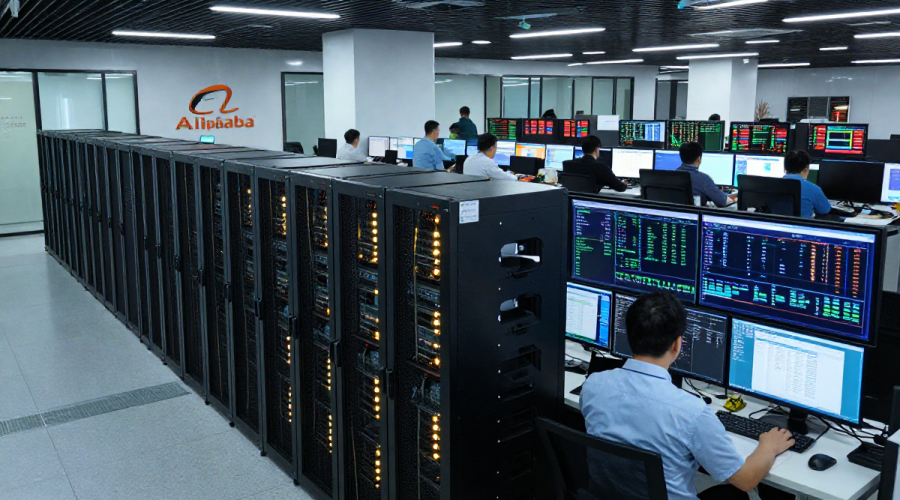
The clear standout is cloud and AI. Alibaba’s Cloud Intelligence Group delivered revenue of about 43.3 billion yuan ($6.2 billion), up 36% year over year and slightly ahead of many expectations. Management highlighted triple-digit growth in AI-related cloud products for the tenth consecutive quarter, along with strong traction for Qwen, its large language model family, and associated enterprise services. Qwen’s consumer-facing chatbot has reached roughly 300 million monthly active users, putting Alibaba among the leading AI platforms in China by scale.
At the hardware layer, the company disclosed that its T-Head chip unit has now brought a proprietary GPU into mass production, shipping over 100,000 units of its Zhenwu 810E AI accelerator. That full-stack approach — spanning chips, cloud infrastructure, models, and applications — is designed to mirror the integrated strategies of US heavyweights like Nvidia, Amazon, and Microsoft, but it comes with intense capital requirements.
Is the AI bet worth the earnings hit for Alibaba?
CEO Eddie Wu was explicit about the trade-off on the earnings call. He said Alibaba has “entered into an investment phase to build long-term strategic value in AI technologies and infrastructure and a consumption platform integrating daily life services and e-commerce.” The company is targeting more than $100 billion in combined external AI and cloud revenue over the next five years, implying compound annual growth of roughly 35% from today’s levels.
To support that goal, Alibaba has reorganized nearly all AI efforts under a new umbrella, sometimes referred to internally as a token-centric hub, and rolled out new enterprise tools such as its Wukong agentic AI platform. It has also raised cloud and AI service prices by as much as 34%, a move that analysts at Morgan Stanley interpret as evidence of strong demand and growing pricing power in China’s AI infrastructure market.
Still, the latest Alibaba Earnings highlight how far that long-term vision is from fully funding itself. Heavy promotions in e-commerce, a price war in food delivery and quick commerce, and the AI buildout together are crushing margins. Profit from operations and free cash flow have weakened materially, leaving investors to ask how long the company can maintain this level of spending before more tangible returns show up on the bottom line.
How do Alibaba and its rivals stack up for US investors?
From a valuation perspective, Alibaba trades at a trailing P/E around the mid-teens and a forward multiple in the low-to-mid teens, with a price-to-sales ratio near 0.3. Some US and global investors view that as deep value given Alibaba’s scale, cloud growth, and extensive share repurchase authorization of about $19.1 billion through March 2027. Others argue that the premium to domestic competitors like JD.com and PDD Holdings is no longer justified after repeated earnings disappointments.
Opinion is split. Some institutional investors, including firms such as Mirae Asset and certain growth-focused funds, have increased positions in recent quarters, citing Alibaba’s leading cloud share and AI optionality. On the other side, players like Cantor Fitzgerald have slashed exposure, pointing to persistent regulatory, macro, and geopolitical overhangs that do not affect US-based peers in the S&P 500 and NASDAQ to the same degree.
Research houses are equally cautious. At least one prominent Seeking Alpha contributor now sees the stock as a Hold, arguing that the aggressive AI and cloud pivot carries an “enormous price” in the form of margin compression and cash burn. Meanwhile, other commentators at outlets like The Motley Fool emphasize the structural AI opportunity, suggesting something “big is brewing” beneath the surface if investors can tolerate volatility.
For US portfolios, Alibaba sits at the crossroads of two powerful but opposing forces: secular AI growth that could rival the opportunity at American hyperscalers, and a structurally tougher operating and regulatory environment that keeps risk premiums high.
The business goal of Alibaba’s AI strategy is very clear. Over the next five years, our goal is to surpass $100 billion in combined cloud and AI external revenue.— Eddie Wu, CEO of Alibaba Group
In the end, the latest Alibaba Earnings underscore a simple truth for investors: this is no longer a pure e-commerce recovery story, but a high-stakes AI infrastructure bet where timing, execution, and capital discipline will determine whether today’s pain turns into tomorrow’s upside.