
Can the Allianz AI Strategy really deliver cheaper insurance, higher margins and bigger shareholder payouts without breaking its workforce model?
How is Allianz using AI to reshape its business?
At the heart of the Allianz AI Strategy is a clear bet on large language models to automate low-value tasks and improve the customer experience. CEO Oliver Bäte has argued that the insurer can become “dramatically better and cheaper” for clients by embedding generative AI across underwriting, claims and back-office functions. Allianz has selected Anthropic’s Claude models as a cornerstone of its internal AI platform, targeting faster claims handling, more precise risk analysis and enhanced compliance and training tools.
The first wave of implementation focuses on activities Bäte describes as having “no real added value” – especially pure information processing in call centers and support units. This approach echoes what US investors have already seen at big-tech names like NVIDIA and Apple, where AI is deployed to drive operating leverage rather than just headline innovation. For Allianz, the payoff is expected to come through lower administrative expenses, quicker cycle times and a structurally higher margin profile in its already strong property and casualty and international retail and commercial lines.
What does the Allianz AI Strategy mean for jobs and costs?
The flip side of the Allianz AI Strategy is a tangible workforce reshaping. Allianz Partners announced in late 2025 that it plans to cut between 1,500 and 1,800 positions globally, primarily in call centers where conversational AI can handle routine customer interactions around the clock. Management has made it clear that every role in the group will be systematically reviewed for automation potential over the coming years.
Bäte stresses that technology must first prove reliable before Allianz moves ahead, followed by discussions with regulators, works councils and labor representatives. Still, the direction of travel is unmistakable: AI-enabled productivity gains are expected to be a key lever for hitting the company’s 2026 efficiency and profitability targets. For US and global investors used to cost-cutting stories at large financials, the Allianz roadmap looks familiar – but with a heavier reliance on generative AI than many peers in the sector.
How is Allianz defending its distribution in an AI world?
Beyond internal efficiency, Allianz is also positioning for a potential overhaul of insurance distribution. Since early February, OpenAI has allowed insurance apps inside ChatGPT, including the ability to generate personalized offers directly within the chat interface. That development has sharpened a key strategic question for incumbents: when AI agents do the comparing and buying for customers, which brands will still be visible – and chosen?
Allianz sees “agentic search” as a new battleground and wants its products to feature prominently in AI-driven recommendations. Thanks to its global scale and balance sheet strength, the group believes it can invest heavily to ensure that in an AI-mediated purchase journey the answer to the customer’s query is, ideally, Allianz. For investors who follow US platform players like Tesla in automotive or big cloud providers in tech, the message is clear: AI is not just an internal tool, it is also a new distribution channel that could reshape how retail policies are sold.
How attractive is the stock after the pullback?
Fundamentally, Allianz continues to deliver solid operating performance. Adjusted earnings trends are positive, revenues are growing at a healthy pace and the board has once again raised the dividend. On top of that, the company is returning additional capital through multibillion-euro share buyback programs, reinforcing its appeal as a high-yield, shareholder-friendly blue chip in the European financials universe.
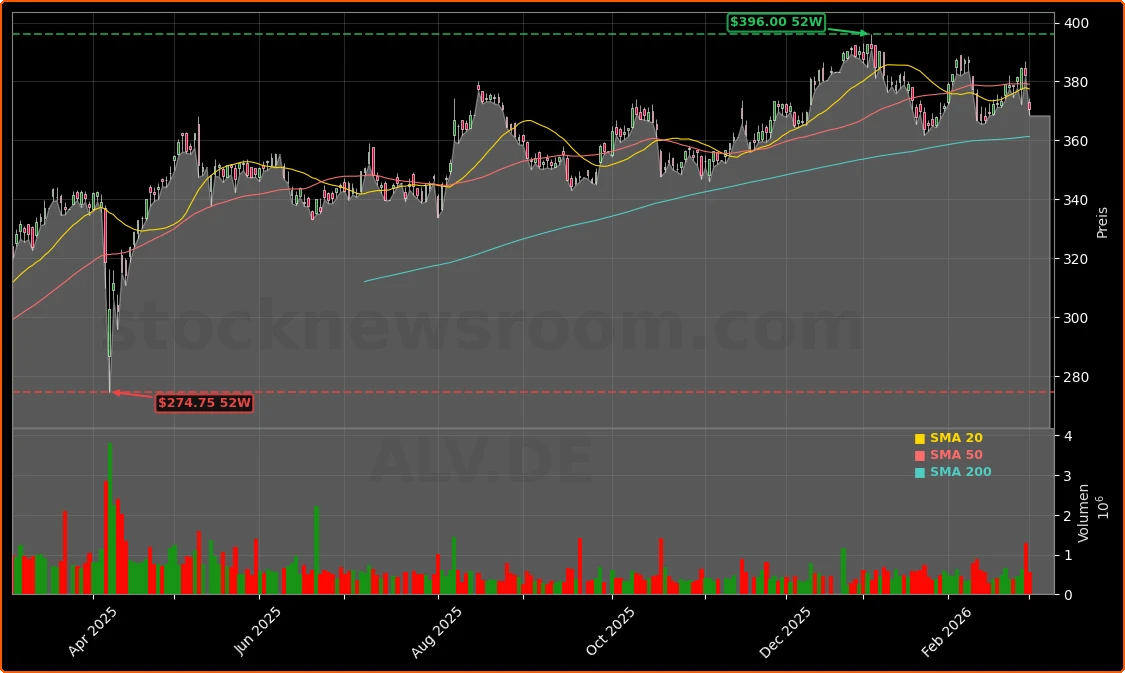
Technically, the stock recently flashed a strong signal as it broke above its 200-day moving average and a prior downtrend line, forming a so-called golden cross. While Monday’s roughly 3% drop reflects heightened geopolitical risk and sector-wide AI angst, many chart watchers see room for another attempt at record highs if sentiment stabilizes. Dividend-focused research outlets such as Seeking Alpha have highlighted Allianz among high-yield names with double-digit total return potential over a multi-year horizon, putting it on the radar for US income investors looking to diversify beyond domestic insurers.
What are analysts and US investors watching next?
On Wall Street and in European research circles, Allianz is broadly viewed as a quality compounder rather than a high-growth tech story, but the Allianz AI Strategy is starting to influence valuation debates. The key questions for analysts at banks like Goldman Sachs, JPMorgan and Morgan Stanley are whether AI-driven cost savings can offset any margin pressure from increased competition and how quickly automation will flow through to the bottom line.
I am convinced that activities such as pure information processing will become superfluous in the future.
— Oliver Bäte, CEO of Allianz
Conclusion
With the stock still below its 52-week high, the risk-reward profile looks appealing to more speculative traders as well. Leveraged call strategies discussed in European trading services underline the upside sensitivity: a low double-digit percentage move in the shares can translate into several hundred percent gains in structured derivatives. For long-term US investors, however, the more relevant datapoints will be Allianz’s 2026 guidance updates, progress on job cuts, and concrete evidence that AI deployments are cutting expenses without undermining service quality.
Further Reading
- Allianz SE Quote and Profile (Yahoo Finance)
- Top 10 High-Yield Dividend Stocks For March 2026 (Seeking Alpha)
- Allianz SE (Wikipedia)