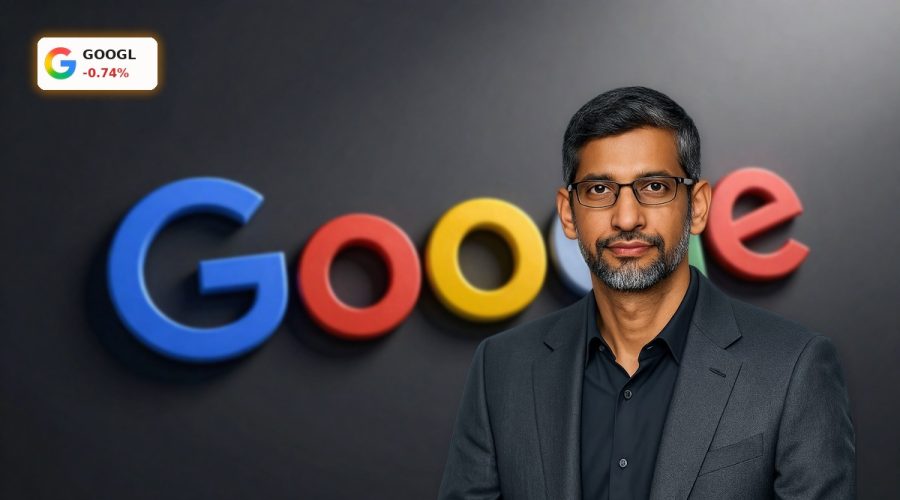
Are Alphabet’s massive AI investments and century bond a bold masterstroke for long-term growth or a looming margin squeeze?
How are markets reacting to Alphabet’s AI capex surge?
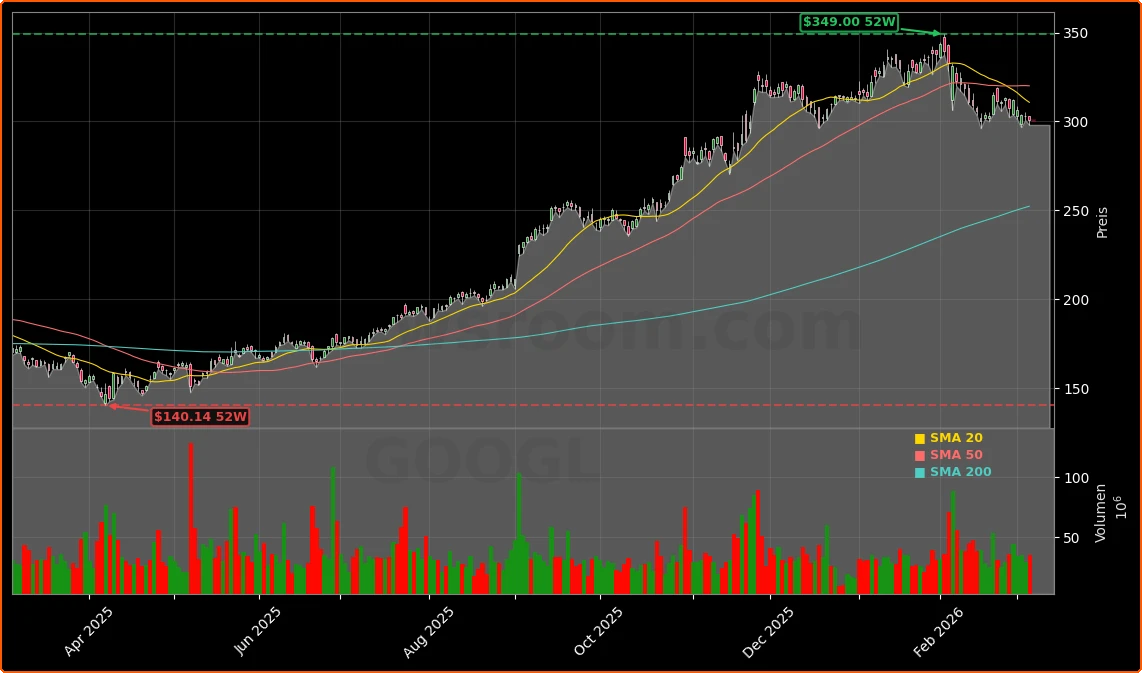
Alphabet (GOOGL) traded lower on Thursday, closing at $300.88, down about 0.7% from the prior session, with Alphabet Inc. (GOOG) mirroring the move at $300.91. In after‑hours trading, shares eased slightly further, tracking broader risk‑off sentiment on Wall Street amid higher oil prices and geopolitical tensions. The stock sits below recent 52‑week highs, underlining that the latest pullback is a consolidation rather than a breakout to new records.
Behind the modest decline is growing investor debate over the scale of upcoming Alphabet AI Investments. Management is preparing to spend an estimated $175 billion to $185 billion in 2026 on AI‑related infrastructure, roughly doubling 2025 levels, with a focus on servers, data centers, networking and power. While analysts at major banks broadly retain “Buy” or “Overweight” ratings and consensus price targets around the mid‑$360s, some caution that margins and free cash flow could be pressured in the near term as spending ramps.
Institutional positioning remains supportive. Recent filings show managers such as Waycross Partners, Synovus Financial and Syon Capital increasing holdings in Alphabet, even as insiders have sold shares into strength. For S&P 500 and Nasdaq‑100 investors, the stock remains a core megacap AI exposure where capital allocation decisions could materially influence index‑level earnings growth.
Why is Alphabet issuing a 100‑year bond?
One of the most striking moves around Alphabet AI Investments is the company’s decision to issue 100‑year bonds. Locking in ultra‑long‑term financing signals management’s conviction that the AI and cloud build‑out will be a multi‑decade infrastructure cycle rather than a short‑lived hype phase. The proceeds effectively match long‑duration assets – hyperscale data centers, fiber networks and specialized AI silicon – with equally long‑duration funding.
Alphabet is part of a small group of U.S. hyperscalers – including Amazon, Microsoft, Meta and Oracle – that are channeling the vast majority of their free cash flow back into AI infrastructure. Industry estimates suggest hyperscaler capex in 2026 could reach around $700 billion, representing up to 90% of their combined cash flow and accounting for roughly 70% of the entire AI market. Within that context, Alphabet’s century bond is less an outlier and more a logical extension of an arms race where scale and time horizon are competitive weapons.
The capital is flowing directly into suppliers such as NVIDIA, Broadcom, AMD, Marvell and Arista Networks, underpinning a broader rally in AI‑linked semiconductor and networking names. Broadcom recently highlighted Google as a key customer in its custom AI chip and networking portfolio, reinforcing Alphabet’s strategy of combining its in‑house TPU roadmap with external silicon partners to optimize performance and cost.
Alphabet AI Investments and the next cloud growth wave
At the core of Alphabet AI Investments is Google Cloud and the Gemini AI platform. In enterprise cloud, Alphabet is using AI as a wedge to deepen relationships, as seen in a new partnership with CVS Health. CVS is launching Health100, an AI‑powered health tech subsidiary built on Google Cloud that will tap Gemini models and agentic AI to deliver real‑time patient engagement and pharmacist‑led care programs starting in 2026. For Alphabet, deals like this translate AI capex into higher‑margin cloud revenue and long‑term contracts.
Alphabet is also competing aggressively in advertising technology. While The Trade Desk faces rising competition from the “walled gardens” of Alphabet and Amazon in connected TV and retail media, Alphabet must fend off new AI‑native models, with OpenAI and Anthropic exploring ways to integrate advertising directly into conversational agents. Trade Desk is reportedly collaborating with OpenAI on ad formats for ChatGPT, a development that could incrementally pressure YouTube and Search ad budgets if conversational interfaces gain share.
At the same time, Alphabet’s YouTube franchise remains structurally strong. A recent YouTube Gaming report showed 8.8 billion hours watched in 2025, up 12% year over year, underscoring the platform’s power with Gen Z and esports audiences. That engagement provides a rich data and content foundation for generative AI tools that can streamline content production, personalization and ad targeting.
How is Alphabet securing power and hardware at hyperscale?
The physical layer of Alphabet AI Investments is becoming just as important as the software. AI data centers demand vast amounts of constant, low‑latency power and cooling. To secure that, Google has entered into partnerships around emerging energy technologies such as small modular reactors (SMRs), for example with Kairos Power, aiming to guarantee 24/7 baseload electricity that intermittent solar and wind cannot fully provide. Reliable nuclear‑backed power could be a key differentiator as AI workloads scale into the tens of gigawatts.
On the hardware side, Alphabet is a cornerstone customer for high‑end GPUs and custom accelerators. Chipmakers and contract manufacturers report rapidly rising orders from hyperscalers like Google, Meta, Anthropic and OpenAI, with deliveries approaching 10 gigawatts of AI compute capacity over the next year. Companies such as Celestica are benefiting from surging demand for data‑center design and manufacturing services, with their hardware platform businesses growing more than 60% in 2024 thanks to top customers including Alphabet, Amazon and Meta.
Competition is intensifying at the device and ecosystem level as well. Apple has launched a low‑priced MacBook Neo at $599, targeting students who historically gravitated toward Chromebooks. That move indirectly challenges Google’s education footprint and could influence long‑term OS and cloud preferences, even as Apple simultaneously deepens its own AI ties to Alphabet by integrating Gemini‑powered features into Siri. The strategic overlap highlights how AI is blurring the lines between platform rivals and partners across mobile, PC and cloud.
Despite pockets of legal and regulatory risk – including litigation around Gemini outputs and scrutiny of self‑driving unit Waymo – Wall Street analysts at firms such as Morgan Stanley, Goldman Sachs and Citigroup continue to frame Alphabet as a top‑tier AI compounder. Price targets in the $350–$380 range imply notable upside from current levels if execution on AI infrastructure, monetization and safety keeps pace with spending.
Conclusion
In sum, Alphabet AI Investments are transforming the company into an even more capital‑intensive but potentially more defensible hyperscaler. For U.S. and global investors, the key question is whether today’s monumental capex and century‑long debt will translate into durable cloud, ads and platform cash flows. The next several quarters of GPU deliveries, Gemini adoption and Google Cloud deal wins will be critical in showing whether this AI super‑cycle can justify the bill.
Further Reading
- Alphabet Inc. (GOOGL) Stock Price, News & Analysis (Yahoo Finance)
- CVS Health partners with Google; launching health tech subsidiary (Chain Store Age)
- CVS taps Google Cloud to roll out AI-powered health platform (Reuters)
- Is Google Stock Still Cheap or Is It Time to Let Go? (The Motley Fool)