
Can Alphabet’s massive AI spending spree turn record revenue and cash flow into durable dominance—or is Wall Street funding an overbuild?

How are Alphabet’s shares positioned on Wall Street?
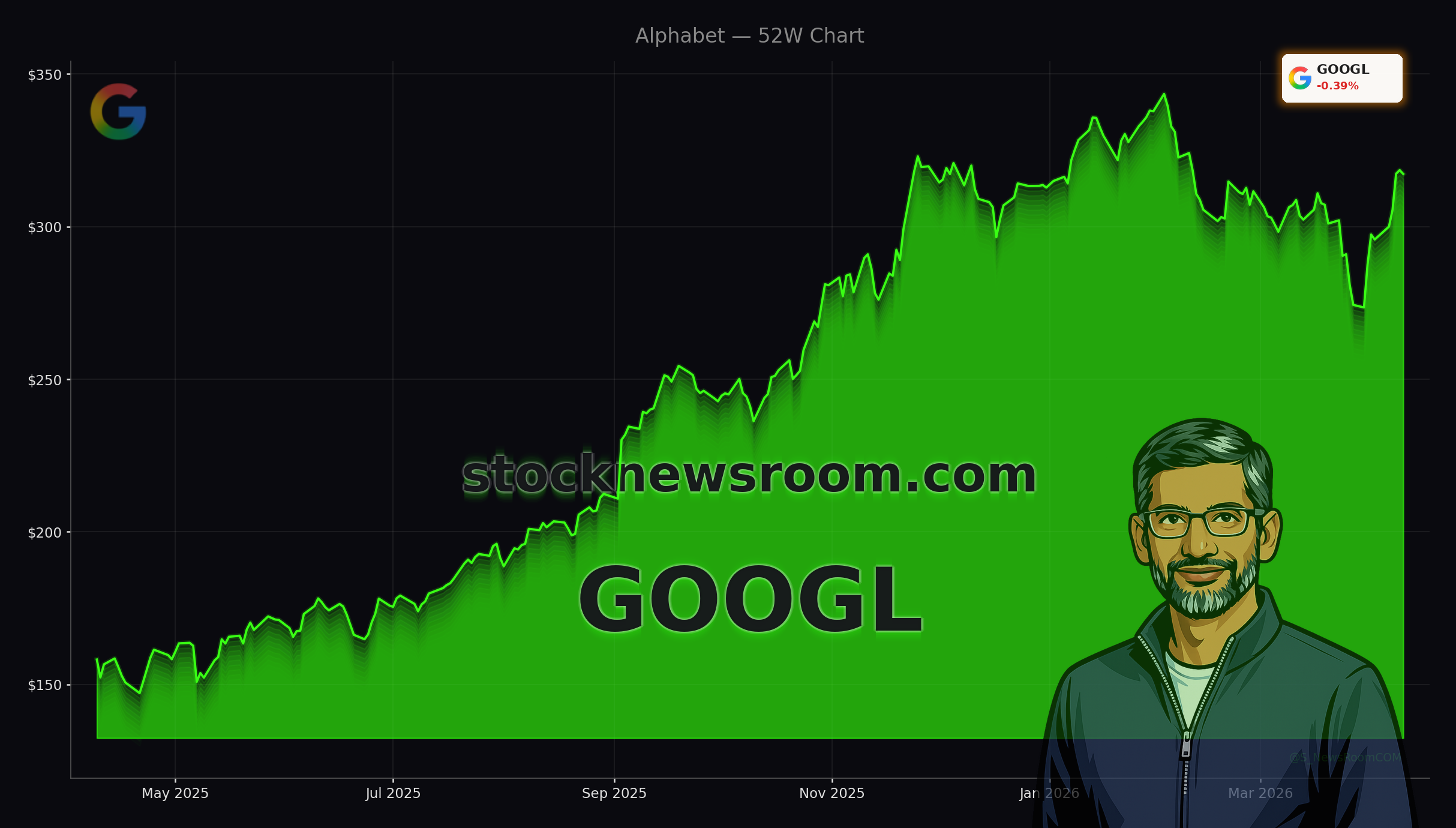
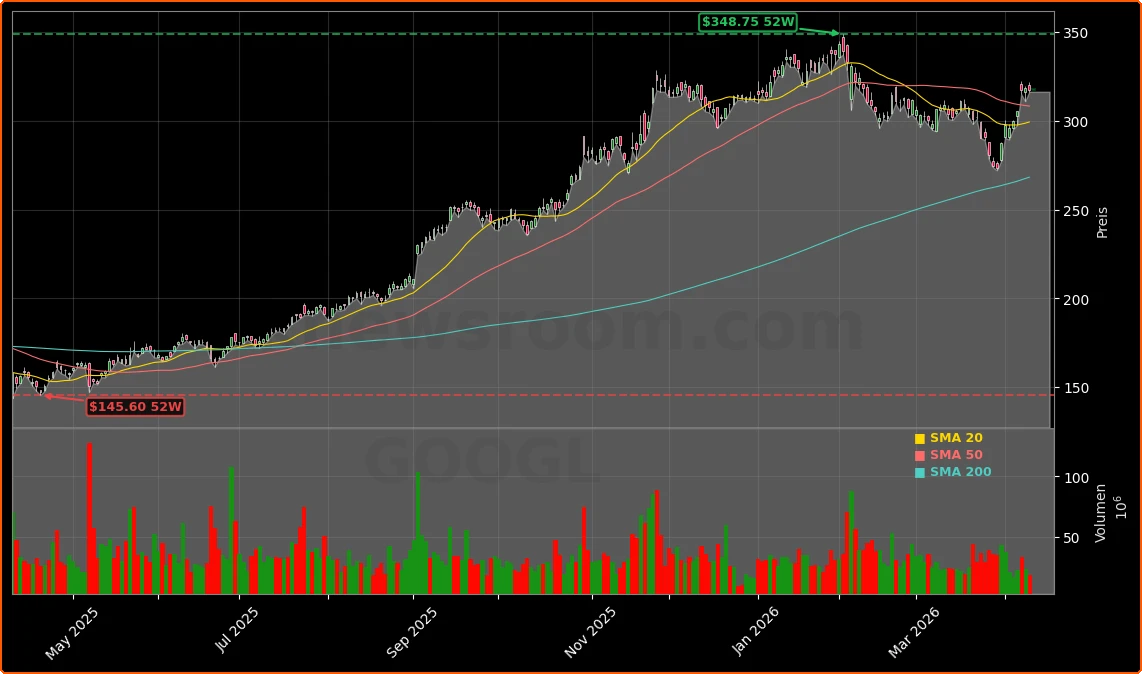
Alphabet’s Class A stock closed recent trading at $317.24, marginally below the prior close of $318.51, with after‑hours trading nudging the price to $317.80. Class C shares finished at $315.72 with a similar 0.18% after‑hours uptick. Despite the latest consolidation, the stock has more than doubled over the last 12 months, far outpacing the NASDAQ and the broader S&P 500. The current pullback from the early‑February level of about $332 comes as investors reassess the scale and timing of returns from Alphabet AI Investments.
Fundamentally, Alphabet just delivered a milestone year. 2025 consolidated revenue reached $402.8 billion, its first time above $400 billion, while net income surged 32% year over year to $132.2 billion. A 32.8% net margin and return on equity near 36% leave ample room to fund growth, buybacks and a newly introduced quarterly dividend of $0.21 even as capex ramps. MarketBeat data shows a “Moderate Buy” consensus with an average target around the mid‑$360s, while Needham reiterated a Buy with a $400 target and BNP Paribas analyst Nick Jones assigned a $390 target, both emphasizing AI strength.
Is core Search still funding the AI push at Alphabet?
Yes. Google Search remains the cash engine behind Alphabet AI Investments. Search and other Search‑related revenue reached $224.5 billion in 2025, or roughly $615 million per day. In Q4 alone, Search and other revenue grew 17% year over year to $63.1 billion, even as AI features rolled across the product. CEO Sundar Pichai highlighted that Search usage hit all‑time highs, arguing AI is expanding the market instead of cannibalizing legacy keyword queries.
On the advertising side, Google’s AI‑driven formats such as AI Max and Performance Max are helping brands unlock higher returns. Retailers have reported revenue lifts of up to 80% after enabling new AI ad tools, underlining why ad revenue reached $82.3 billion in Q4, up 13.5% versus the prior year. With 15% of daily queries still entirely new, Alphabet’s Gemini models are increasingly central to matching intent with ads in real time, an important validation that Alphabet AI Investments into models and ad tooling are already monetizing.
What makes Alphabet AI Investments so aggressive?
The clearest signal is capex. After spending $91.4 billion in 2025, Alphabet has guided 2026 capital expenditures to an eye‑popping $175 billion to $185 billion, largely for AI‑ready data centers, networking and its in‑house tensor processing units (TPUs). That more than 90% year‑over‑year step‑up has stirred debate across Wall Street about whether hyperscalers, including NVIDIA customers, might be over‑building capacity. Michael Burry, for example, has questioned the economic life of GPUs and other AI chips, warning of potential low returns on such massive build‑outs.
Analyst Nick Jones at BNP Paribas, however, argues those fears are overdone. He points to robust cloud backlogs and rising revenue per employee at Alphabet as evidence that current spend is demand‑driven and increasingly efficient. Crucially, Alphabet’s custom TPUs and AI‑optimized infrastructure should lower its long‑term total cost of ownership versus rivals relying solely on off‑the‑shelf accelerators, a structural advantage that could pressure competitors like Apple and smaller cloud players.
How important are Cloud and venture stakes to the story?
Google Cloud has quietly become Alphabet’s second engine behind Search. Q4 2025 Cloud revenue jumped 48% year over year to $17.7 billion, with operating income more than doubling to $5.3 billion. Management says Cloud exited 2025 at over $70 billion in annualized revenue, with AI platform services and custom silicon a major driver of new workloads. New agreements, such as Google’s 1‑gigawatt data center project with DTE Energy in Michigan, reinforce how AI data centers are now tied to regional infrastructure and utility growth plans.
Beyond operating segments, Alphabet holds roughly $150 billion in what some investors describe as overlooked venture assets. A roughly 7% stake in SpaceX, acquired for about $900 million nearly a decade ago, is now estimated to be worth more than $100 billion. Its approximate 14% stake in Anthropic, built on about $3 billion of investment, could be worth around $50 billion at recent private valuations. That means Alphabet AI Investments are not just internal capex and R&D; they also include external bets on frontier model providers and space infrastructure that could unlock strategic synergies for Google Cloud.
What are regulators and institutions watching now?
In Washington, AI is increasingly seen as a national security issue. The White House has convened leaders from Alphabet, Microsoft and major U.S. banks to discuss cyber‑risks from advanced models, after Anthropic restricted an AI model that could help find software flaws. Those conversations underscore that Alphabet AI Investments in powerful models must be balanced with governance, especially as Google Cloud broadens into sensitive sectors like finance, defense and critical infrastructure.
Institutional investors, meanwhile, continue to treat Alphabet as a core holding despite bouts of profit‑taking. Filings show firms such as West Branch Capital LLC nudging positions higher, making Alphabet their third‑largest holding at 7.4% of assets, while others have trimmed after the rally but still keep Alphabet as a top position. TradingView sentiment on Class C shares skews bullish, with several traders targeting higher levels on the back of AI momentum, though some expect near‑term volatility around the upcoming Q1 2026 report on April 27.
How does Alphabet compare to other AI leaders?
In the current AI arms race, Alphabet sits alongside Tesla, Amazon and Microsoft as one of Wall Street’s system‑level platforms, while NVIDIA remains the dominant chip supplier. Alphabet’s decision to build its own TPUs and scale data centers through triple‑digit‑billion capex puts it closer to Amazon’s AWS strategy than to more consumer‑focused peers. Needham’s argument that many standalone large language model projects will not survive over the long term suggests capital will consolidate toward platforms like Alphabet that pair distribution (Search, YouTube, Android) with infrastructure and model depth.
For U.S. investors, that mix of entrenched cash flow, bold Alphabet AI Investments and hidden venture assets offers both resilience and upside — but increases exposure to regulatory, political and execution risks that will likely remain front and center through 2026 and beyond.
Related Coverage
Investors who want a deeper dive into the capex side of the story can read Alphabet Forecast Boom: Can AI Capex Really Pay Off?, which analyzes whether the current spending surge could become a long‑term profit engine or a drag on free cash flow and valuation. For a contrast in AI‑driven platform strategies, Palantir AI Analysis: -1.9% Shock After a Huge AI Rally looks at how Palantir’s premium valuation and unique software moat stack up against mega‑cap platforms like Alphabet in the race to monetize AI.
Search saw more usage than ever before, with AI continuing to drive an expansionary moment.— Sundar Pichai, CEO of Alphabet Inc.
Alphabet AI Investments now span record‑scale data centers, in‑house TPUs and high‑profile stakes in SpaceX and Anthropic, all funded by world‑class Search and Cloud profitability. For American portfolios, the stock offers a rare combination of durable cash flows and asymmetric AI upside, albeit with heavier near‑term capex and regulatory scrutiny. The next quarterly report on April 27 should show whether this aggressive AI strategy is continuing to translate into faster growth, leaving long‑term investors well positioned if execution stays on track.