
Can Alphabet’s massive $185 billion AI strategy supercharge growth without breaking its core search, cloud and regulatory risk balance?


How is Alphabet trading as AI bets ramp up?
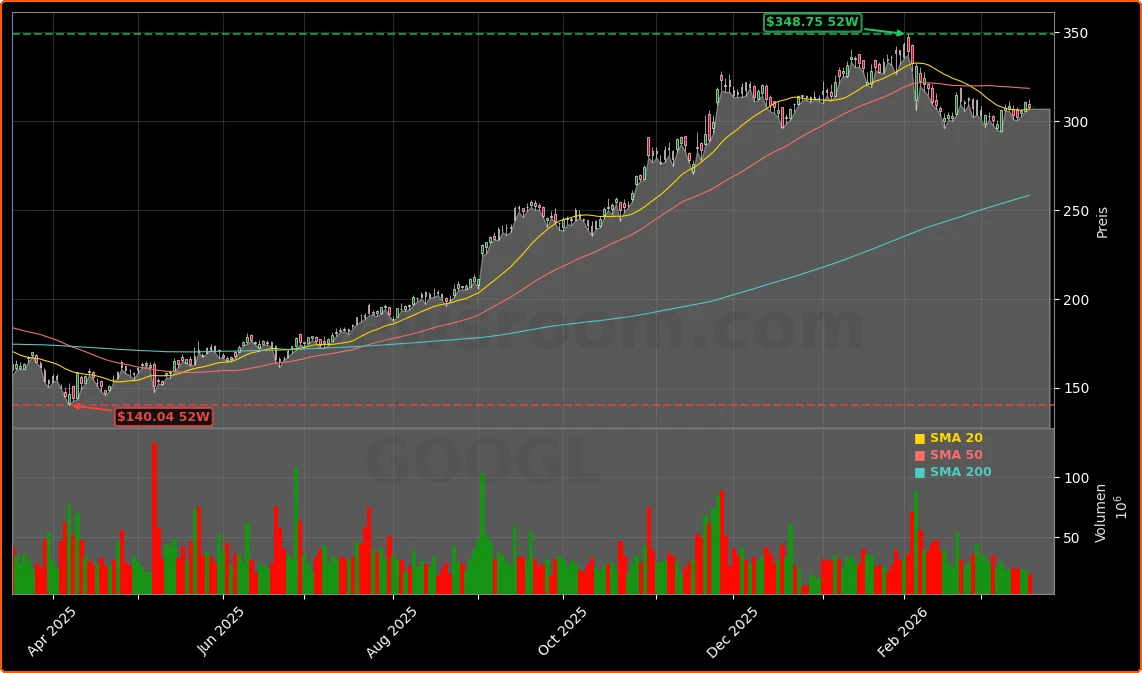
Alphabet Inc. (Google) shares eased alongside the broader tech complex on Wednesday, with Class A stock (GOOGL) closing at $307.69, down about 1.0% from the prior close of $310.39. The non‑voting Class C shares (GOOG) ended at $306.30, also off around 1%. After-hours moves were muted, with GOOGL inching higher to $307.73 as Wall Street weighed the latest macro and geopolitical headlines against the company’s accelerating AI execution.
The pullback leaves Alphabet below recent highs but still solidly up from early‑2025 levels, after the stock rallied nearly 66% last year. The current quote sits under the widely cited 12‑month average analyst target around $351.82, implying low double‑digit percentage upside if the bullish case around AI monetization, cloud margins and capital discipline plays out.
For U.S. investors, the stock remains a core component of NASDAQ and S&P 500 tech exposure. With all 44 covering analysts recently carrying a Buy or Strong Buy rating and none recommending a Sell, Alphabet continues to stand out even among the so‑called Magnificent 7, where valuation and growth dispersion have become more pronounced.
Why is Alphabet AI Strategy central to Wall Street?
The core of the bullish case is that Alphabet AI Strategy now spans the full stack: from custom chips and hyperscale data centers to models, products and monetization surfaces in ads, cloud and consumer services. After being perceived as an AI laggard during the first wave of ChatGPT enthusiasm, Google has reasserted itself with its Gemini model family and a faster release cadence across Search, Workspace and Android.
Analysts covering the stock have essentially turned the question from “Will Alphabet catch up?” into “How quickly can management monetize AI without disrupting core businesses?” The recently disclosed plan to spend roughly $185 billion on AI‑related investments in 2026 — including data centers, specialized hardware, and research — epitomizes the magnitude of the bet. Commentators are split on whether this is a masterstroke that cements Alphabet’s lead or an overextension that could pressure returns if demand fails to keep pace.
For now, institutional portfolios appear comfortable with the risk. The company remains a top position for high‑profile managers such as billionaire Chase Coleman, who reportedly has about 20% of his hedge fund portfolio concentrated in Alphabet and Microsoft, citing their durable AI moats. Long‑term investors focused on cash generation and market share seem willing to give CEO Sundar Pichai and his team the benefit of the doubt as long as revenue and operating income track upward with the investment cycle.
How strong is Alphabet’s cloud and AI revenue momentum?
Concrete financials underpin the optimism. In Q4 2025, Google Cloud revenue surged roughly 47.8% year over year, while operating income jumped about 154% to $5.3 billion. That pivot from heavy investment phase to profitability is a major reason many on Wall Street now see Google Cloud as a co‑equal growth engine alongside the company’s legacy advertising franchise.
Several research houses have publicly reinforced this view. BMO Capital Markets analyst Brian Pitz recently raised his Google Cloud growth estimate for Q1 2026 to around 40% and reiterated a Buy rating on GOOGL, calling the stock his Top Pick. At Truist, internet analyst Youssef Squali also reiterated a Buy and placed Alphabet among his preferred internet names for 2026, alongside Amazon and Meta, highlighting strong fundamentals, favorable catalysts and what he sees as an attractive valuation relative to growth.
The cloud story is tightly intertwined with AI. Google is positioning Gemini as a native capability inside its cloud platform, enabling enterprises to build and deploy generative applications using Google’s proprietary models, open‑source alternatives or their own fine‑tuned versions. The company’s recent agreement to acquire cybersecurity specialist Wiz — a deal that expands its cloud security portfolio — is also framed as an AI‑driven growth play, aiming to reassure large customers that they can safely adopt powerful automation in sensitive environments.
Against entrenched rivals like Amazon Web Services and Microsoft Azure, Google’s cloud arm remains the smaller player by revenue, but its current growth rate and margin expansion have led some investors to view it as one of the most attractive large‑cap cloud names in the market.
What do Gemini and ‘Personal Intelligence’ mean for Google?
The most visible manifestation of Alphabet AI Strategy for consumers is Gemini, the model suite that now underpins a growing share of Google’s products. Over the past two weeks, Google has rolled out a new Personal Intelligence feature for U.S.‑based free‑tier Gemini users. The feature can tap into a user’s Gmail, Search history, Photos and YouTube data to deliver highly personalized answers, summaries and recommendations.
Google is pitching this as a way to create a more proactive, context‑aware assistant that understands a user’s digital life in detail. In the long run, such capabilities could deepen engagement with core properties like Search, Gmail and YouTube, fortifying the advertising business while generating incremental subscription and cloud consumption opportunities.
The launch is also a test of how far Alphabet can push personalization without triggering a consumer or regulatory backlash. In supporting materials, the company has emphasized that Gemini and AI Mode are “built with privacy in mind,” noting that they do not train directly on users’ full Gmail inboxes or Photos libraries. Instead, Google says it relies on limited information, like specific prompts and model responses, to improve functionality over time, alongside aggregated and anonymized signals.
At the same time, Gemini tools are being embedded across Docs, Sheets, Slides and Drive in beta, where users can ask the assistant to draft text, summarize meeting notes, generate spreadsheets or suggest visual content. For corporate customers already paying for Workspace, these capabilities may justify higher price points, similar to how Microsoft is monetizing its Copilot suite. For individual users, they serve as a gateway into the broader AI ecosystem Google is building.
How is Google defending search while pushing AI?
Search remains the crown jewel of Google’s empire, and it sits at the heart of any realistic assessment of Alphabet AI Strategy. The company has introduced AI‑generated overviews, conversational answers and an AI Mode that can summarize and contextualize web content directly in the results page. These features are designed to keep users inside the Google experience longer and make answers feel more direct and helpful — but they also raise difficult questions.
Publishers and content creators worry that AI overviews siphon traffic by giving users everything they need without clicking through. News and specialized sites in particular have reported notably lower click‑through rates where AI‑generated summaries appear at the top of results. That has drawn the attention of regulators, especially in Europe and the U.K., who fear Google could entrench its dominance in search while weakening the economic incentives for content production.
In the U.K., where Google handles more than 90% of search queries, the Competition and Markets Authority has designated the company as having “strategic market status” in search services. The regulator has been exploring remedies that would allow publishers to opt out of having content used in AI overviews or for model training, require more transparent ranking practices, and make it easier for users to switch default search engines on their devices.
In response, Google has said it is developing new search controls to let websites opt out of specific generative AI features more precisely. It has also proposed a less intrusive device‑level switch to change default search settings, instead of frequent pop‑up prompts, arguing that too much friction could harm user experience. The company maintains that overly rigid constraints would have “disproportionate and detrimental consequences” for users, publishers and its ability to innovate, but it has pledged to work with authorities on “practical solutions.”
Is regulation the biggest threat to Alphabet?
Regulatory scrutiny is one of the clearest risks in any long thesis on Alphabet Inc. (Google). Beyond the U.K., antitrust and competition authorities in the U.S. and Europe are probing how Google bundles search, Chrome, Android, YouTube and its ad tech stack, especially as AI capabilities become more deeply integrated across these platforms.
The core concern is that walled‑garden AI systems — where powerful generative and predictive tools are embedded inside large platforms like Google, Meta and Amazon — could marginalize open‑internet players and third‑party intermediaries. In advertising, for example, many agencies and brands worry about becoming too dependent on automated systems they do not fully control or understand, even as they rely on those systems for audience targeting, bidding and measurement.
Independent ad tech vendor The Trade Desk, whose stock has been under pressure over the past year, is often cited as a casualty of this shift. Google can now offer advertisers a seamless AI‑driven workflow entirely within its own ecosystem, reducing the need for external demand‑side platforms in certain use cases. Meanwhile, regulators question whether such vertical integration unfairly disadvantages rivals and restricts choice.
For U.S. investors, the key is to distinguish between manageable compliance costs and structural remedies that could materially alter Alphabet’s economics. Fines and reporting requirements may dent margins but are unlikely to derail the AI roadmap. Forced divestitures, interoperability mandates or strict limitations on how first‑party data can be used to train models would have more profound implications. So far, no concrete measures of that severity have been imposed, but the direction of travel is clearly toward tighter oversight.
How big is Alphabet’s AI capex and energy footprint?
The scale of Alphabet’s infrastructure build‑out is another critical aspect of the investment story. Across the big four U.S. hyperscalers — Amazon, Microsoft, Alphabet and Meta Platforms — total capital spending is expected to climb from roughly $376 billion in 2025 to about $618 billion in 2026, largely driven by AI infrastructure. Alphabet’s own share of that pie includes billions for data centers, networking gear, and AI accelerators, along with associated land and facilities.
Rising energy consumption is both a constraint and an opportunity. To secure long‑term capacity and address sustainability concerns, Google has been striking large‑scale renewable energy deals. One notable example is its collaboration with NextEra Energy, announced in late 2025, to develop gigawatt‑scale AI data centers powered by clean energy. By pairing hyperscale compute clusters with dedicated renewable generation, Alphabet aims to reduce its carbon footprint while locking in more predictable energy costs over the life of its infrastructure.
This matters for investors on multiple fronts. First, power and cooling are increasingly material components of data center operating expenses; clean, contracted supply can help shield margins from energy price volatility. Second, regulators and large enterprise customers are stepping up scrutiny of tech companies’ environmental impact. Demonstrating credible progress toward net‑zero targets is becoming a prerequisite for winning major contracts, especially from governments and multinationals with their own ESG commitments.
On balance, the capex ramp is a double‑edged sword. It enables Alphabet to pursue AI growth aggressively but also raises the bar for required returns. If AI demand matches current expectations — fueled by new use cases across consumer apps, enterprise automation and even defense — the spending could prove highly accretive. If adoption slows or pricing comes under pressure from intensifying competition, investors may question whether Alphabet overbuilt.
How does Alphabet stack up against rivals?
Competitively, Alphabet now faces serious AI challenges from multiple directions. Microsoft, in partnership with OpenAI, has embedded generative models across its Office, Windows and Azure franchises, carving out a strong position in productivity and developer tools. Amazon is leaning on AWS, its Bedrock model platform and its massive retail data footprint to offer tailored AI services to enterprises. Meta is open‑sourcing its Llama models and pushing AI into social and messaging products at scale.
On the hardware side, NVIDIA has become the dominant supplier of graphics processing units and AI accelerators that power many of these data centers, including Google’s. While Alphabet also develops its own Tensor Processing Units (TPUs), the overall AI arms race has been a major driver of NVIDIA’s revenue and stock price. At the same time, device manufacturers like Apple are steadily adding on‑device AI capabilities to iPhones, Macs and iPads, which could shift some workloads away from cloud providers over time.
Yet Alphabet retains distinctive advantages. Its search engine and YouTube platform offer unparalleled data to train and refine models. Its Android and Chrome ecosystem gives it direct access to billions of users and endpoints. And its vertically integrated stack — from custom chips to data centers to end‑user applications — allows tight optimization that many smaller competitors cannot easily match.
For U.S. investors building AI exposure, that integrated stack is a core part of the appeal. It provides multiple monetization levers: advertising, cloud, hardware, subscriptions and potentially new verticals like healthcare, automotive and finance. The flip side is that missteps in any one area — say, a botched search interface redesign or a high‑profile security lapse — could have cascading effects across the ecosystem.
Where does Waymo fit into the AI puzzle?
While most discussions of Alphabet AI Strategy focus on search, cloud and productivity tools, the company’s self‑driving arm Waymo is also becoming more relevant to the long‑term story. Waymo recently raised around $16 billion in external capital and has expanded its robotaxi operations into additional U.S. cities. In the Bay Area, the service is now allowing minors to ride unaccompanied in its self‑driving vehicles, reflecting growing confidence in the safety and reliability of its technology.
From a strategic perspective, Waymo serves as a showcase for Alphabet’s capabilities in perception, planning and reinforcement learning — areas that complement generative AI but involve distinct technical challenges. If Waymo can scale commercial deployments and prove out attractive unit economics, it could validate Alphabet’s broader ambition to apply AI to real‑world, safety‑critical domains.
Investors received another signal of the unit’s importance when details of Sundar Pichai’s compensation package surfaced. Up to $130 million of his potential pay over the next several years is explicitly tied to Waymo’s performance milestones. That kind of linkage suggests the board views autonomous driving not just as a speculative side bet but as a strategic pillar worth incentivizing at the highest levels of leadership.
Still, robotaxis remain a volatile space, with evolving regulations, public perception issues and intense competition from both startups and automakers. For now, Wall Street tends to treat Waymo as a valuable but long‑dated call option within the Alphabet conglomerate, with limited impact on near‑term valuation multiples.
How are institutional and political investors positioned?
Institutional appetite for Alphabet remains robust. Beyond well‑known hedge fund stakes, the stock is a standard overweight in many large‑cap growth and tech‑focused mutual funds, owing to its liquidity, index weight and diversified revenue base. The unanimous Buy‑side analyst stance reinforces this institutional consensus, even as some quantitative frameworks have turned more selective on mega‑cap tech after the 2025 rally.
Government officials have also been active in the name. Recent disclosures show that Representative Cleo Fields of Louisiana purchased between $100,001 and $250,000 worth of Alphabet (GOOGL) stock in early February 2026, alongside sizeable buys in Meta Platforms and Micron Technology. While such congressional trades should not drive individual investment decisions, they are closely watched indicators of sentiment within policymaking circles.
In the broader market narrative, Alphabet is frequently grouped with Tesla and other high‑profile growth stories that have captured public and political attention. But unlike Tesla’s heavy exposure to cyclical auto demand, Alphabet’s revenue mix is more skewed toward recurring digital services and subscriptions. That difference matters if inflation and interest rate volatility continue to unsettle equity markets; investors may be more inclined to stick with cash‑rich platforms that can self‑fund innovation through downturns.
At the same time, Alphabet’s influence over information flows, political advertising and content moderation ensures it will remain at the center of legislative debates around AI governance, online speech and data privacy. Political ownership stakes do little to reduce that scrutiny and may even heighten perceptions of conflict of interest among critics.
What role does Alphabet play in defense and national security?
Another emerging dimension of Alphabet AI Strategy is its renewed engagement with the U.S. defense establishment. After stepping back from certain controversial projects several years ago, Google has been carefully rebuilding its relationship with the Pentagon, emphasizing responsible AI principles and transparency while competing for major cloud and AI contracts.
As defense agencies modernize their IT infrastructure and explore AI for applications ranging from logistics and threat detection to cyber defense and battlefield management, hyperscalers with advanced AI stacks are natural partners. Alphabet’s deep research bench, secure cloud offering and strong machine learning capabilities make it a compelling contender, especially as political and ethical debates swirl around some of its rivals.
From an investor standpoint, a stronger defense footprint could provide Alphabet with a relatively resilient revenue stream that is less correlated with consumer ad budgets or corporate IT cycles. It could also accelerate the hardening of its cloud and AI platforms against sophisticated cyber threats, benefiting commercial customers in regulated industries like finance and healthcare.
However, expanding in defense also carries reputational risks and internal cultural challenges. Google must balance employee concerns with shareholder expectations, all while navigating strict procurement rules and security standards. Success here would reinforce the view that Alphabet can operate across the full spectrum of AI use cases, from consumer search queries to mission‑critical national security systems.
What should U.S. investors watch next?
For American portfolios, the key question is not whether AI will be material to Alphabet — that is already evident in cloud, ads and product updates — but how efficiently the company can translate that into earnings per share. Several signposts over the next 12–18 months will be particularly important:
1. Cloud growth and margins. Investors will track whether Google Cloud can sustain growth rates near 40% while expanding operating margins. Any notable slowdown relative to AWS and Azure, or a stall in profitability, could pressure the multiple.
2. Search monetization under AI. The impact of AI overviews and conversational search on ad pricing, click‑through rates and user behavior remains uncertain. Management will need to show that AI enhancements increase overall ad effectiveness and revenue rather than cannibalizing existing formats.
3. Capex intensity and free cash flow. The $185 billion AI capex backdrop heightens sensitivity to capital efficiency. If free cash flow per share keeps climbing despite elevated investment, concerns about overspending will likely ease. Conversely, a prolonged squeeze on cash generation could spark calls for more restraint.
4. Regulatory milestones. Outcomes of major antitrust and competition proceedings, especially in the U.S. and U.K., may redefine what Google can do with first‑party data, how it bundles services, and how transparent its ad tech must become. Even incremental remedies could shape the contours of future AI products.
5. Competitive product launches. Advances from Microsoft, Amazon, Meta and others — as well as device‑level AI from companies like Apple — will influence how differentiated Google’s offerings remain. The pace of enterprise adoption of Gemini‑based tools and Google Cloud AI services will be a critical barometer.
The current consensus suggests that, despite these uncertainties, Alphabet is positioned as one of the more compelling ways to gain diversified AI exposure at mega‑cap scale. Its blend of mature cash‑generating businesses and high‑growth AI adjacencies offers a profile that many long‑term investors find attractive.
Alphabet is no longer just an ad business with an AI lab attached; it’s becoming an AI infrastructure company with a cash‑rich ad engine funding the transition.— Fictional Wall Street portfolio manager
In conclusion, Alphabet AI Strategy is reshaping the company from an advertising‑centric search giant into a multi‑pillar AI platform spanning cloud, consumer apps, autonomous driving and defense. The combination of rapid cloud growth, aggressive infrastructure investment and expanding Gemini deployments gives U.S. investors a powerful, albeit complex, vehicle for AI exposure. The next several quarters — particularly as regulators tighten the screws and competitors fire back — will show whether Google’s massive bet delivers the earnings traction needed to justify its ambition, but for now Alphabet remains a central, forward‑looking holding in many American portfolios.