Can Alphabet’s aggressive AI buildout and mega buybacks keep powering the stock, or is the data-center arms race peaking?
How does Alphabet AI Strategy move the stock today?
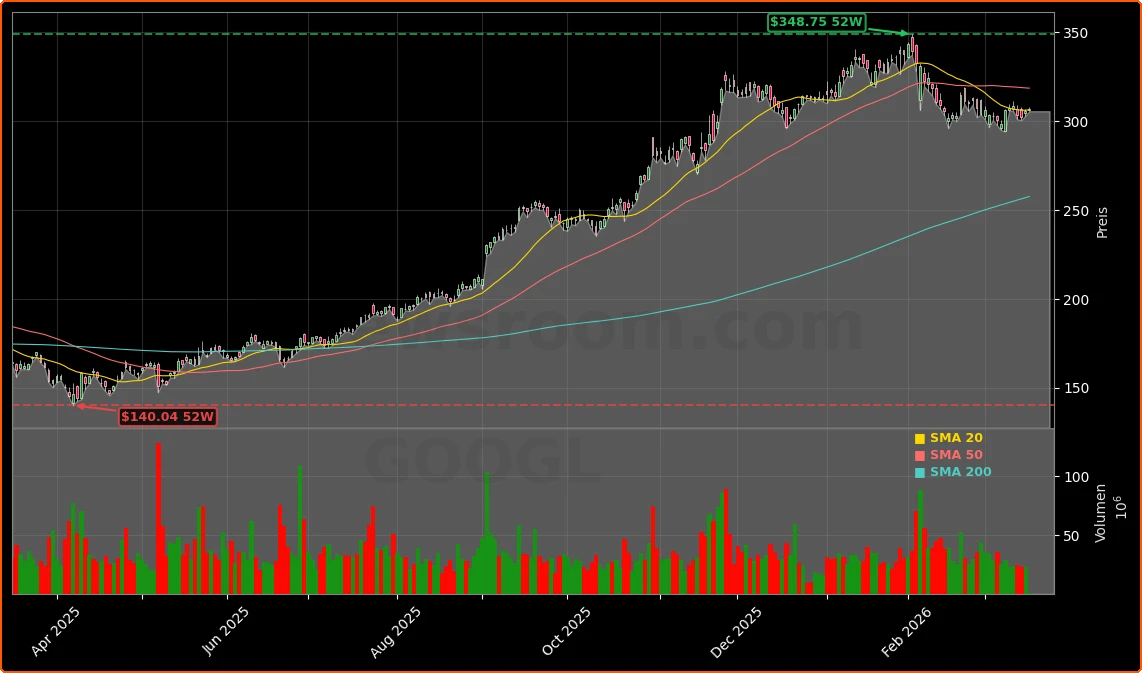
Alphabet Inc. (Google) is trading modestly higher on Tuesday, with GOOGL up around 0.47% to $306.99 and GOOG up 0.40% to $305.55 as of early afternoon ET. The moves come as Wall Street continues to digest the Alphabet AI Strategy, which spans hyperscale data centers, model development and shareholder returns. The stock remains below recent 52-week highs, but analysts still see upside: Wells Fargo, for example, lifted its price target to $387 and rates the shares Overweight, highlighting Alphabet’s compute scale and rich user data as durable AI advantages.
Institutional positioning underscores the split between short‑term profit taking and long‑term conviction. Recent filings show smaller holders such as Humankind Investments trimming GOOGL, while others including Hilltop Holdings and Kids Capital Management have boosted positions, making Alphabet a top‑10 or even top‑5 portfolio weight. MarketBeat’s consensus points to a “Moderate Buy” rating and an average target near $367, suggesting expectations of continued AI‑driven growth on top of robust cash flows.
Why is Alphabet’s AI push so capital intensive?
The core of the Alphabet AI Strategy is infrastructure. Management plans to increase compute capacity from 15 gigawatts at the end of 2025 to 35 gigawatts by 2028, effectively more than doubling its AI data‑center muscle. That expansion requires vast power and cooling resources: Alphabet has signed agreements with utilities AES and Xcel Energy to supply new data centers and is investing $50 million into battery storage in Minnesota to stabilize its energy usage.
Google is also exploring advanced liquid‑cooling systems with manufacturers in China as AI workloads push traditional air‑cooling to the limit. Vendors have showcased coolant distribution units built to Google specifications, underscoring how tightly the company is optimizing hardware for generative AI. In the U.S., Google is weighing participation in Project Cannoli, a hyperscale data center campus in Michigan backed by a 2.7‑gigawatt clean‑energy financing deal with DTE Energy. Combined, these initiatives position Alphabet alongside NVIDIA and Microsoft at the center of the global AI compute race.
How do Search, YouTube and Cloud fit the Alphabet AI Strategy?
Operationally, the Alphabet AI Strategy is about embedding models across its existing franchises while opening new revenue streams. Google has maintained roughly 89%–93% global search market share for a decade, but large language models threaten to shift user behavior toward direct answers rather than link lists. In response, Alphabet is integrating Gemini into Search, Chrome and other apps to defend its ad moat and deliver more context‑aware results.
YouTube, valued by some on Wall Street at $500 billion–$560 billion as a standalone asset, is another pillar. Subscription offerings such as YouTube TV, Premium and NFL Sunday Ticket are growing nearly twice as fast as advertising, while AI tools help creators generate more targeted, monetizable content. On the enterprise side, Google Cloud has become the fastest‑growing of the major cloud providers, with AI services on Vertex AI and Gemini Enterprise driving 48% year‑over‑year revenue growth in the latest reported quarter. These platforms directly compete with Apple’s ecosystem ambitions, Microsoft Azure and Amazon Web Services, giving Alphabet multiple AI monetization vectors.
What role do buybacks play beside Alphabet AI Strategy?
Alongside heavy AI capex, Alphabet has quietly executed one of Wall Street’s largest repurchase plans. From 2016 through 2025, the company bought back roughly $346 billion of its own stock, cutting the share count by more than 13% and effectively reversing dilution back to mid‑2000s levels. This has meaningfully boosted earnings per share even before factoring in incremental AI profits.
Alphabet is pairing one of the most ambitious AI build‑outs on Wall Street with one of the largest buyback programs in corporate history.
— StockNewsroom.com analysis
Conclusion
Alphabet ended 2025 with about $126.8 billion in cash, equivalents and marketable securities and generated $164.7 billion in operating cash flow, easily funding both capex and buybacks despite nearly $25 billion in stock‑based compensation. While Tesla and other growth names rely on equity issuance, Alphabet’s self‑funded approach more closely mirrors Apple’s capital‑return playbook, reinforcing its profile as a mature yet still fast‑growing mega‑cap in the NASDAQ and S&P 500.
Further Reading
- Alphabet Inc. (GOOGL) Stock Price, News, Quote & History (Yahoo Finance)
- Google weighs joining Van Buren Township data center project (The Detroit News)
- Hilltop Holdings Inc. Boosts Stake in Alphabet Inc. (GOOGL) (MarketBeat)