
Can the Alphabet AI Strategy’s record cloud growth and massive chip bets really keep $300-plus shares powering higher from here?
Is Wall Street buying the new Alphabet AI Strategy?
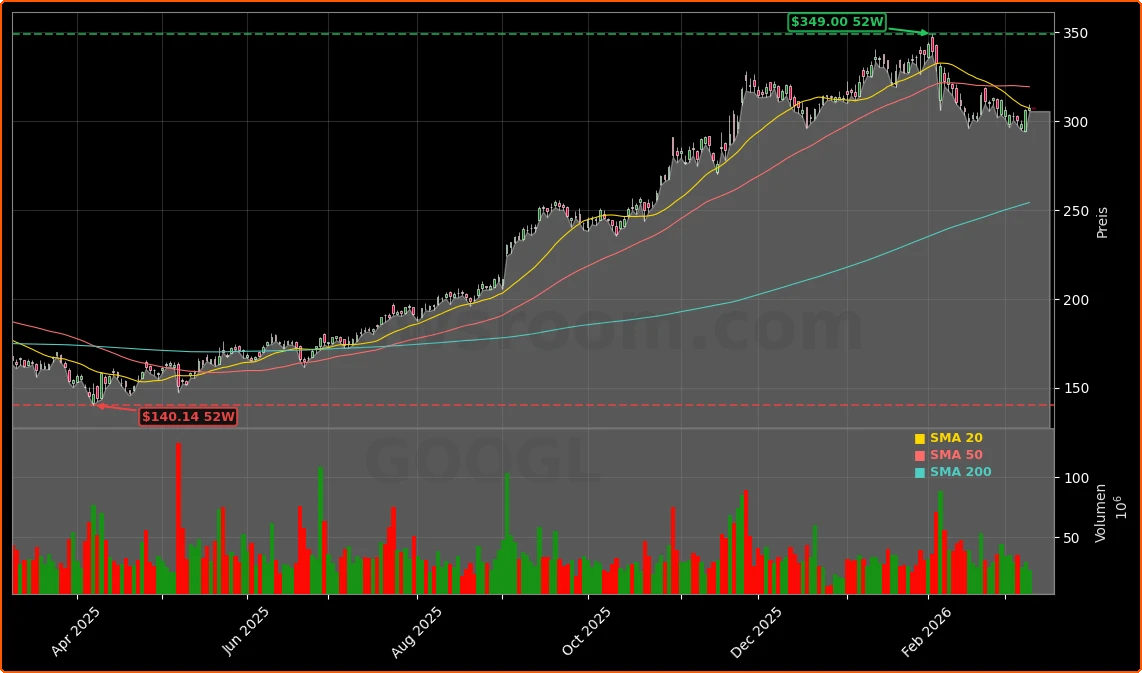
Alphabet Inc. shares were recently changing hands near $307 in early Wednesday trading, slightly below the prior close but still close to recent highs on the NASDAQ. Despite bouts of profit‑taking and insider selling, institutional demand remains robust: several asset managers, including AlphaCore Capital, Barrow Hanley Mewhinney & Strauss and Kepler Cheuvreux Suisse, have all increased or initiated positions in the stock over recent quarters. Those moves underscore confidence that the Alphabet AI Strategy can sustain double‑digit growth even as the broader S&P 500 technology cohort becomes more crowded with AI narratives.
Alphabet’s latest quarter showed why many large funds are staying put. Google Cloud revenue surged about 48% to more than $17 billion, driven largely by demand for AI infrastructure and tools. That positions Alphabet alongside hyperscaler peers like NVIDIA-powered Microsoft Azure and Amazon Web Services as core enablers of generative AI workloads. While analysts’ detailed target revisions were not highlighted in the latest filings, the broader Wall Street stance remains a “Moderate Buy” with consensus fair‑value estimates well above the current $300‑plus range, reflecting expectations of continued AI monetization.
How is Google Cloud monetizing generative AI?
The core of the Alphabet AI Strategy is to make Google Cloud the default platform for enterprise generative AI. The company is deploying its Gemini model family across search, productivity tools and cloud APIs, and is increasingly focused on large, multi‑year agreements that embed Google AI deeper into customers’ workflows. A notable recent example is the long‑term deal with French media group Canal+, which will use Google Cloud’s generative AI to streamline video production and personalize content recommendations across its streaming operations.
Deals like Canal+ showcase how AI can move beyond hype into recurring, usage‑based revenue. Google Cloud is bundling infrastructure, models and security into vertically tailored offerings for media, healthcare and the public sector. Billionaire investor Stanley Druckenmiller recently added Alphabet to his AI portfolio, emphasizing that Alphabet and Amazon currently stand out as AI players already turning large‑scale AI investments into visible top‑line growth. For U.S. investors comparing mega‑caps, that near‑term monetization sets Alphabet apart from some rivals still in the earlier phases of AI product rollouts.
What role do custom chips and energy play for Alphabet?
On the hardware side, the Alphabet AI Strategy is doubling down on in‑house accelerators to reduce dependence on third‑party GPUs and optimize costs over time. Its latest tensor processing unit (TPU), codenamed Ironwood, has been used to train the newest Gemini 3 large language models. Alphabet is working with Broadcom to design and fabricate these chips, and AI start‑ups are taking notice: Anthropic has placed massive TPU orders worth tens of billions of dollars in total for delivery in 2026 and 2027, which should help improve utilization in Alphabet’s data centers.
Feeding those data centers also requires reliable, low‑carbon power. Alphabet has been an early mover in signing innovative energy deals, including partnerships around advanced nuclear technologies. Projects such as the planned small modular reactors in Oak Ridge, Tennessee aim to supply clean electricity for future AI data centers, helping stabilize long‑term power costs and address ESG concerns. For portfolio managers focused on sustainability mandates, this energy component of the Alphabet AI Strategy could prove as important as the chips and models themselves.
How does CEO Pichai’s mega pay package fit in?
A new, performance‑linked compensation package for CEO Sundar Pichai puts corporate governance back into the spotlight. Over the next three years, Pichai could earn up to $692 million if Alphabet stock massively outperforms the S&P 100 and if ambitious growth targets are hit, especially in newer bets. His fixed base salary remains around $2 million annually, while the bulk of the package consists of stock options and restricted stock units.
Crucially, a large slice of the award is tied to the performance of Alphabet’s “Other Bets” such as self‑driving unit Waymo and drone‑delivery venture Wing Aviation. New stock awards worth up to $350 million are linked specifically to scaling these businesses. The board argues that this setup aligns Pichai’s incentives with shareholders and rewards his track record: since he became Google CEO in 2015, the share price has nearly septupled and Alphabet’s market capitalization briefly crossed $4 trillion earlier this year, far outpacing European peers like SAP and even challenging U.S. giants such as Apple.
How does Alphabet stack up against other AI leaders?
For U.S. investors allocating across the AI ecosystem, Alphabet sits in a different bucket than chip manufacturers or pure‑play software names. Hyperscalers including Alphabet, Amazon and Microsoft are spending hundreds of billions of dollars collectively on AI‑driven capital expenditures, funding data centers, networks and specialized silicon. That capital intensity contrasts with the asset‑lighter models of companies like Tesla in autonomous driving software or media groups adopting AI for content curation.
Compared with NVIDIA, which sells high‑margin GPUs to the entire industry, Alphabet’s upside is more diversified: it can monetize AI through higher ad relevance in Search and YouTube, premium features in productivity tools, and fast‑growing cloud contracts. At the same time, this breadth introduces execution risk if any segment stumbles or if regulatory scrutiny around data and competition intensifies. For now, steady institutional buying, accelerating cloud growth and the ambitious Alphabet AI Strategy suggest that Wall Street still views the company as a core holding for long‑term exposure to generative AI.
Conclusion
In conclusion, the expanded Alphabet AI Strategy — spanning cloud, custom chips, nuclear‑backed energy supply and high‑stakes CEO incentives — is transforming the company into one of the most leveraged plays on enterprise AI. For investors on Wall Street, the key question is whether Google Cloud and newer bets like Waymo can grow fast enough to validate today’s premium multiples. The next few quarters of AI‑driven revenue and margin trends will show whether Alphabet can maintain its edge over mega‑cap tech rivals and remain a foundational AI position in diversified U.S. portfolios.
Further Reading
- Alphabet Inc. (GOOGL) Stock Price & Data (Yahoo Finance)
- Canal+ taps Google’s AI for video production, content recommendation (Reuters)
- Google completes $32B acquisition of Wiz (TechCrunch)
- Billionaire Stanley Druckenmiller Just Dropped This AI Big Spender and Bought Shares of These AI Players (The Motley Fool)