
Is the latest Alphabet Lawsuit a one-off legal scare or the opening shot in a much bigger war on Big Tech?

How is the Alphabet Lawsuit hitting the stock?
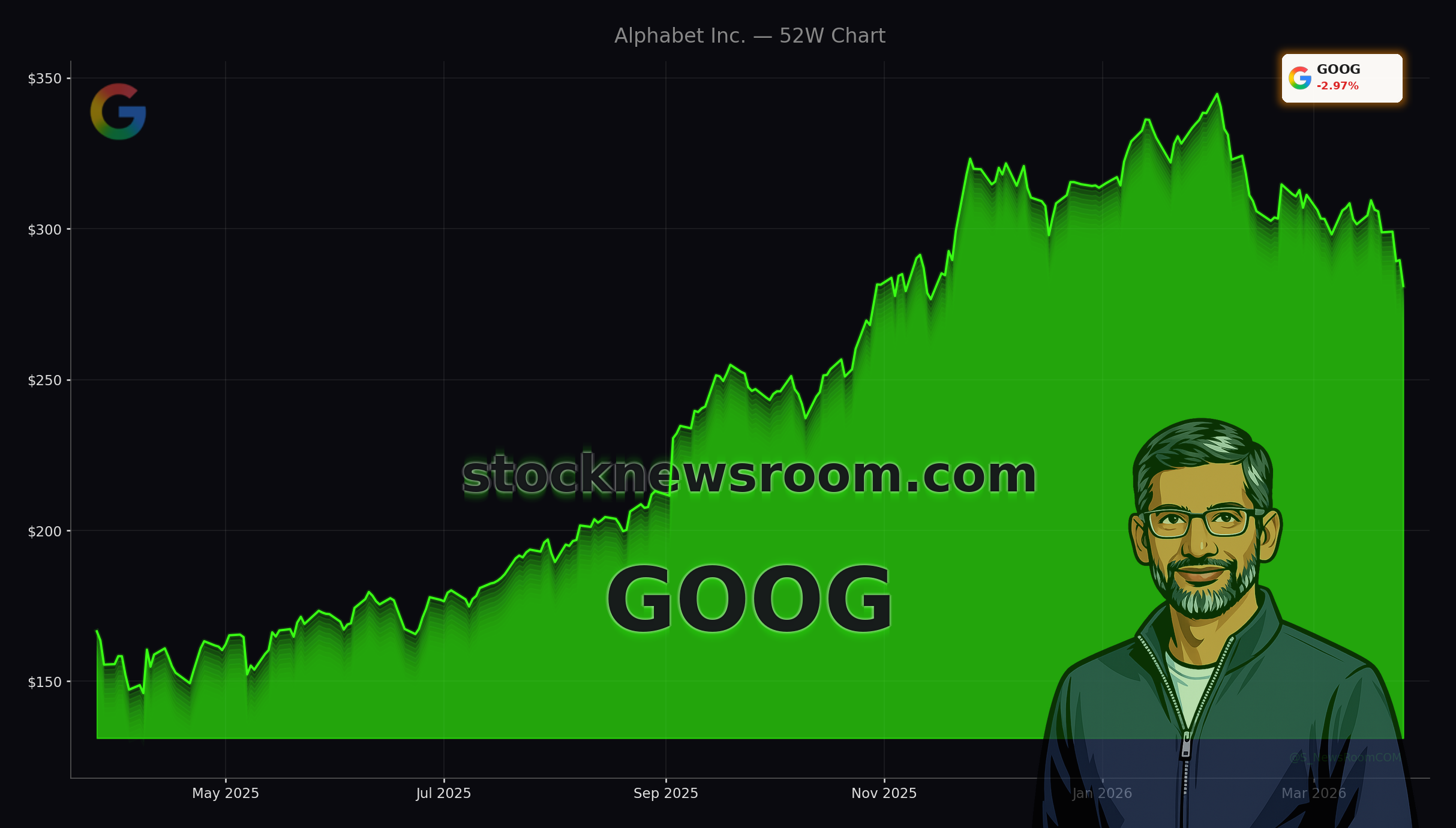
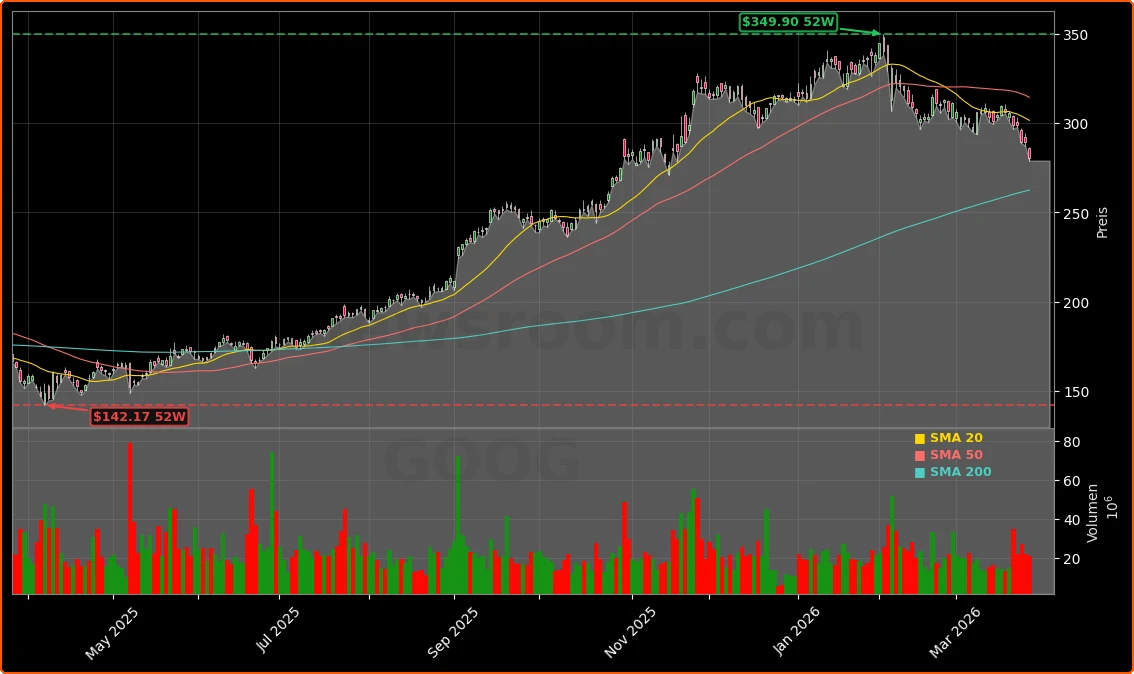
Alphabet Inc. (Google) shares closed around $280.64 for GOOG and $280.77 for GOOGL on Thursday, down roughly 3% on the day and well below the 52‑week high near $349 reached in February. The move came as investors digested a jury verdict that found YouTube and Meta Platforms negligent for allegedly designing addictive features that harmed a young user’s mental health. The plaintiff was awarded $3 million from the two companies, a modest sum financially but a potential inflection point for legal risk.
On a volatile day for the NASDAQ and S&P 500 amid Middle East tensions and rising oil prices, Alphabet underperformed broad indices but did not experience a panic‑style selloff. Market strategists noted that the Alphabet Lawsuit verdict adds to a growing stack of legal and regulatory issues around social media, data use, and AI, yet most Wall Street models still assume manageable settlement costs relative to Alphabet’s more than $1 trillion market value and strong cash generation.
Institutional demand remains evident: World Investment Advisors recently lifted its Alphabet position by 8.7% to over 190,000 shares, according to a MarketBeat filing, reflecting continued conviction in the stock despite headline risk.
Why is this Alphabet Lawsuit a potential watershed?
The Los Angeles jury rejected the long‑standing defense that platforms are not responsible for third‑party content, focusing instead on allegedly addictive product design, recommendation algorithms, and notification mechanics. Legal experts compare the dynamic to early tobacco litigation, where initial verdicts paved the way for larger, coordinated cases years later. Alphabet and Meta plan to appeal, arguing that teen mental health cannot be tied to a single app and that YouTube is primarily a streaming platform, not classic social media.
Still, Meta and Alphabet now face thousands of consolidated complaints from teenagers, school districts, and state attorneys general, underscoring why some commentators call this Alphabet Lawsuit a “watershed moment” for Big Tech. A major multi‑state case against Meta set for trial in San Francisco this summer is widely seen as the next test; if a similar theory of liability is upheld there, investors may need to reprice long‑term legal exposure for both companies.
At the same time, most sell‑side analysts have not yet modeled a “Big Tobacco” scenario involving massive, multi‑decade settlement payments. Instead, they see a spectrum of possible outcomes: from incremental compliance costs and product redesigns for teen users to more material one‑off settlements, but still manageable relative to Alphabet’s scale.
Can AI and TurboQuant offset legal headwinds?
While the Alphabet Lawsuit grabbed headlines, the company also reminded markets why it remains central to the AI arms race. This week, Google unveiled TurboQuant, an AI memory‑compression algorithm that reportedly shrinks key‑value cache usage by roughly six times with no loss of model accuracy. The news hammered memory‑chip names such as Sandisk and Micron Technology, which had rallied on tight AI‑related supply, but some analysts argue the fears are overdone.
Morgan Stanley, for example, sees TurboQuant as enabling more complex and frequent AI workloads rather than structurally reducing demand for DRAM and storage. By cutting memory overhead, TurboQuant could let developers deploy larger models and richer applications at a lower cost, ultimately driving more compute intensity across cloud and data‑center environments led by Alphabet, NVIDIA, and other AI leaders.
Beyond infrastructure, AI remains critical to Alphabet’s core franchises. Zacks Investment Research recently highlighted that Gemini‑powered upgrades are boosting engagement and monetization in Google Search, while Google Cloud continues to win enterprise workloads tied to generative AI. Despite near‑term margin pressure from heavy capex—FactSet estimates over $170 billion in 2026 spending—most firms, including Morgan Stanley’s Brian Nowak, maintain Buy ratings with price targets well above current levels, citing Search, YouTube, Cloud, and Waymo as multi‑year growth engines.
How does Waymo and competition shape the outlook?
Waymo remains a key differentiator for Alphabet in autonomous driving. The robo‑taxi unit has logged more than 170 million rider‑only miles without a human driver through December 2025, with a significant reduction in serious and injury‑causing accidents versus human drivers. Morgan Stanley expects Waymo to expand from 10 U.S. cities to as many as 25 this year, reinforcing Alphabet’s lead over rivals like Tesla and Chinese player Pony.ai in the emerging robo‑mobility market.
At the same time, AI competition is heating up across software and devices. OpenAI’s recent decision to scale back its AI‑video ambitions has been interpreted as a relative win for YouTube and Google Cloud, potentially clearing space for Alphabet to set standards in AI‑generated video and creator tools. That said, Microsoft’s integration of AI into Bing and Windows, as well as ecosystem plays from Apple and other platform giants, keep pressure on Alphabet to execute, especially while its legal backdrop is in flux.
For U.S. investors, the key trade‑off is stark: the Alphabet Lawsuit sequence may cap near‑term valuation multiples, but accelerating AI monetization and autonomous‑driving optionality continue to support a constructive long‑term thesis.
Related Coverage
Investors following the Alphabet Lawsuit narrative may also want to watch how AI competition is playing out at smaller software names. A recent analysis at stocknewsroom.com titled “AppLovin AI Competition: -10.1% Plunge Tests AI Hype” examines whether a double‑digit drop in AppLovin is a sign that AI enthusiasm is peaking or simply a reaction to macro volatility. Together with Alphabet’s legal risk and AI investments, this piece helps frame how AI‑driven growth stories are being repriced across the NASDAQ.
In the end, the Alphabet Lawsuit underscores that legal, regulatory, and reputational risk are becoming structural factors in the valuation of mega‑cap tech, even as AI products like TurboQuant and Waymo showcase the company’s long runway for innovation. For long‑term investors willing to stomach volatility, the next few quarters—including Q1 2026 earnings and the upcoming San Francisco trial—will be critical in determining whether Alphabet’s legal drag is temporary or a lasting discount to its AI‑powered growth potential.