Can Alphabet Security really strengthen while Iran threats escalate and Google’s own quantum research rattles the crypto world?

How are Iran threats hitting Alphabet today?
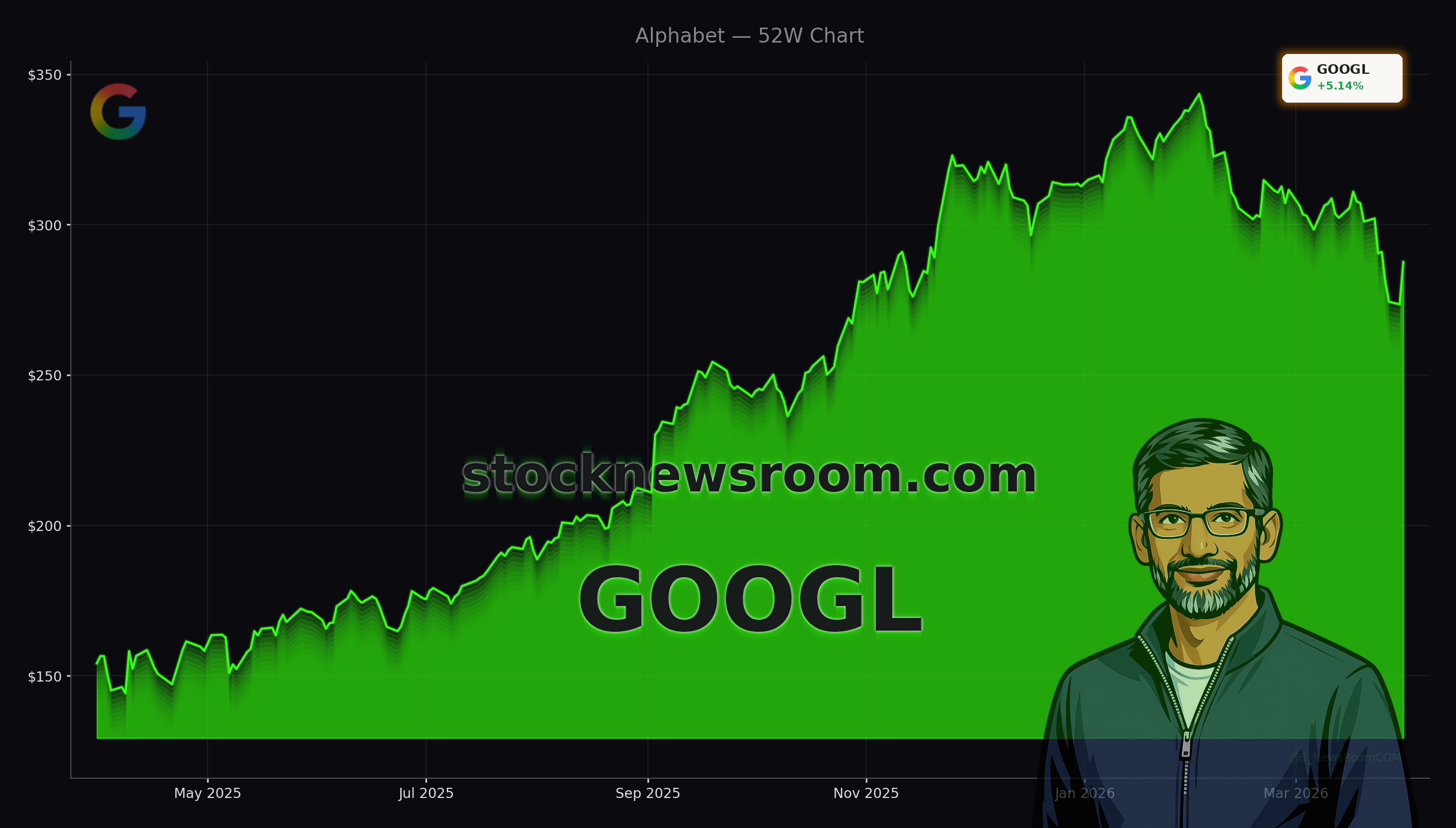
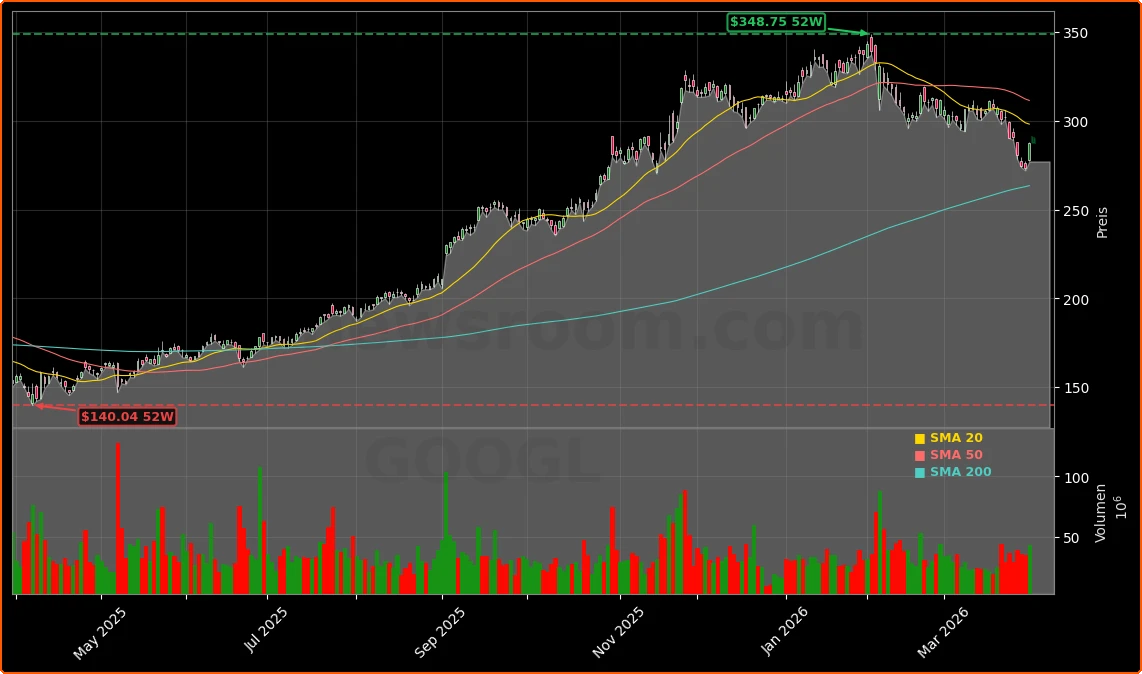
Alphabet Inc. (Google) shares are trading higher despite an escalation in Middle East risk. Class A shares recently changed hands around $287.56, up roughly 5% on Tuesday’s close, with pre-market indications near $290.73, while Class C shares hovered near $286.86 with a similar pre-market lift. The advance comes even as Iran’s Islamic Revolutionary Guard Corps named Google among 18 U.S. and allied tech firms it now deems “legitimate targets” in retaliation for U.S. and Israeli strikes.
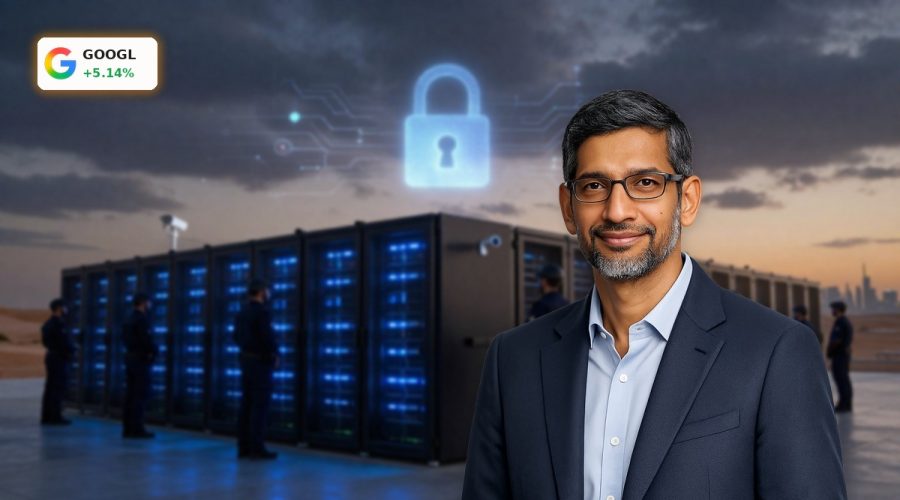
The group warned that attacks on those companies’ regional facilities could begin Wednesday evening Tehran time and urged employees to leave data centers and offices. The same list includes NVIDIA, Apple, Microsoft, Intel, IBM, Tesla, Boeing and several regional cloud and AI players. The episode underscores how Alphabet Security now requires hardening not just digital infrastructure, but also physical assets and staff safety as U.S. tech funnels more AI infrastructure spending into the Middle East.
While there are no confirmed physical attacks on Google facilities so far, the prior strike on AWS infrastructure in the region shows cloud and AI build-outs have become part of a broader geopolitical chessboard. For investors, the near-term question is whether higher perceived regional risk slows Google Cloud’s expansion or forces costlier redundancy, putting a new cost line into the Alphabet Security calculus.
What does the quantum paper mean for crypto?
A separate shock to Alphabet Security arrived via a 57-page Google Quantum AI whitepaper coauthored with Ethereum Foundation researcher Justin Drake and cryptographer Dan Boneh. The research argues that breaking the 256-bit elliptic-curve discrete logarithm problem underlying most blockchain signatures would require roughly 500,000 physical qubits, a 20-fold reduction from many prior estimates.
In practical terms, the team models a future quantum machine that could steal a Bitcoin in-flight by deriving a private key in roughly nine minutes, giving an attacker a roughly 41% chance of draining funds before the next block confirmation. That does not mean such a machine exists today, but it reframes timelines and elevates quantum risk from theoretical to planning-critical. Alphabet Security strategy now clearly includes driving a post-quantum cryptography migration across the wider internet, not only inside Google’s own stack.
Google has quietly spent years preparing: early PQC experiments in Chrome in 2016, internal PQC protections since 2022, ML‑KEM defaults in Chrome’s TLS 1.3 and QUIC in 2024, quantum-safe signatures in Cloud KMS in 2025 and PQC in Android 17 this March. By publishing the blockchain analysis without revealing the full attack circuits—verified via zero-knowledge proofs—Google is effectively issuing a controlled alarm. Crypto projects that adapt with hybrid signatures and robust key-rotation could become showcases for future trust infrastructure, giving Alphabet Security a new thought-leadership angle with regulators and enterprises.
Is AI tech offsetting these Alphabet Security risks?
On the AI front, Google Research last week unveiled TurboQuant, a software-based memory compression technology designed to boost large-model inference efficiency. By applying error-corrected compression to the KV-cache used in transformer models, TurboQuant can expand effective cache capacity about sixfold and deliver up to eightfold faster inference without sacrificing accuracy, at least in internal tests.
That has two implications for investors. First, TurboQuant could materially lower inference costs inside Google Cloud, supporting margins even as AI workloads explode. Second, it could partially ease dependence on scarce high-bandwidth memory chips that currently constrain data center build-outs, with potential knock-on effects for suppliers closely tied to NVIDIA’s AI GPU ecosystem. An earlier StockNewsroom piece, “Alphabet TurboQuant Shock: Is Google Rewriting AI Memory Costs?”, dives deeper into how this technology might reshape chip demand and Alphabet’s long-term cost base.
Wall Street is taking note. Needham recently reiterated a Buy on Alphabet with a $400 price target, up from $330 earlier in the year, arguing that Google’s AI infrastructure, global distribution and vast user data leave it well placed to lead AI monetization. Wells Fargo also lifted its target to $397 with an Overweight rating, highlighting AI leadership and deepening enterprise traction in Google Cloud. Across MarketBeat-tracked research, consensus still sits at a “Moderate Buy” with average targets around the mid-$360s, well above current trading levels.
Where does robotaxis and cloud fit into Alphabet Security?
Beyond data centers and cryptography, Alphabet Security increasingly touches roads and cities. Waymo, Alphabet’s autonomous ride-hailing subsidiary, has logged over 20 million rides and claims 92% fewer serious or pedestrian-injury crashes than human drivers per mile in its operating zones. A recent survey by law firm Murphy & Prachthauser found that while 7 in 10 Americans are initially uneasy about driverless rideshares, comfort rises significantly after first-hand experience—aligning with Waymo’s reported 93% satisfaction rate.
For investors, that makes Waymo a long-dated but tangible option on a robotaxi market where Alphabet and Tesla are seen as early leaders. A recent funding round that valued Waymo at roughly $126 billion—still only a slice of Alphabet’s roughly $3.5 trillion market cap—illustrates the scale of that optionality. Meanwhile, Google Cloud continues to post rapid backlog growth, with enterprise AI demand driving a 55% sequential surge in booked business and helping fuel 18% top-line growth in the most recent reported quarter.
Institutional investors appear comfortable with this broadened Alphabet Security profile. Harrington Investments, Argentarii and Ferguson Wellman all count Alphabet as one of their largest positions even after modest Q4 trims, while Norges Bank and Berkshire Hathaway have been adding shares. Alphabet remains a top-three weight in the Invesco QQQ Trust alongside Apple and NVIDIA, anchoring many U.S. index and ETF strategies tied to the NASDAQ-100 and S&P 500 growth trade.
Related Coverage
For a deeper dive into how TurboQuant might change AI hardware dynamics and Alphabet’s cost structure, read “Alphabet TurboQuant Shock: Is Google Rewriting AI Memory Costs?”. Investors tracking the broader AI infrastructure boom should also look at “NVIDIA Mega Deals +5.6% Rally Shock on OpenAI, Marvell Bets”, which explores how NVIDIA’s latest agreements could reinforce its leadership in AI chips that power Google Cloud and rival platforms.
Putting it all together, Alphabet Security now spans physical facilities in volatile regions, a fast-approaching post‑quantum cryptography transition and intense AI competition in both the cloud and autonomous driving. The stock’s rebound, rising analyst targets and entrenched role in major indices suggest investors see more upside than downside in that complexity. The next few quarters of AI monetization, Waymo expansion and geopolitical risk management will show whether Alphabet Security becomes a durable competitive edge or an ongoing market worry.