
Are Amazon AI Investments and a record debt-fueled $200 billion capex wave the catalyst the stock has been missing?
Are Amazon AI Investments a turning point for the stock?
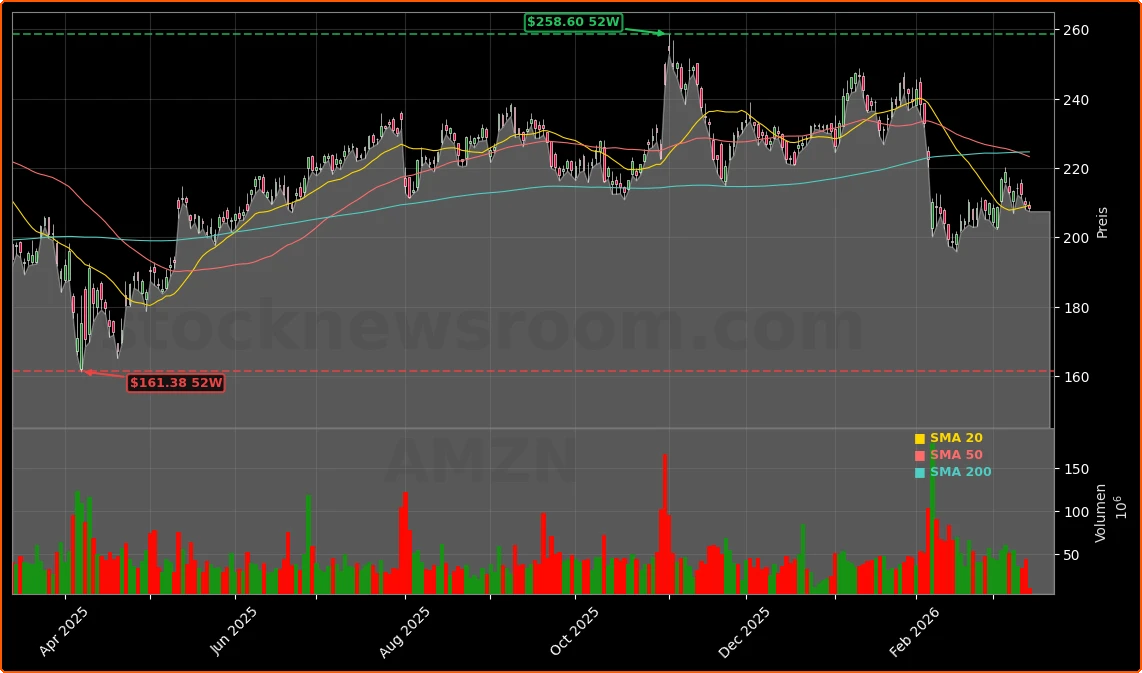
At around $208.55 in Friday afternoon trading, Amazon (AMZN) is fractionally below its previous close and down roughly 7% year to date, underperforming both the S&P 500 and most of the “Magnificent Seven.” Over the past five years, the stock has delivered an annualized return of about 6.9%, well below mega-cap peers and even the broader index. Yet Amazon AI Investments are accelerating just as the shares trade at roughly 29 times earnings and about 26 times forward earnings, levels close to a two-decade low for the company’s valuation multiple.
That combination of muted performance and compressed multiples is drawing in some institutional buyers. Modern Wealth Management, for example, recently boosted its Amazon position by more than 60,000 shares, making AMZN one of its more significant holdings. Other asset managers like Natixis Advisors have also nudged their stakes higher, even as some firms, including First Trust Advisors and Grantham Mayo Van Otterloo, trimmed exposure. The mixed positioning underscores how polarizing Amazon AI Investments have become on Wall Street.
How big is Amazon’s new AI and cloud spending wave?
The new investment cycle is staggering in scale. Earlier this year, Amazon outlined roughly $200 billion in capital expenditures, about 50% higher than the prior year, with the bulk earmarked for AI and cloud infrastructure. That includes hyperscale data centers, networking, and specialized silicon for training and inference workloads that compete with GPU solutions from NVIDIA.
To fund this, Amazon has launched one of the largest corporate bond offerings ever seen in Europe and the U.S. In recent days the company sold about $54 billion in U.S.-dollar bonds, including tranches with maturities up to 50 years, alongside roughly EUR 14.5 billion of euro-denominated debt after strong investor demand. One U.S. dollar bond due 2031 came with a 4.25% coupon, while a longer-dated issue maturing in 2046 priced around 5.65%, illustrating that the market is willing to finance Amazon AI Investments, but at a meaningful cost of capital.
Amazon had already been testing the waters with a smaller $10 billion debt raise in late 2025, signaling that excess cash reserves and free cash flow alone would no longer cover the growth agenda. Across the tech sector, cash balances have fallen back toward levels last seen during the dot-com bubble and the global financial crisis, pushing companies to choose between slowing AI spending or embracing leverage. Amazon has clearly chosen the latter.
Can Amazon Web Services defend its lead with AI?
The strategic rationale is centered on Amazon Web Services (AWS). While AWS remains a market leader in cloud infrastructure, it has recently ceded some ground to rivals that moved faster on AI capacity and partnerships. Microsoft’s alliance with OpenAI and Google’s ramp-up in custom TPU deployments helped them navigate GPU shortages more effectively, leaving AWS perceived as late in some high-end AI workloads.
Management is now responding with a full-stack approach: more data centers, heavier use of in-house chips such as Inferentia and Trainium, and deeper integration of generative AI services for business customers. Analysts argue that without this surge in Amazon AI Investments, AWS could see further share erosion just as enterprises standardize on AI platforms for the next decade.
Macro risks complicate the picture. AI-heavy data centers are highly energy-intensive, and power market distortions – such as recent spikes tied to mechanisms like the Base Residual Auction in the PJM grid – can squeeze margins. Still, large-scale players like Amazon, Apple and Tesla are increasingly viewed by some investors as new quasi-defensive holdings, benefiting from software-driven models less exposed to traditional industrial supply chains.
How is Wall Street valuing Amazon AI risk?
Despite worries about overspending, Wall Street’s fundamental stance on Amazon remains broadly constructive. Roughly 90% of covering analysts rate the stock a “Buy” or equivalent. Several firms have recently reiterated bullish views, with a median 12‑month price target around $285 per share, implying roughly one‑third upside from current levels. Research houses like Wolfe Research have lifted their targets in recent months, citing improving cloud growth, operating leverage in e‑commerce, and the long-term payoff from Amazon AI Investments.
At the same time, some institutional investors are de‑risking. Korea Investment CORP and SPX Gestao de Recursos both cut their stakes during the latest reported quarter, signaling concern over AI capex intensity, regulatory scrutiny, and tax investigations. Hedge funds profiled by outlets such as The Motley Fool show a preference for AI infrastructure names, with Amazon frequently appearing alongside chip and data-center leaders in the top holdings of billionaire investors.
The scale of Amazon AI Investments means investors will be judging not just innovation, but hard returns on billions of dollars in new capital.
— StockNewsroom.com analysis
Conclusion
Compared with other Magnificent Seven names, Amazon’s setup is unusual. While NVIDIA has already re-rated sharply on realized AI demand, Amazon is spending ahead of revenue, accepting near-term pressure on free cash flow and returns on invested capital. For long-term investors, the key question is whether the company can convert this spending into durable high-margin AI services inside AWS and new monetization layers across e‑commerce, advertising, and consumer devices.
Further Reading
- Amazon.com, Inc. (AMZN) Stock Price, News, Quote & History (Yahoo Finance)
- Amazon Is Down 7% in 2026. Is This a Once-in-a-Lifetime Buying Opportunity? (The Motley Fool)
- Modern Wealth Management LLC Acquires 61,034 Shares of Amazon.com, Inc. AMZN (MarketBeat)
- Here Are Billionaire Steven Cohen’s 5 Biggest Stock Holdings (The Motley Fool)