
Will Amazon’s massive AI investments push free cash flow into the negative, or lay the groundwork for the next growth surge?
Amazon AI Investments: Curse or Blessing?
Amazon.com, Inc. is implementing the most aggressive investment strategy among hyperscalers this year, with AI and cloud expenditures totaling $200 billion. The goal is to meet the rapidly growing demand for computing power for generative AI, particularly through Amazon Web Services (AWS). However, this is expected to result in free cash flow turning negative in 2026, following a drop from $38.2 billion to $11.2 billion in 2025, as investments grow faster than operating cash flow.
The Amazon AI investments aim to alleviate capacity constraints in global data centers. The demand from enterprise customers currently exceeds the existing infrastructure, which is hampering potential revenue. At the same time, stock buybacks and financial flexibility are under pressure—a key reason for the corrections seen in recent months.
How Much Does Amazon Benefit from AWS and Advertising?
Despite skepticism, the core business remains impressively profitable. AWS leads the competition with an annualized revenue run rate of approximately $142 billion and grew by 24% in Q4 2025—the highest growth rate in years. New large clients like Visa, Salesforce, DoorDash, and OpenAI reinforce the trend of companies shifting their IT budgets from on-premise systems to the cloud.
Simultaneously, the advertising business is booming: In 2025, Amazon generated nearly $69 billion in revenue, a 22% increase from 2024. The high margins in this segment help cushion the massive Amazon AI investments. Additionally, the company is launching new e-commerce services like “Amazon Now,” which enables delivery times of 30 minutes and has significantly increased order frequency among Prime customers in test markets—such as India.
With Prime Video advertising formats now reaching 315 million viewers and AI-powered tools for campaign creation, Amazon is building an integrated advertising and commerce ecosystem that promises additional revenues and economies of scale in the long term.
How Do Morgan Stanley and Other Analysts View Amazon?
Analyst opinions are conflicting. Morgan Stanley sees Amazon as one of the top beneficiaries of AI and maintains an “Overweight” rating with a price target of $300. The investment bank expects AWS to grow again at over 30% per year in 2026/27, significantly increasing the return on capital for AI and data center investments. “Agentic Commerce”—AI assistants like Rufus that personalize the shopping experience and increase conversion rates—are particularly highlighted.
Other firms remain optimistic but adjust their expectations. Bernstein lowered its price target from $300 to $265 but kept the “Outperform” rating. The reasoning: The strong performance of AWS and operating results justifies part of the spending, but it is too thin in the short term to fully explain the $200 billion capex. Benchmark reduced its price target from $295 to $275 and also maintains a “Buy” rating.
Bank of America analyst Justin Post defends the strategy: Given AWS’s leading customer base and revenues, it is logical for Amazon to invest more than competitors. Among the 72 analysts covering the stock, about 92% still recommend it as a buy, with an average twelve-month potential of nearly 40%.
How is Amazon Currently Valued?
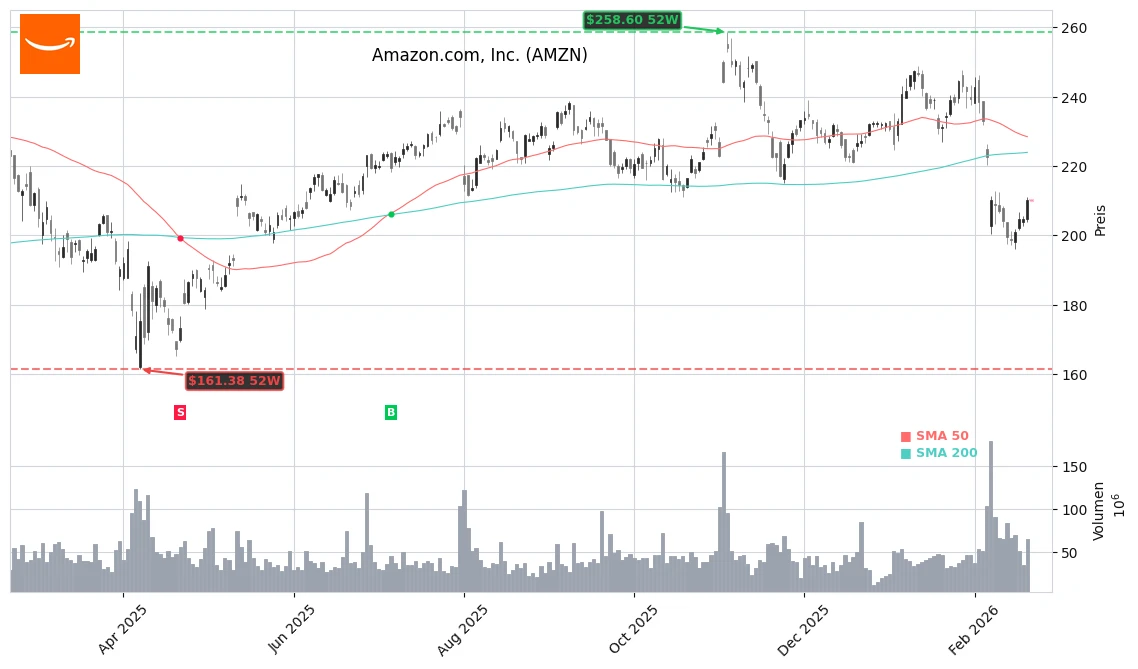
With a price of $210.11, the stock is trading about 18% below its all-time high and roughly 10% lower since the beginning of the year. Based on earnings estimates, the expected P/E ratio is around 25 to 26, only slightly above the S&P 500 average, even though Amazon is increasing revenue in the mid-teens percentage range and expanding margins.
Compared to other consumer giants, the stock appears moderately valued: Walmart has a higher multiple, even though Amazon is projected to become the world’s largest company by revenue in 2025 with $717 billion and benefits more from the AI boom. A critical concern remains the currently minimal free cash flow yield of about 0.35% measured against enterprise value—a direct effect of the Amazon AI investments. However, the long-term scale and network effects of e-commerce, cloud, and advertising suggest that free cash flow could reach new heights after this wave of investments.
We have deep experience in reading demand signals in the AWS business and translating that capacity into a strong return on invested capital.
— Andy Jassy, CEO of Amazon
Bottom Line
The $200 billion offensive of Amazon AI investments places short-term pressure on free cash flow and sentiment but clearly aims to secure structural leadership in cloud, commerce, and advertising. For investors, this creates a tension between increased risk and extraordinary scaling potential, especially as valuation and analyst consensus currently lean more in favor of the stock. It will be crucial to see whether AWS and new AI-driven services justify the wave of investments starting in 2027—those willing to take this bet will find Amazon to be a dominant growth stock with a long-term intact risk-reward profile.
Related Sources
- Amazon.com, Inc. (AMZN) Overview (Yahoo Finance)
- Amazon.com, Inc. (AMZN) Named Top AI Pick as Morgan Stanley Sees AWS Acceleration and Agentic Upside (Finviz)
- Analysts Maintain Buy on Amazon (AMZN) Despite 18% Share Depreciation (Finviz)
- Could Amazon Stock Gain 79% This Year? 1 Wall Street Analyst Thinks So. (The Motley Fool)