Will the massive Amazon OpenAI investment be a jackpot for AI or a costly risk for shareholders?
What is behind the Amazon OpenAI investment?
Amazon.com, Inc. is reportedly positioning itself as a major investor in a new funding round for OpenAI, which could raise over $100 billion. According to consistent reports, Amazon is expected to commit around $50 billion, thereby becoming the first major direct investor in OpenAI. The planned Amazon OpenAI investment would thus be one of the largest single deals in the global tech sector, potentially elevating OpenAI’s valuation to as much as $850 billion. Strategically, this entry is closely linked to the use of Amazon’s own chips and cloud services to increasingly integrate OpenAI workloads into the company’s infrastructure.
OpenAI, in turn, plans to make massive capital expenditures on new data centers to meet the demand for generative AI. For Amazon, the partnership presents an opportunity to draw additional computing and storage loads onto Amazon Web Services (AWS), thereby increasing the utilization of its already significantly expanded infrastructure. The Amazon OpenAI investment is thus not only a financial commitment but also a deal aimed at strengthening its own platform and boosting sales of chips, cloud capacities, and AI services.
Why is Amazon taking full risk in AI expansion?
Amazon plans to shoulder up to $200 billion in capital expenditures this year—primarily for data centers, chips, and network technology. Together with Alphabet, Meta, and Microsoft, the capital expenditure plans of the major tech companies for the coming year total around $660 billion. The company is simultaneously investing in its own AI chips, an expanded model portfolio, a revamped version of Alexa, and the shopping assistant Rufus, which has already reached hundreds of millions of customers and, according to company reports, generates additional billions in revenue.
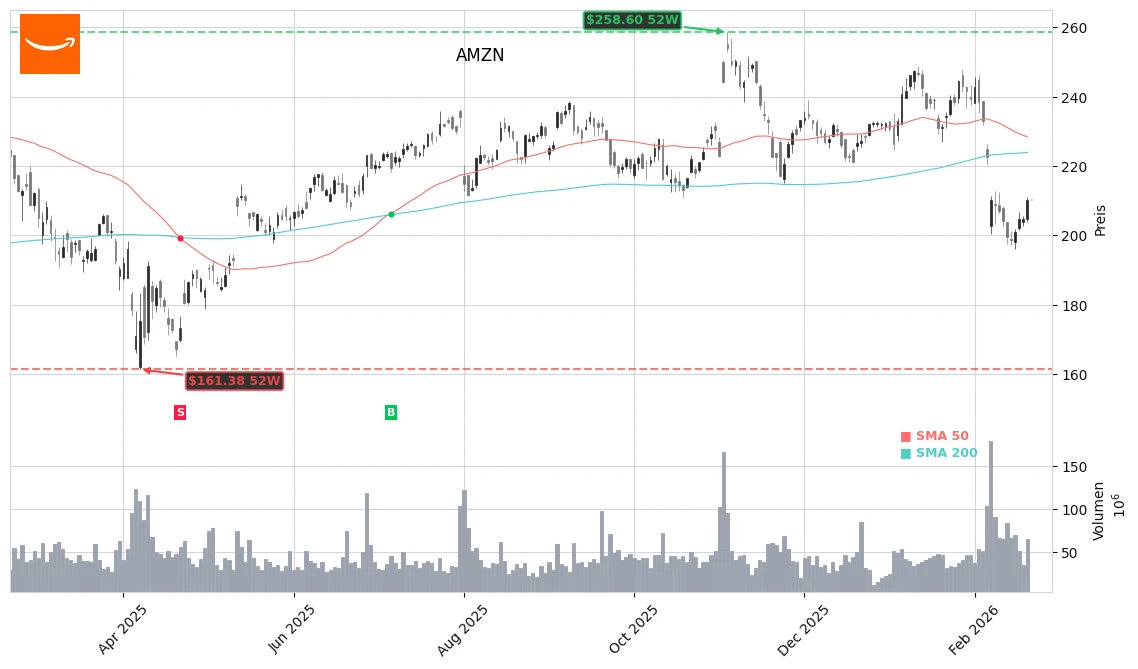
At the same time, skepticism is growing among investors about whether this wave of spending can be sustainably earned back. Some major investors have significantly reduced their Amazon stock holdings in recent months, while the stock has been under noticeable pressure since the Q4 2025 results. Recently, the question has been raised whether the free cash flow—estimated at $160 to $180 billion—is sufficient to finance the planned $200 billion in capital expenditures or whether increased debt will be necessary. Against this backdrop, the Amazon OpenAI investment is perceived by parts of the market as an additional burden factor.
How is Amazon’s core business performing?
Despite concerns about its appetite for investment, the operational business of Amazon.com, Inc. shows robust trends. In 2025, the company generated approximately $717 billion in revenue, surpassing Walmart as the world’s largest company by revenue. A significant portion of the growth comes from AWS, which has become the most profitable segment and recently recorded a resurgence in revenue growth. In e-commerce, the use of robotics and AI is already leading to significantly higher efficiency and rising margins.
The advertising business is also gaining significant importance: Amazon is now one of the largest digital advertising platforms in the world, with high margins and strong growth. Together with third-party services—from fulfillment to fees to advertising—this creates a high-margin ecosystem that makes the company less dependent on traditional retail. For many analysts, this combination of retail, cloud, advertising, and AI infrastructure is the central investment case into which the Amazon OpenAI investment strategically fits.
How do analysts evaluate the Amazon OpenAI investment?
On Wall Street, Amazon is seen as a structural winner of the AI transformation despite the stock decline. Several firms point out that the valuation appears attractive in historical comparison and relative to Walmart or Costco. Estimates suggest an average earnings growth of around 17% annually over the next three years, while the price-to-earnings ratio is significantly lower than many defensive consumer stocks. While some research houses like Seeking Alpha have recently pointed to growing financial risks and a potential burden on free cash flow and margins, traditional investment banks—such as Goldman Sachs, Morgan Stanley, or Citigroup—continue to predominantly rate Amazon with buy recommendations and double-digit price potential.
On the other hand, more cautious analysts, such as those at RBC Capital Markets, warn that the market demands concrete evidence of the returns from massive AI investments. It will be crucial whether AWS can quickly convert the additional demand from the OpenAI environment and other AI clients into higher-margin revenue. If successful, the Amazon OpenAI investment could prove to be a lever for margin and valuation potential—if the monetization effect fails to materialize, further pressure on the stock price may ensue.
The stock is currently trading at $204.06, slightly below the previous day’s close of $204.79. Following a significant decline since the beginning of the year, the price reflects both the strength of the core business and growing doubts about capital discipline. For investors, the question now centers on whether Amazon can achieve sustainable profit growth with the Amazon OpenAI investment and its other AI initiatives.
Bottom Line
In conclusion, the Amazon OpenAI investment is a symbolic building block in Amazon’s strategy to establish itself as a leading infrastructure provider for generative AI. Despite short-term uncertainties regarding capital expenditures and cash flow, Amazon.com, Inc. remains a central player for the next technology wave with record revenues, growing cloud power, and a broad AI portfolio. The upcoming quarters and the integration of OpenAI workloads into AWS will determine whether this billion-dollar initiative pays off—this could present an exciting entry opportunity for risk-oriented investors.
Related Sources
- Amazon.com, Inc. on Yahoo Finance (Yahoo Finance)
- Amazon surpasses Walmart in annual revenue for first time (CNBC)
- Amazon dethrones Walmart as world’s biggest company by sales (The Detroit News)
- Amazon tops Walmart in annual revenue for the first time (Yahoo Finance)