
Can the massive Amazon OpenAI-Partnership really turn AWS’s AI slowdown into a long-term cash machine for investors?
How big is the Amazon OpenAI-Partnership?
The Amazon OpenAI-Partnership combines a direct investment of up to $50 billion with a dramatically expanded cloud and compute agreement. OpenAI will integrate its models more deeply into Amazon’s Bedrock platform and designate AWS as its exclusive third‑party cloud distribution provider for certain services, while also ramping use of Amazon’s custom Trainium chips for training and inference. At the same time, an existing compute deal is being expanded by roughly $100 billion over eight years, underscoring the massive infrastructure build required to support OpenAI’s rapidly growing user base and model complexity.
OpenAI’s latest funding round totals about $110 billion and values the ChatGPT maker in the high‑hundreds of billions, alongside heavy commitments from NVIDIA and SoftBank. For Amazon, the scale of the Amazon OpenAI-Partnership effectively ties a significant portion of its announced $200 billion capex surge in 2026 directly to monetizable AI demand running on AWS data centers and silicon.
What does this mean for Amazon Web Services?
AWS remains the global cloud market leader by revenue, but its growth had slowed versus Microsoft Azure and Google Cloud over the last two years. Management has already telegraphed a step‑function increase in AI‑driven infrastructure spending, taking planned capital expenditures from roughly $92 billion a year ago to about $200 billion for 2026. The Amazon OpenAI-Partnership gives investors a clearer line of sight on where a large chunk of that money is going.
By pulling more OpenAI workloads onto AWS and onto Trainium, Amazon is not only selling more raw compute but also strengthening its differentiated AI stack, spanning chips, managed foundation models on Bedrock, and higher‑level services for enterprises. CEO Andy Jassy has framed these AI data centers as long‑life, high‑return assets, arguing that AWS can earn strong margins over time even if free cash flow is temporarily pressured while the build‑out peaks.
Importantly, Amazon continues to back Anthropic as well, reflecting a deliberate multi‑model, multi‑lab strategy. OpenAI, Anthropic, and in‑house models can all run atop AWS, giving customers optionality while helping Amazon capture value across the broader AI ecosystem rather than betting on a single winner.
How does this reshape Big Tech AI competition?
The Amazon OpenAI-Partnership lands in the middle of a complex web of alliances. Microsoft still retains its core strategic relationship with OpenAI, including an exclusive license to key intellectual property and Azure as the primary cloud for stateless OpenAI APIs. Nevertheless, Amazon’s role as OpenAI’s exclusive third‑party cloud distributor and a major Trainium supplier shifts some AI gravity back toward AWS.
For investors, the move highlights how intertwined the mega‑caps have become. NVIDIA is simultaneously powering OpenAI’s GPU needs, investing capital, and selling chips to Microsoft, Amazon, Apple and others. Alphabet’s Google Cloud and its TPUs remain central to Anthropic’s roadmap, despite Amazon’s equity stake there. The net effect is a high‑stakes race where each cloud provider is trying to pull the most valuable AI traffic onto its own stack while still partnering tactically with rivals when it makes economic sense.
On Wall Street, the key question is whether Amazon’s heavy spending will ultimately produce outsized free‑cash‑flow growth. Recent quarters showed strong top‑line and operating income trends, particularly in AWS and advertising, but shrinking near‑term free cash flow as management leans into AI infrastructure. Research firms such as Zacks have flagged this capex intensity as a risk factor, even as they acknowledge that Amazon remains one of the cheaper mega‑caps on a growth‑adjusted earnings multiple.
How is Amazon stock reacting?
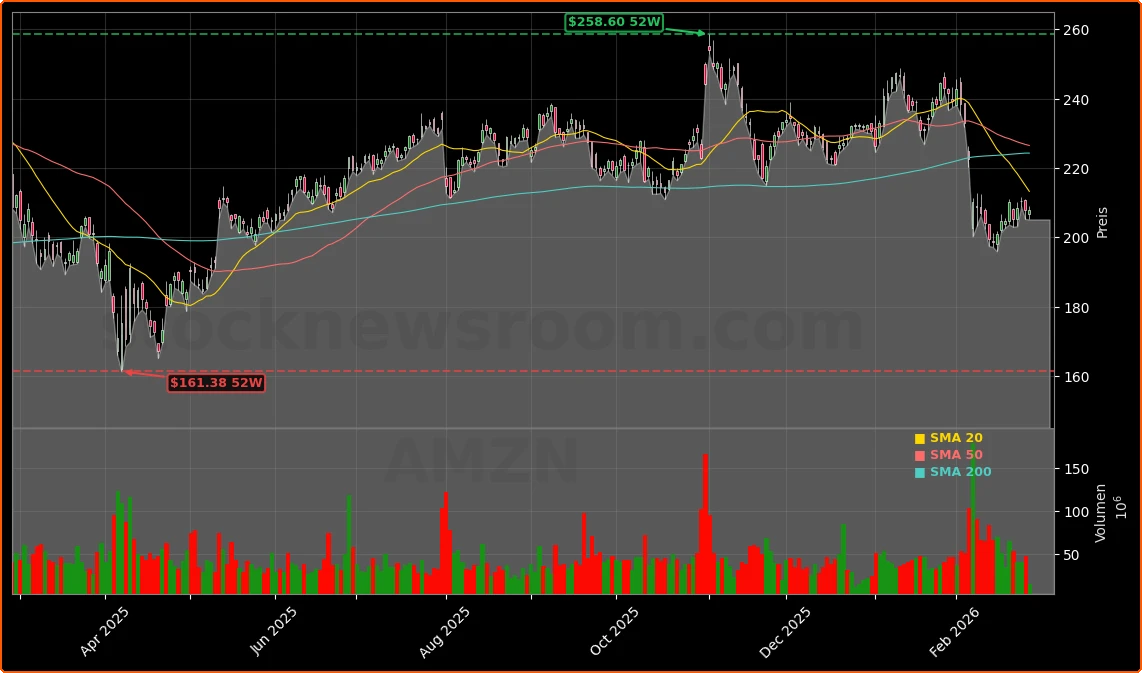
At about $207.95, Amazon trades roughly flat on the day and below recent highs, as some investors digest the added capex and execution risks around the Amazon OpenAI-Partnership. The stock has been consolidating after a strong multi‑year run from its 2022 lows, and technicians are watching key moving averages and long‑term trendlines as support levels. Some institutional holders, including Berkshire Hathaway, have recently reduced positions, while other long‑term managers have used pullbacks to add exposure, viewing Amazon as one of the more attractively valued names within the so‑called “Magnificent 7.”
We think they’ll be one of the big winners in AI, we can help them grow, and we believe we’ll earn a strong return for Amazon over the long term.
— Andy Jassy, CEO of Amazon
Conclusion
Sell‑side sentiment remains broadly constructive. Many analysts emphasize that Amazon’s core businesses—e‑commerce, AWS, logistics, and advertising—continue to generate substantial operating cash flow that can be redirected from growth to profitability if AI returns disappoint. For diversified U.S. investors, the stock remains a liquid way to gain exposure to both consumer spending and the accelerating commercialization of generative AI.
Further Reading
- Amazon.com, Inc. (AMZN) Stock Quote & Overview (Yahoo Finance)
- Amazon Bets $50 Billion On OpenAI In Landmark AI Partnership (Benzinga)
- Amazon invests $50B in OpenAI, deepens AWS partnership with expanded $100B cloud deal (GeekWire)
- OpenAI’s $110 billion funding round draws investment from Amazon, Nvidia, SoftBank (Reuters)
- Will Heavy Capex Spending Weigh on Amazon’s AI Ambitions? (Zacks Investment Research)