Can AMC’s latest refinancing pivot and S&P downgrade coexist with a box office rebound that just pushed the stock into a fresh rally?

How is AMC trading after the latest headlines?
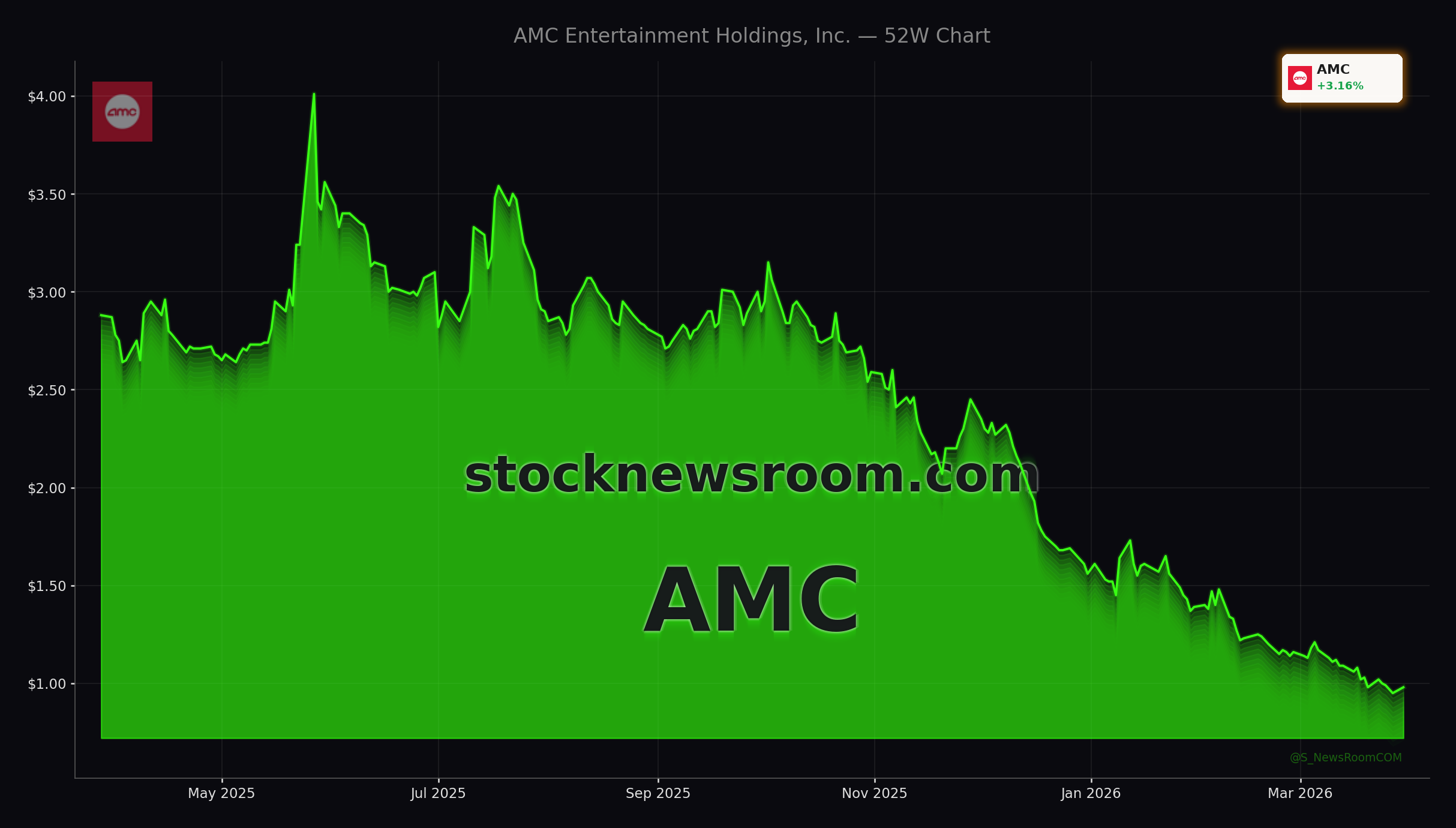
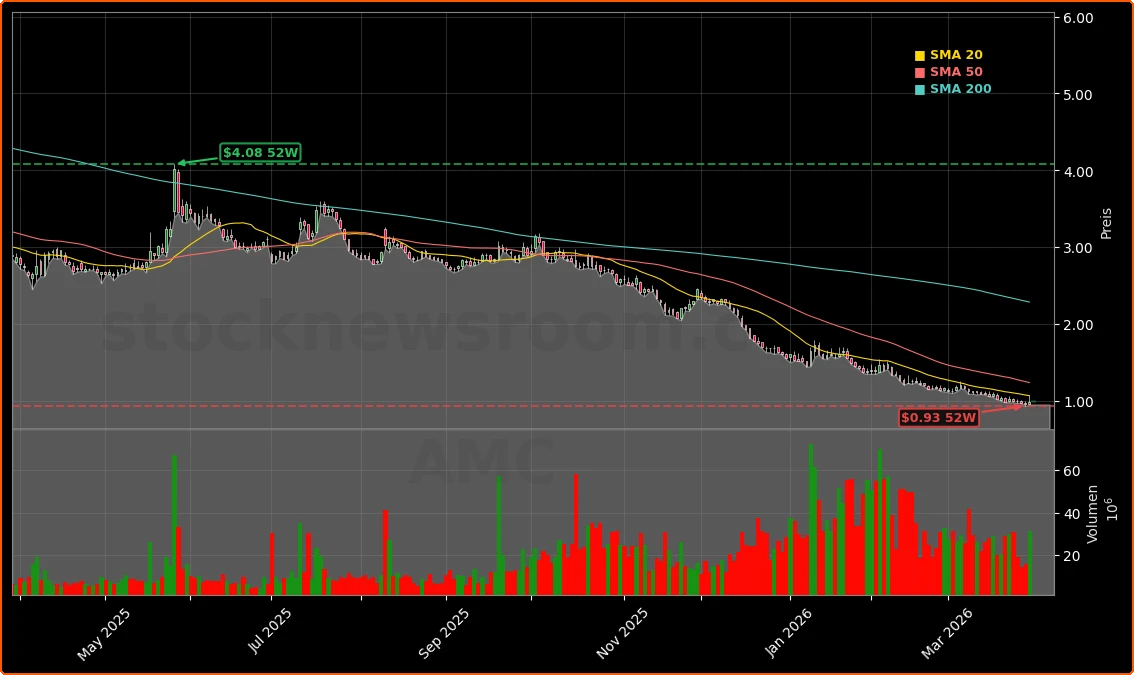
AMC Entertainment Holdings, Inc. (AMC) closed Monday’s regular session on the NYSE at $0.98, up 3.35% from the prior close of $0.95, and ticked slightly higher to $0.99 in after‑hours trading. The move came off the back of the company’s biggest opening weekend of 2026 thanks to sci‑fi release “Project Hail Mary,” which boosted admissions revenue and briefly shifted attention away from ongoing balance sheet concerns. Still, with a 52‑week range of $0.93 to $4.08, the stock remains near the bottom of its one‑year trading band and far below the levels seen during the meme‑stock peaks that once put AMC alongside names like Tesla and NVIDIA on retail traders’ watchlists.
While the latest rally highlights how hit content can still move the stock in the short term, institutional investors on Wall Street are increasingly focused on the feasibility and timing of the broader AMC Refinancing strategy, given the company’s heavy debt load and history of shareholder dilution.
What exactly did S&P change on AMC’s debt?
S&P Global Ratings lowered its issue‑level rating on AMC’s $112 million exchangeable notes due 2030 to CCC- from CCC+. The recovery rating on those notes was cut to ‘6’ from ‘4’, signaling an expectation of negligible recovery—essentially 0%—for lenders in a payment default scenario. S&P kept the CCC+ ratings and ‘4’ recovery ratings unchanged on roughly $877 million of senior secured notes due 2029 issued at Muvico LLC and AMC Entertainment Holdings, Inc., along with $360 million of 7.5% senior secured notes due 2029.
The revised analysis assumes an updated capital structure including a $2.0 billion senior secured first‑lien term loan maturing in 2029, the $112 million of rated exchangeable notes plus an additional $156 million of unrated exchangeables due 2030, $877 million of secured notes at Muvico/AMC due 2029, a proposed $425 million 10.5% first‑lien term loan at Odeon Finco PLC maturing 2031, the $360 million of 7.5% senior secured first‑lien notes due 2029, and about $126 million of subordinated notes due 2027.
In a hypothetical 2027 default scenario built around slower‑than‑expected theater attendance and a sharp shift to alternative film distribution, S&P models EBITDA at emergence of $532 million, applies a distressed multiple of 6x, and derives a net enterprise value of roughly $3.0 billion after administrative costs. Under that waterfall, first‑lien term loan creditors are expected to recover around 95%, while exchangeable and subordinated noteholders are modeled at zero recovery. This reinforces the view that the equity remains a high‑risk claim on residual value after substantial secured obligations.
How does the new AMC Refinancing plan differ?
The downgrade is closely tied to a strategic pivot in AMC Refinancing plans. Management chose not to proceed with a previously announced transaction that would have issued $1.73 billion of new senior notes and a $750 million term loan. That earlier plan would have reworked collateral provisions and aligned all first‑lien debt pari passu on AMC collateral, while giving certain new instruments and exchangeable notes a priority claim on Odeon assets, effectively reshuffling the security package across the U.S. and European operations.
Instead, AMC now intends to refinance the Odeon notes with a new $425 million senior secured credit facility at an expected coupon of around 10.5%, maturing in 2031. S&P has not yet finalized a rating on this proposed term loan. Under the revised structure, the new Odeon facility will hold a priority claim on European assets, while the existing first‑lien term loan and senior secured notes keep first‑priority claims on core AMC assets in the U.S. and Muvico. From a creditor standpoint, this preserves stronger recoveries for the core term loan and senior secured notes, but leaves the exchangeable notes structurally disadvantaged, prompting the CCC- cut.
For equity investors, the shift in the AMC Refinancing roadmap suggests management is still searching for the most viable combination of cost of capital, collateral coverage, and maturity extension in an environment where high‑yield borrowing costs remain elevated and the company’s rating sits deep in speculative territory.
What does the balance sheet look like now?
On S&P’s numbers, pro‑forma first‑lien exposure is substantial: a $2.0 billion senior secured term loan due 2029, $877 million of Muvico senior secured notes also due 2029, the $360 million AMC 7.5% senior secured notes due 2029, and the upcoming $425 million Odeon loan due 2031, all ranking ahead of subordinate and exchangeable obligations. Approximately $238 million of exchangeable notes (of which $112 million are rated) and $126 million of subordinated notes due 2027 sit below these claims.
This complex stack—spanning multiple issuing entities, different collateral pools, and staggered maturities—makes the AMC Refinancing process intricate. The company has already issued roughly 15.38 million Class A common shares as consent fees to certain selling stockholders related to Muvico exchangeable notes, a maneuver designed to secure creditor cooperation but which added incremental dilution for existing shareholders without bringing in new cash proceeds.
Legal overhang adds another complication. Multiple law firms, including Bronstein, Gewirtz & Grossman and Pomerantz LLP, have filed or promoted class‑action lawsuits tied to AMC Preferred Equity Units (APEs), alleging that a technical loophole in the APE Certificate of Designations unfairly excluded APE holders from a special dividend paid only to common shareholders. These suits create additional uncertainty around governance practices and potential future settlements, elements that bond investors and ratings agencies factor into their overall risk assessments.
How does the box office rebound change the story?
Operationally, AMC continues to benefit from a stronger release slate in 2026 after several years of pandemic and strike‑related disruptions. “Project Hail Mary” just delivered AMC’s biggest opening weekend of the year, lifting foot traffic and concessions revenue at a time when theater operators worldwide are trying to re‑establish moviegoing habits. Management has also pointed to a broader pipeline of franchise titles and premium large‑format screenings as key revenue drivers through 2026–2027.
The core question for Wall Street, however, is whether these box office gains can meaningfully outpace rent, labor, interest expense, and ongoing capital costs. The S&P default case still assumes a risk that streaming and direct‑to‑consumer releases erode traditional windowing and keep EBITDA below what is needed to comfortably service the debt pile. Compared with more diversified content and platform players such as Apple or large‑cap tech names in the NASDAQ that can leverage subscription ecosystems and hardware integration, pure‑play exhibitors like AMC remain highly sensitive to each quarter’s film slate and attendance trends.
That makes the latest movie hit an important proof point rather than a definitive turning point. Strong weekends help liquidity and near‑term optics, but they do not, by themselves, eliminate the need for further AMC Refinancing measures if credit markets stay tight or if attendance disappoints later in the year.
How are analysts and retail traders reacting?
On the sell‑side, major investment banks have already been cautious on AMC for months, citing leverage, dilution risk, and a challenging exhibition backdrop. While no fresh price‑target changes were disclosed alongside Monday’s move, the CCC- rating on the exchangeables aligns with the broader view from high‑yield desks at firms like Goldman Sachs and Morgan Stanley that AMC’s unsecured paper sits in a very high‑risk bucket and is suitable only for speculative accounts that can tolerate potential restructuring outcomes.
Retail interest remains elevated compared with most small‑cap theater peers, with trading ideas on platforms like TradingView still discussing the potential for gamma squeezes, large short‑covering moves, and multi‑dollar upside targets. That speculative backdrop echoes the 2021 meme‑stock era that brought AMC into the same conversation as Tesla and other heavily shorted names, even though the stock is now down more than 90% from its peaks and recently flirted with fresh 52‑week lows around the $1 level.
The core tension in AMC right now is that the box office is finally healing, but the balance sheet never really did.— Fictional Wall Street credit strategist
At the same time, AMC’s CEO has drawn criticism for a sometimes combative tone on social media, which some institutional investors argue distracts from the company’s core financial execution. Combined with the APE‑related lawsuits and continuing share registrations that signal ongoing dilution, this has reinforced a perception that equity holders are being used as a financing tool of last resort while the company prioritizes near‑term solvency over long‑term per‑share value.