Are new AMD AI Export Restrictions to China just noise, or a real threat to AMD’s long-term AI growth story?
AMD AI Export Restrictions: How Big Is The China Hit?
The latest headline dragging AMD lower is a potential U.S. export regime that would cap shipments of high‑end AI chips to Chinese customers. Policymakers in Washington are examining rules that would limit each Chinese firm to a combined total of 75,000 Nvidia H200 accelerators and comparable AMD parts such as the MI325. Crucially, this cap is cumulative across vendors: if a customer buys 50,000 NVIDIA chips, it could only buy around 25,000 AMD units under the proposed framework.
That is a stark cut versus the levels of demand large Chinese cloud and internet platforms have signaled. Major players like Alibaba and ByteDance have previously indicated they were looking to secure on the order of 200,000 advanced accelerators each, far above the 75,000 ceiling now under review. While NVIDIA’s larger current share in AI accelerators means it would absorb more of the direct impact, AMD is not spared. The AMD AI Export Restrictions would structurally limit AMD’s ability to use China as a volume growth lever just as it ramps its Instinct MI300‑series and forthcoming MI325 offerings.
For U.S. investors, the key question is not whether China goes to zero – it won’t – but whether constrained volumes and higher compliance friction lower the terminal growth rate and margin opportunity for AMD’s data center segment. Even with a strong U.S. and European hyperscaler pipeline, a capped China addressable market narrows the upside case that was being priced in when AI enthusiasm lifted AMD into the upper echelon of the NASDAQ winners over the past year.
Advanced Micro Devices as an AI Contender to NVIDIA
The export debate lands just as AMD is finally emerging as a credible second source to NVIDIA in AI accelerators. Historically, the first mover in a new semiconductor market often captures 70–80% share, with the second player – frequently AMD – fighting for 10–20%. That pattern has held in GPUs, where NVIDIA’s CUDA ecosystem has dominated training and inference workloads. AMD’s Instinct line is AMD’s attempt to change the narrative, targeting hyperscaler build‑outs and enterprise AI deployments with an open software stack and competitive performance per watt.
AMD’s recent financial performance reflects this pivot. In its latest reported quarter, the company delivered roughly $10.3 billion in revenue and earnings per share around $1.53, handily beating Wall Street estimates and growing the top line by more than 30% year over year. That surge was driven largely by data center and AI‑related demand rather than the more cyclical PC market. Analysts at firms such as Citigroup and Morgan Stanley have responded with upbeat commentary and raised targets, and the consensus rating on AMD currently sits at “Moderate Buy” with an average price objective in the neighborhood of $290 per share.
However, relative to NVIDIA, AMD still operates from a position of lower profitability. External comparisons of margins and returns on capital show that while AMD’s revenue growth has outpaced several legacy peers, its operating margins trail NVIDIA’s significantly. That is partly due to AMD’s need to invest heavily in both hardware R&D and the surrounding software ecosystem to catch up to CUDA. The AMD AI Export Restrictions therefore hit at an awkward time: AMD is trying to amortize a heavy investment cycle across as broad a demand pool as possible, and any forced geographic shrinkage increases execution risk.
Advanced Micro Devices in the Broader AI Supply Chain
Investors also need to view AMD within the vertical AI value chain. The most acute policy risk today sits upstream, at the level of GPUs and accelerators – exactly where AMD and NVIDIA compete. The supply chain is relatively narrow: a handful of GPU designers tap Taiwan Semiconductor Manufacturing Company’s advanced processes, which themselves rely on ASML’s lithography tools. That concentration makes export controls an effective lever for Washington to slow China’s access to cutting‑edge AI hardware.
AMD, like its peers, is thus both a beneficiary of AI demand and a target of AI geopolitics. On the demand side, AMD CPUs and GPUs already power factory robots with micrometer‑level precision, automated infrastructure inspection systems and minimally invasive surgical platforms that shorten patient recovery times. The company’s processors are moving AI from flashy software demos to tangible productivity and automation gains in manufacturing and healthcare. Partnerships with ecosystem players – from data center operators to specialized server builders – deepen AMD’s position in this “real economy” phase of AI adoption.
A recent example is Akash Systems’ launch of diamond‑cooled AI servers built around AMD Instinct MI350X GPUs. The system promises lower cooling power, higher performance per watt and improved token throughput in demanding data center environments, all of which directly boosts the economics of large‑scale AI training. Another proof point is Riot Platforms, a major Bitcoin miner that is repurposing part of its power‑rich footprint toward AI and high‑performance computing infrastructure under a data center deal with AMD. These deployments show AMD pushing deeper into vertical AI infrastructure, even as policy debates swirl around its highest‑end products destined for Chinese clouds.
Advanced Micro Devices, Institutional Flows and Valuation Risk
From a portfolio‑construction standpoint, AMD’s shareholder base remains heavily institutional, but the flows are nuanced. Several large asset managers trimmed positions in recent quarters, even as others added aggressively. The South Dakota Investment Council cut its AMD stake by roughly 15%, ending Q3 with about 144,000 shares, while Bahl & Gaynor modestly reduced its holdings. In contrast, Contrarius Group boosted its position in AMD by nearly 28%, highlighting the ongoing tug‑of‑war between profit‑taking after a furious rally and conviction that AI upside is still underappreciated.
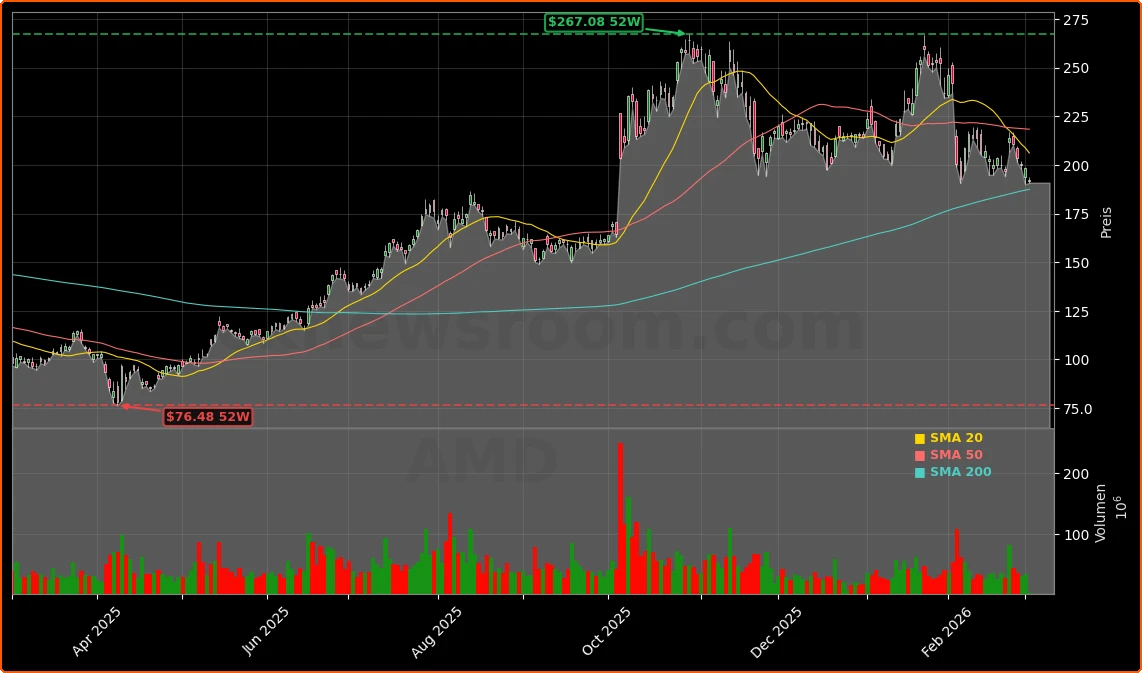
Insider activity also sends mixed signals. CEO Lisa Su and other executives have engaged in notable stock sales, which can be interpreted either as routine diversification after a strong run or as management acknowledging that near‑term valuation already bakes in a lot of good news. On Wall Street, though, the analyst community largely remains constructive. Firms like Bank of America, RBC Capital Markets and Citigroup maintain bullish or at least overweight stances, anchored by the AI data center story and an average price target in the high‑$200s, substantially above the current share price around $192.
That valuation premium comes with clear risk. AMD trades at a lofty multiple of both next‑twelve‑month earnings and sales compared with legacy chipmakers and even relative to some high‑growth software names in the S&P 500. In frameworks that compare AMD to peers such as Intel, Broadcom, Qualcomm or Marvell, AMD’s outperformance on the stock chart over the past year is undeniable, but so is its higher valuation and lower operating profitability. The AMD AI Export Restrictions insert an additional variable into this already demanding setup: if export caps materially dampen data center growth expectations, multiple compression could be painful.
Advanced Micro Devices vs. Big Tech Demand Drivers
The policy overhang arrives even as big U.S. and global tech buyers remain hungry for GPU capacity. Hyperscalers and cloud giants in the U.S., Europe and parts of Asia ex‑China continue to bulk up on accelerators to power large language models, recommendation systems and AI‑enhanced consumer products. Microsoft’s Copilot+ push into PCs, for example, has created a new category of AI‑capable client devices. AMD is leaning into this with what it bills as the world’s first Copilot+ desktop chips, extending AI processing closer to the edge and reinforcing its role in the broader AI stack.
This demand from U.S. and allied markets could offset at least part of any volume lost to the AMD AI Export Restrictions in China. Additionally, AMD has been securing domestic infrastructure wins that align with Washington’s desire to onshore more critical compute capacity. Its data center lease arrangement with Riot Platforms in Texas is one such example, positioning AMD as a beneficiary of cheap U.S. power and growing AI infrastructure investment. These dynamics reduce the company’s dependence on China, even if they do not fully neutralize the impact of tighter export regimes.
At the same time, competition for those domestic and allied budgets is fierce. Apple and other device makers are designing more custom silicon, cloud providers are experimenting with their own AI accelerators, and established chipmakers like Tesla in the autonomous driving space and various ASIC vendors are vying for niche segments. NVIDIA still commands the lion’s share of training workloads, with a deep software moat. For AMD, winning a sustainable 15–20% share of the AI accelerator market outside China could still justify a premium multiple, but the room for error narrows if one major geography is effectively capped.
Is Advanced Micro Devices Still a Buy for U.S. Investors?
Putting it all together, AMD sits at the intersection of three forces: explosive AI demand, aggressive competition and increasingly assertive U.S. industrial policy. The AMD AI Export Restrictions being contemplated do not destroy the AI thesis; instead, they reshape it. China transitions from being a potential hyper‑growth driver to a more constrained, quota‑limited market, while domestic and allied demand must carry more of the valuation load. For investors benchmarked to the NASDAQ or S&P 500, that means reassessing position size, time horizon and risk tolerance rather than abandoning the name outright.
Bulls can point to several key arguments. First, AMD’s execution under Lisa Su has been consistently strong, with repeated product cycles that closed performance gaps versus competitors and expanded the company’s addressable markets. Second, the firm’s presence across CPUs, GPUs and adaptive computing gives it multiple shots on goal in AI, from data center training to edge inference to industrial automation. Third, institutional ownership remains high and analyst sentiment from houses like Citigroup and RBC Capital Markets is generally positive, with targets implying substantial upside from current levels if AI data center growth tracks expectations.
Bears and skeptics, on the other hand, will emphasize the risks. The stock is richly valued, insider selling is non‑trivial, and AMD is still the clear number two in AI accelerators, with work to do on its software ecosystem to truly challenge NVIDIA. The AMD AI Export Restrictions add geopolitical uncertainty on top of normal competitive and execution risks. If U.S.‑China tensions escalate further, future rule sets could be even tighter than the currently discussed 75,000‑unit caps, or could broaden to other product lines and customers in adjacent regions.
For diversified U.S. investors, a pragmatic stance might be to treat AMD as a core but volatile AI exposure: position sizing should acknowledge both the upside from AI infrastructure and the downside from policy shocks. Those with shorter time horizons or low risk tolerance may prefer to wait for more clarity on the final shape of export rules and for a better entry point if the stock corrects further. Long‑term, however, as AI diffuses across industries—from smart factories to medical devices to cloud services—AMD’s role as a key silicon provider looks secure enough that the current export debate is more about calibrating expectations than abandoning the growth story.
Conclusion
In conclusion, the emerging AMD AI Export Restrictions are a meaningful new variable in the investment equation, but not a thesis killer. They cap one growth vector while leaving many others intact. Investors who believe AMD can continue taking share in data center AI, deepen its ecosystem and capitalize on domestic and allied demand may view any policy‑driven pullbacks as opportunities rather than warnings. Those wary of geopolitical risk and high valuations should proceed more cautiously, but for now AMD remains one of Wall Street’s most consequential AI hardware plays – just with a sharper policy edge than before.
Further Reading
- Advanced Micro Devices, Inc. (AMD) Quote & Profile (Yahoo Finance)
- Is Advanced Micro Devices Stock Outperforming Its Rivals? (Trefis)
- US Considers Capping Nvidia H200 Chips at 75,000 per Chinese Customer (Bloomberg)
- South Dakota Investment Council Has $23.27 Million Holdings in Advanced Micro Devices, Inc. (MarketBeat)
- Akash Systems Announces World’s First Diamond Cooled AI Servers with AMD Instinct MI350X GPUs (PR Newswire)