Can massive AMD AI Partnerships with Meta and OpenAI really rewrite the race against Nvidia in next‑gen data centers?
How do Meta and OpenAI deals change AMD?
The latest AMD AI Partnerships with Meta Platforms and OpenAI mark a structural shift in the AI infrastructure market. In October 2025, AMD signed a roughly 6‑gigawatt deployment agreement with OpenAI, followed by a similar 6‑gigawatt deal with Meta in February 2026. Both contracts are built around upcoming Instinct MI450 GPUs, sixth‑generation EPYC CPUs and the ROCm software stack, with first large‑scale deployments slated for the second half of 2026.
For Meta, the agreements are part of an “everything strategy” in AI infrastructure: buying large volumes of chips from both NVIDIA and AMD, building out its own data centers, and reserving additional capacity from neo‑cloud providers such as Nebius. Meta plans up to $27 billion in infrastructure spending over five years while cutting about 20% of its workforce to protect margins and fund these capital‑intensive projects. As part of the AMD AI Partnerships, Meta and OpenAI have also taken sizable warrant positions in AMD, aligning incentives and signaling long‑term commitment to its hardware roadmap.
Can AMD close the AI gap with Nvidia?
Even after today’s 1.68% gain, AMD stock is still down roughly 7% year to date through mid‑March, reflecting concerns over its ability to challenge NVIDIA in AI accelerators. Nvidia continues to dominate training workloads, but is effectively sold out at the high end, creating an opening for rivals. Hyperscalers eager to avoid single‑supplier risk are now actively diversifying their silicon stacks, and AMD is one of the few alternatives with scale, software and advanced packaging capabilities.
AMD’s data center segment already shows the impact of this pivot. In Q4 2025, data center revenue reached about $5.4 billion, up 39% year over year, driven by strong EPYC server CPU demand and accelerating Instinct AI deployments. The new Meta and OpenAI contracts extend that momentum, effectively locking in a multi‑year demand pipeline for MI400‑ and MI500‑class accelerators as they roll out in 2026 and beyond.
On the systems side, AMD has teamed up with Celestica on the Helios rack‑scale AI platform, designed to interconnect MI450 GPUs with high‑bandwidth networking switches for cloud, enterprise and research clusters. Helios, based on Open Compute Project standards, targets availability in late 2026 and is tailored for massive training and inference workloads. Combined with its EPYC CPU franchise, AMD is positioning as a full‑stack infrastructure provider rather than a pure chip vendor.
What are analysts and rivals signaling?
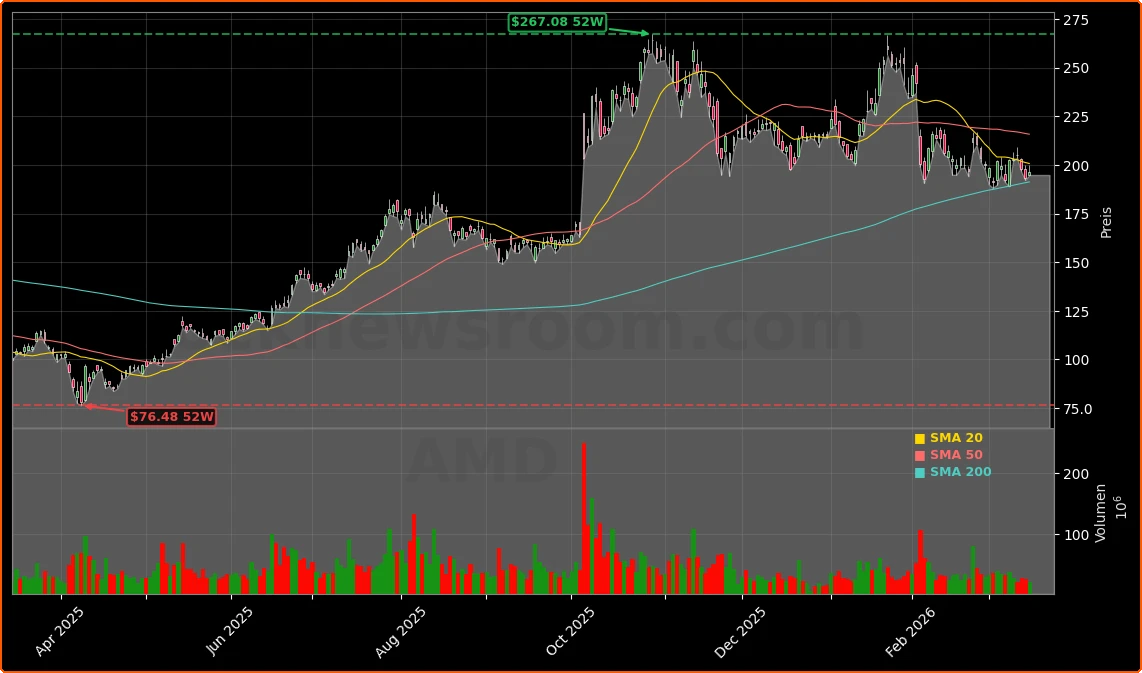
Wall Street’s view on AMD remains broadly constructive despite volatility. Truist Securities recently reiterated its Buy rating with a $283 price target, pointing to the Meta deal and expanding AI footprint. RBC Capital Markets keeps a Hold rating with a $230 target, highlighting rich valuation but acknowledging the strategic importance of AMD’s growing AI backlog. Other research houses have stressed that pullbacks toward key moving averages could be attractive entry points for investors who believe in the durability of the AI cycle.
Broader ecosystem signals also support the thesis that AMD AI Partnerships are riding a secular wave. Memory specialist Micron expects triple‑digit DRAM growth tied to demand from customers including NVIDIA and AMD, underscoring how AI accelerators drive pull‑through across the stack. Server maker SuperMicro has surged to become a top server vendor as it builds AI‑optimized systems around AMD chips, particularly for on‑premise agentic AI use cases where enterprises want cloud‑class performance on their own infrastructure.
The AI train keeps rolling, and AMD has become one of the core names investors are watching as we enter the next phase of the infrastructure cycle.
— Unnamed Wall Street portfolio manager
Conclusion
Risks remain. Insiders at AMD have sold roughly $33 million of stock in recent months, and new GPU competitors in China and in‑house chip efforts at players like Meta could limit long‑term pricing power. Still, AMD’s recent multi‑year IP agreement with Adeia, which settles prior disputes and expands access to advanced semiconductor IP, reduces legal overhang and gives more flexibility in future chip designs. For diversified U.S. investors with exposure to mega‑cap tech and AI, AMD now represents a more credible second source to NVIDIA and a leveraged play on hyperscaler capex.
Further Reading
- Advanced Micro Devices, Inc. (AMD) on Yahoo Finance (Yahoo Finance)
- AMD stock surge as analysts stay bullish on AI demand (Invezz)
- Celestica, AMD partner for ‘Helios’ rack-scale AI platform (TipRanks)
- Advanced Micro Devices (AMD) Ties Up With Adeia in a Multi-Year IP License Agreement (Insider Monkey)
- Advanced Micro Devices Has Sold Off. Here’s Why the Bull Case Isn’t Broken. (The Motley Fool)