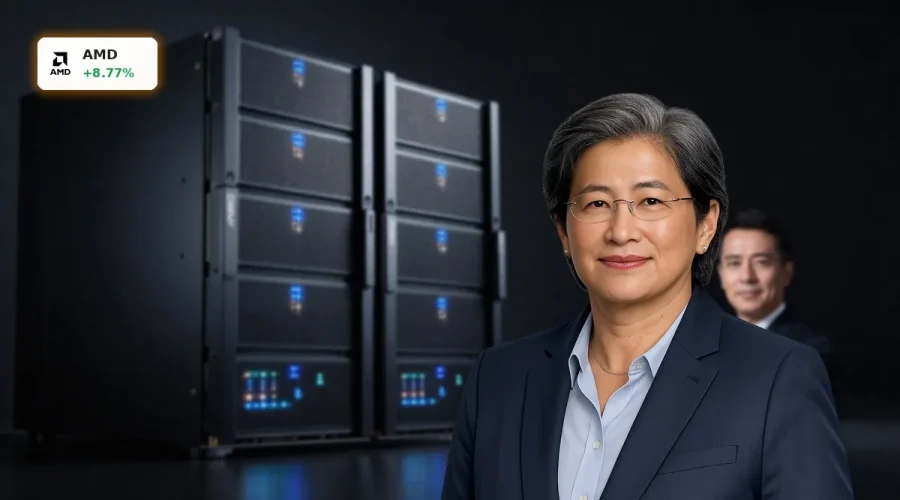
Can the massive AMD Meta-Deal break NVIDIA’s dominance in the AI chip market and permanently elevate the stock to new price levels?
What is behind the AMD Meta-Deal?
At the center of the AMD Meta-Deal is a multi-year purchase commitment from Meta for specialized AI chips and complete data center systems from AMD. The volume ranges from approximately $60 billion to over $100 billion over a five-year period, depending on the source. Meta aims to integrate up to six gigawatts of GPU power into its AI data centers—a scale equivalent to the output of several nuclear power plants. The technical foundation consists of Meta-adapted MI450 GPUs, as well as new Venice and Verano CPUs and the Helios rack system, which allows AMD to deliver complete AI server racks from a single source.
Particular attention from the market is focused on the equity component: Meta will receive performance-based warrants to purchase up to 160 million AMD shares. If fully exercised, this would correspond to about 10% of the company, potentially making Meta the largest single shareholder. The exercise prices are partly symbolic at one cent but are tied to delivery volumes, technical milestones, and price levels.
How is the market reacting to AMD?
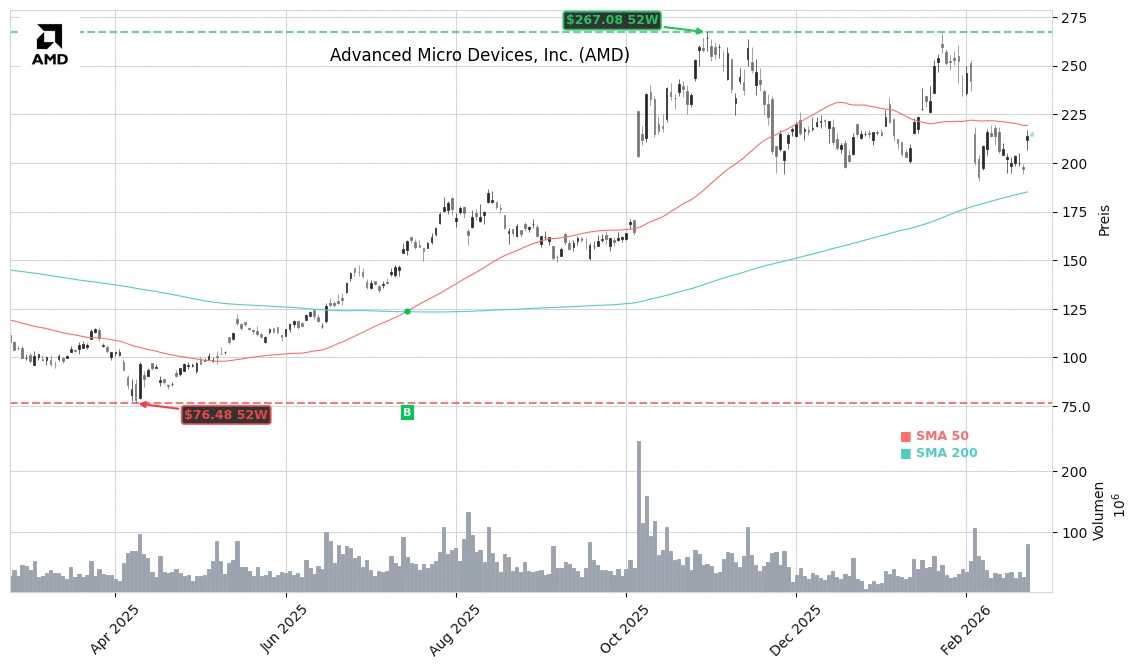
The stock of AMD surged by approximately 9% following the announcement of the deal and is currently trading at $213.84, with a slight increase in pre-market trading to $215.15. This brings the value closer to the recent price range where analysts see price targets between $240 and $300. Importantly, despite the rally, this does not represent a new all-time high, as the price remains below previous peaks of the stock.
The sector is benefiting broadly. The semiconductor index recently marked record levels, and suppliers such as network and testing equipment providers have also seen significant gains after it became clear that the CapEx boom for physical AI infrastructure remains unbroken. At the same time, some network players like Arista Networks have observed short-term profit-taking, even though the expansion of hyperscaler data centers promises long-term tailwinds.
For existing AMD shareholders, the main concern is dilution from the potential new shares for Meta. However, experts emphasize that the margin and cash flow leverage of the deal should more than compensate for the dilution, provided AMD fulfills its delivery commitments profitably.
How does the AMD Meta-Deal change the AI chip market?
Strategically, the AMD Meta-Deal is a direct challenge to NVIDIA’s dominance in the AI GPU space. Just the week before, Meta announced an expanded partnership with NVIDIA and is now clearly opting for a multi-vendor approach. The goal is to reduce dependence on a single manufacturer, optimize costs, and avoid supply bottlenecks. AMD is thus positioning itself as a serious alternative in the high-end segment.
Analysts see a structural advantage for AMD in the combination of GPUs, CPUs, and complete Helios racks. Morningstar, for example, states that AMD is on track to unlock up to $100 billion in AI revenue over the next few years and has raised the fair value of the stock to $300. Wolfe Research also maintains an “Outperform” rating with a price target of $300. Experts emphasize that the majority of future Meta revenues are not yet factored into current consensus estimates for 2027.
The deal also enhances AMD’s creditworthiness, as recurring large orders from hyperscalers like Meta increase the predictability of revenue and cash flows. At the same time, this move signals to other cloud providers that there is a scalable alternative to NVIDIA—an argument that AMD has already leveraged with a similarly structured agreement with OpenAI.
What opportunities and risks do analysts see for AMD?
While firms like Morningstar and Wolfe Research are very optimistic, more skeptical voices point to dilution risks and the enormous execution pressure. A key factor will be whether AMD can deliver the promised six gigawatts of GPU power on time and in the required quality. Only then will the warrants tied to revenue and technical milestones for Meta become fully relevant.
Schwab Network highlights in a recent analysis that the deal illustrates two worlds of AI: training base models and subsequent mass-scale inferencing. AMD could excel in both areas with the Helios system, thereby securing a lasting foothold in the AI data center market. At the same time, NVIDIA remains the clear market leader, indicating that an oligopoly of a few large providers is emerging.
„Meta has significantly accelerated in the AI race—the AMD deal is a clear vote of confidence in AMD’s AI hardware and delivery capability.”
— Matt Britzman, Hargreaves Lansdown
Bottom Line
The AMD Meta-Deal marks a turning point for Advanced Micro Devices, Inc. and firmly elevates the company into the top tier of AI infrastructure providers. For investors, the combination of massive order volume and potential Meta stake, despite dilution risks, presents an attractive growth profile. For those who believe in a sustained AI investment cycle, AMD remains one of the most exciting large-cap bets in the technology sector.
Related Sources
- Advanced Micro Devices, Inc. (AMD) on Yahoo Finance (Yahoo Finance)
- AMD shares jump 8% on $100B+ AI chip deal with Meta (SiliconANGLE)
- AMD: AI Infrastructure Shift Could Turn It Into A Cash Cow (Seeking Alpha)
- AMD Is Making Moves to Get $100 Billion of AI Revenue in the Next Few Years (Morningstar)
- Meta Just Made a Massive AI Chip Bet—And It’s Not on Nvidia (Inc.com)