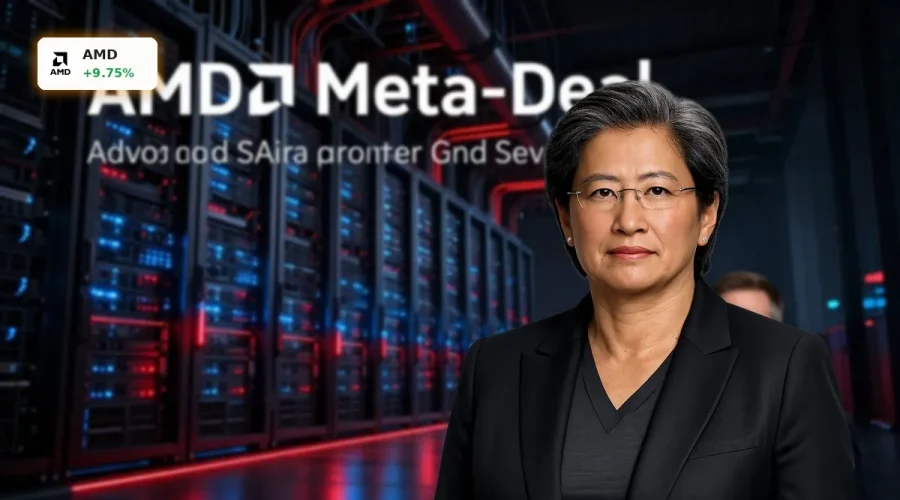
Can the massive AMD Meta deal worth billions and gigawatts of AI power overshadow the current stock decline?
What is behind the AMD Meta Deal?
As part of the AMD Meta Deal, Meta commits to purchasing data center hardware from AMD over the next five years—primarily AI accelerators from the Instinct series and EPYC server processors. The volume of the agreement amounts to up to $60 billion, securing long-term capacity for Meta’s AI initiatives. Concurrently, the Facebook parent company receives warrants for up to 160 million shares of AMD common stock, which can be gradually exercised upon reaching specific technical, commercial, and price-related milestones.
AMD will initially deliver 1 gigawatt of GPU power, with the first tranche of warrants maturing at this threshold. In subsequent phases, capacity is expected to increase to 6 gigawatts. The GPU systems are based on the upcoming Instinct MI450 generation and are set to go live in the second half of 2026. They are optimized for Meta’s specific AI workloads, particularly for inference, which involves executing already trained models.
How does AMD benefit operationally from Meta?
The AMD Meta Deal goes far beyond a mere supply agreement. Both companies are closely aligning their roadmaps for GPU and CPU silicon, systems, and software. At the core of the infrastructure is the Helios Rack-Scale Architecture, developed collaboratively under the Open Compute Project, which combines Instinct GPUs with EPYC CPUs. Notably, the 6th generation EPYC processors, codenamed “Venice” and “Verano,” are designed for maximum performance per dollar and per watt in Meta’s data centers.
Financially, AMD expects a substantial multi-year revenue growth from the partnership, which aims to enhance non-GAAP earnings per share. CFO Jean Hu emphasizes that the performance-based structure closely links the interests of AMD and Meta, creating incentives for rapid scaling of AI platforms. The deal follows a similar agreement with OpenAI and underscores AMD’s strategic ambition to catch up with primary competitor NVIDIA in the AI accelerator market.
How is the market reacting to AMD and Meta?
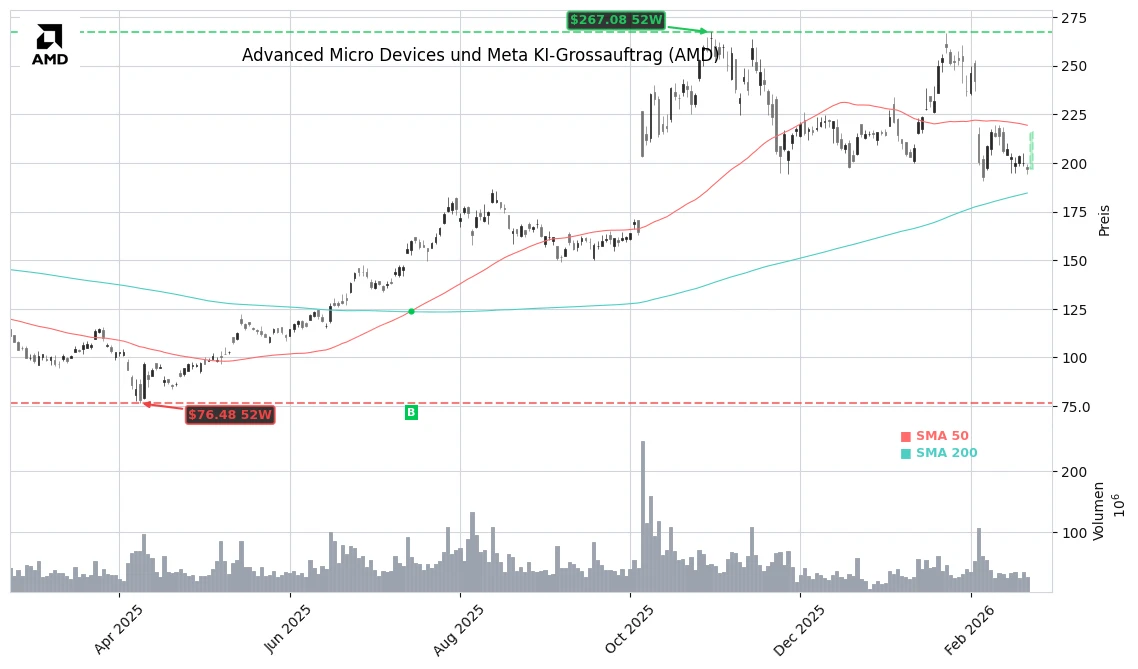
The market is celebrating the AMD Meta Deal: After a closing price of $196.60 the previous day, the stock is trading pre-market at around $215.76, a nearly 10% increase. In early trading, fluctuations of up to 14% were reported. This brings AMD closer to its recent highs, although it cannot yet be considered a new all-time high unless the price clearly exceeds the previous 52-week peak.
Analysts had already positioned AMD strongly in the AI context ahead of this announcement. Firms like Goldman Sachs, Morgan Stanley, Citigroup, and RBC Capital Markets have identified the company as a key beneficiary of the growing AI investments from hyperscalers. The AMD Meta Deal supports this thesis and could lead to further price target increases in the coming days, especially as AMD has now secured multi-year supply agreements with several industry heavyweights.
What does the AMD Meta Deal mean for the AI chip market?
Strategically, the AMD Meta Deal sends a clear signal in the race against NVIDIA. Just days ago, Meta announced plans to integrate millions of NVIDIA GPUs into its AI platforms over the coming years. The collaboration with AMD complements this setup and reduces dependence on a single vendor—a crucial point given global shortages of high-performance chips.
For AMD, Meta represents another prominent anchor customer, following OpenAI, that secures the utilization of future product generations like MI450 for years to come. Additionally, the close co-development of inference-optimized GPUs and custom EPYC CPUs is likely to yield technological advantages that AMD can market to other customers. Given an expected AI investment volume from major tech companies of over $600 billion this year, the deal strengthens AMD’s position at the center of this capital influx.
This multi-year, cross-generational collaboration places AMD at the heart of global AI expansion.
— Dr. Lisa Su, CEO of AMD
Bottom Line
The AMD Meta Deal positions AMD as a key supplier in one of the industry’s largest AI implementations, creating significant multi-year revenue visibility. For investors, this substantially enhances the credibility of the growth narrative in the AI business. The crucial factor now will be whether AMD can meet its ambitious delivery and technology milestones—if successful, the stock could further benefit from sustained strong AI demand.
Related Sources
- Advanced Micro Devices (AMD) Stock Overview (Yahoo Finance)
- AMD clinches second mega chip supply deal, this time with Meta (Reuters)
- Meta and AMD just announced another blockbuster chip deal (Business Insider)
- AMD Stock Surges After AI Chip Maker Agrees Meta Deal (Barron’s)