Is the Apple AI Strategy a late, risky bet or a capital-efficient way to cash in on the AI boom?

Why is Apple falling as AI spending explodes?
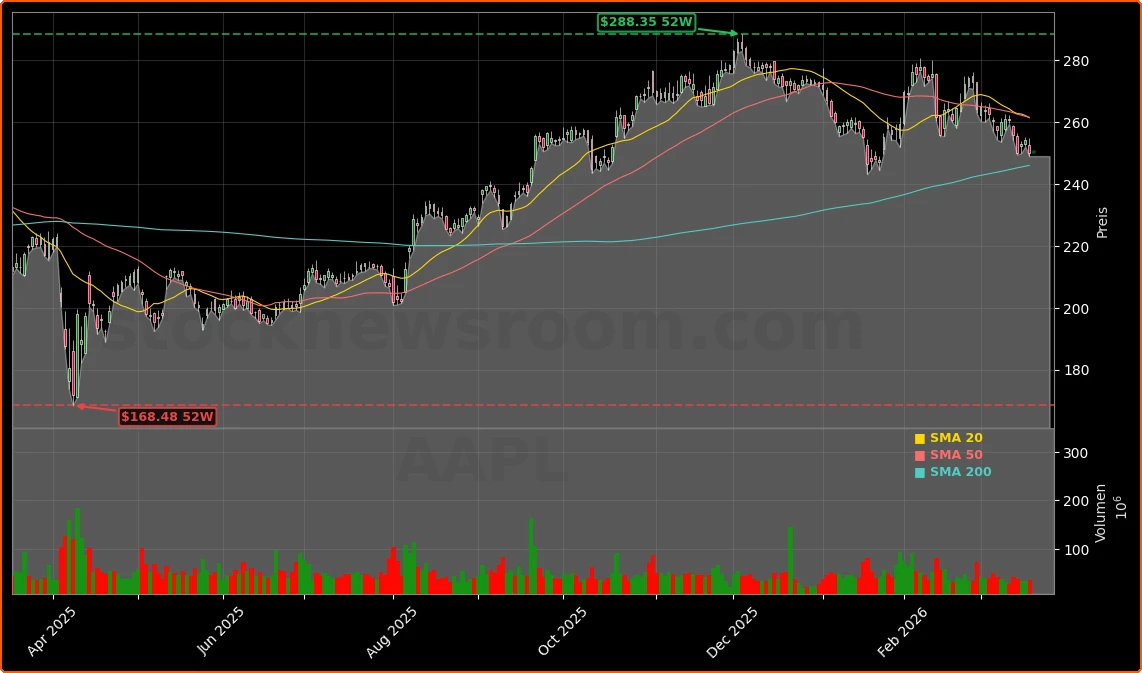
Apple (AAPL) closed Wednesday at $249.94, down 1.69% and slipping below the closely watched 200-day simple moving average, turning a months-long support zone into resistance. The move reflects a mix of macro risk-off sentiment, concern over a massive $600 billion four-year investment plan, and frustration about Apple’s slower visible progress in AI compared with cloud-heavy peers like NVIDIA and Tesla. With the stock roughly 7% lower year to date and trading well below consensus price targets, the selloff looks more like a sentiment reset than a collapse in fundamentals.
Wall Street remains broadly constructive. Across 24 analysts, the average Apple price target sits around $304–$305, implying more than 20% upside from current levels. Wedbush’s Daniel Ives, one of the most vocal bulls, sees Apple’s 2026 story defined by AI, arguing that this is finally the year the company enters the “AI revolution” in a visible way. Major houses including Goldman Sachs, Evercore ISI, Bernstein, Bank of America and Morgan Stanley all maintain price targets between $315 and $340, reinforcing the view that the recent breakdown is technical rather than thesis-shattering.
How does the Apple AI Strategy actually make money?
Despite lacking a blockbuster chatbot of its own, the Apple AI Strategy is already generating real revenue. Generative AI apps distributed through the App Store paid nearly $900 million in fees in 2025, and Apple is on pace to surpass $1 billion in AI-related revenue this year. Roughly three-quarters of those App Store fees come from OpenAI’s ChatGPT, with xAI’s Grok a distant second, showing how Apple’s control of premium devices lets it tax other companies’ AI success.
This “toll road” model is central to the Apple AI Strategy. Rather than matching hyperscalers’ capex — where cloud providers are guiding to nearly $700 billion in AI-related spending this year — Apple is spending a fraction of that and leaning on its installed base of 2.4 billion iOS devices. The focus is on on-device intelligence powered by in-house silicon and user data, not giant cloud models. Investors like Charles Rinehart of Johnson Asset Management argue that this may ultimately prove more capital-efficient: Apple collects high-margin services revenue while avoiding the overbuild risks that companies with large cloud businesses face.
That approach gained further validation when Apple inked a roughly $1 billion deal to use Alphabet’s Gemini large language model instead of rushing to build a comparable cloud model from scratch. For many on Wall Street, the deal shows Apple can bolt best-in-class AI onto its ecosystem without shouldering NVIDIA-scale infrastructure bills.
What about Siri, Gemini and the AI perception gap?
The weak spot in the Apple AI Strategy is perception. Siri still runs on dated technology, struggles with conversational memory and cannot match the research or content creation capabilities of modern chatbots. Years of slow progress helped drive the announced departure of top AI executive John Giannandrea, reinforcing worries that Apple is behind on core AI talent and execution.
To close that gap, Apple and Google plan to launch a new Siri powered by Gemini later this year. Developers and consumers are watching closely, as a successful rollout could instantly reposition the iPhone as a front-end to cutting-edge AI while keeping processing as close to the device as privacy and latency allow. The delay of a smart home display, reportedly due to integration issues with next-generation Siri, underscores both the stakes and the challenges of turning strategy into shipping products.
Even so, Apple’s device moat buys time. OpenAI’s attempts to create its own hardware after hiring former Apple designers, and Elon Musk’s flirtation with and retreat from building a phone, highlight how difficult it is to replicate Apple’s ecosystem. It may ultimately be easier for Apple to deliver competent AI than for AI labs to displace the iPhone as the primary consumer platform.
Is China’s smartphone war offsetting AI concerns?
While investors debate the Apple AI Strategy, China is quietly becoming a bright spot in the equity story. iPhone sales in China jumped 23% year over year in the first nine weeks of 2026, even as the broader smartphone market shrank 4%. Online discounts and government subsidies on the base iPhone 17 have helped, but Apple’s tight supply chain and willingness to absorb higher memory costs rather than raise prices are also key. That contrasts with Android rivals like OPPO and vivo, which are pushing through price hikes and potentially ceding share.
Used-device dynamics are reinforcing this trend. Chinese consumers chasing new AI tools such as OpenClaw are bidding up prices for secondhand Macs and Mac minis, particularly machines with Apple’s latest M4 and M5 chips. ATRenew, a major refurbisher working with Apple and JD.com, reports that spring pricing for used Apple hardware is holding near peak-season levels, and trade-ins from older M1 and M2 machines are accelerating. This suggests Apple’s silicon roadmap is well aligned with on-device AI demand, even if the software narrative lags.
In the U.S. market, carriers like AT&T, Verizon and T-Mobile are intensifying device promotions as customers roll off 36‑month financing plans. Apple kept iPhone 17e pricing largely flat year over year and even cut the 512GB variant by $100, forcing carriers to lean on non-subsidy levers while Samsung raised prices on its Galaxy S26 line. That strategy should help Apple defend share in premium smartphones on both sides of the Pacific.
Related coverage: How does this fit the bigger AI picture?
For investors tracking the evolving Apple AI Strategy, it is worth comparing today’s developments with deeper dives on how Apple could monetize a $1 billion AI run-rate while its stock slips. In our recent analysis “Apple AI Strategy Warning: $1 Billion Boom As Stock Slips”, we explored whether Apple’s quieter, on-device focus risks letting cloud rivals like NVIDIA run away with the upside. Taken together, these pieces suggest that Apple’s true AI opportunity may lie less in headline-grabbing chatbots and more in embedding intelligence across an ecosystem of 1.5 billion iPhones and beyond.
The time is now for Apple to accelerate its AI efforts with the largest consumer installed base in the world.— Daniel Ives, Wedbush Securities
Ultimately, the Apple AI Strategy combines a capital-light toll road on third‑party models, a bet on on-device processing and a resurgent China hardware story at a time when the stock has broken a key technical level but not its fundamental narrative. For long-term investors in the NASDAQ and S&P 500, the current drawdown looks more like a consolidation phase than a structural break. The next Siri upgrade cycle and further clarity on AI features at upcoming product launches will show whether Apple can turn its strategic patience into visible AI leadership.