Can Apple’s MacBook Neo strategy turn the low-end laptop market into its next big growth engine—or just squeeze margins?

Is Apple’s budget push a new growth driver?
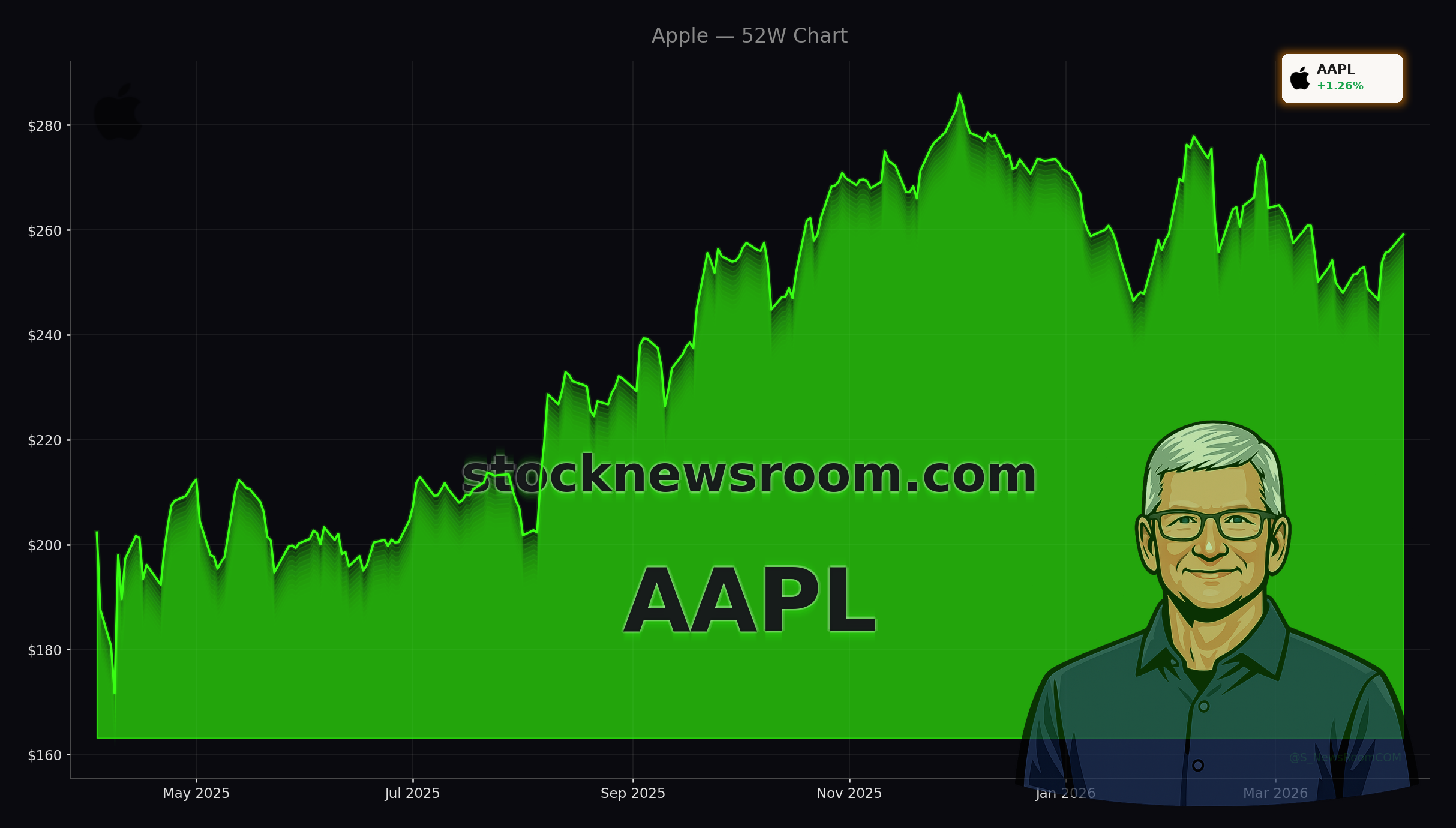
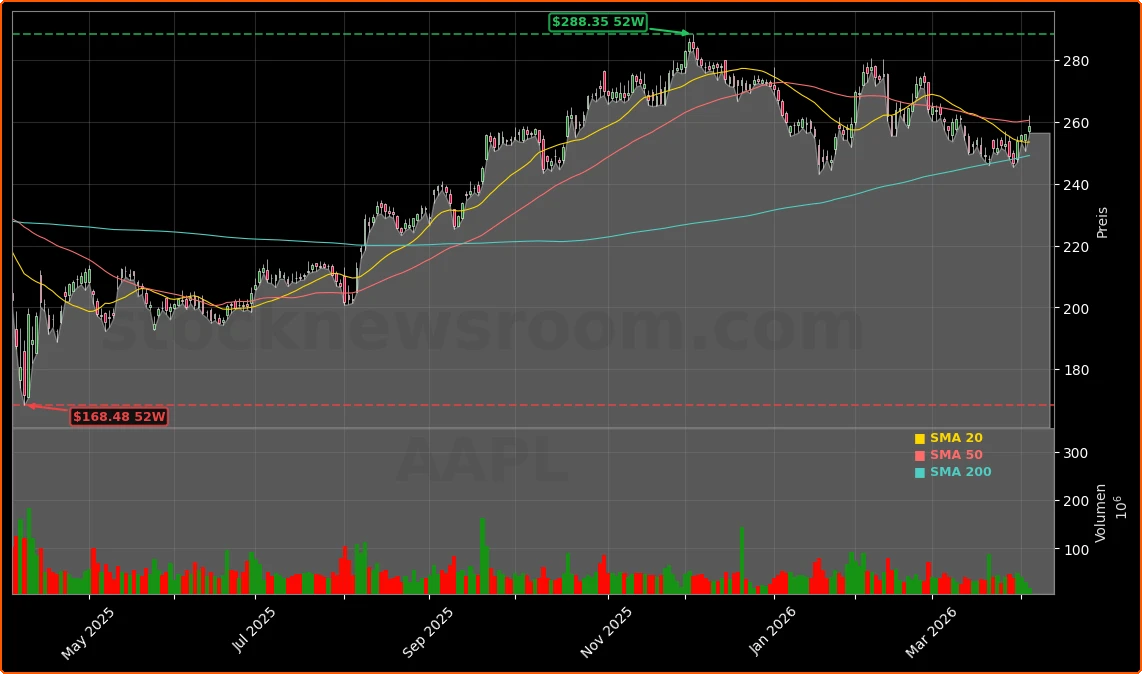
At roughly $258.70 in Monday trading, up about 1.3% intraday and modestly above the prior close of $255.35, Apple Inc. (AAPL) is showing relative strength against parts of the NASDAQ mega-cap complex. The stock briefly probed the $260 area, an important technical zone near its 50-day moving average, as traders weigh whether the Apple MacBook Neo Strategy and firmer iPhone 17 demand signals can support the next leg higher. Options and prediction markets currently assign roughly even odds to a close above $265 in the near term, underscoring how tightly the stock is trading around key resistance.
Technicians are watching the 50-day and 100-day moving averages as near-term battle lines. A decisive close above the low-$260s, followed by a hold on any pullback, would strengthen the case that Apple can rebuild momentum within the NASDAQ-100 and S&P 500 after a choppy first quarter for big tech.
How does MacBook Neo change Apple’s PC game?
Bank of America has put the Apple MacBook Neo Strategy front and center in its bullish thesis, reiterating a Buy rating and a $320 price target, implying roughly 24% upside from current levels. The new MacBook Neo family is Apple’s first serious attempt to target lower-end notebook buyers, a segment where its unit share is currently estimated at less than 1%. With education and base models starting near $499 and higher-tier configurations around $699, Neo comes in well below historic MacBook price points that began at $1,099 and higher.
Bank of America pegs the total addressable market for Neo at about $32 billion, or 64 million units, in calendar 2026. Even a 10% slice of that market could add around $0.03 in incremental EPS. While that may sound small in isolation, it represents a new on-ramp into Apple’s ecosystem, especially in education, emerging markets, and among cost-conscious Windows switchers who previously saw Macs as out of reach.
Strategically, Neo is designed to complement—not cannibalize—the higher-margin MacBook Air and Pro lines. By positioning Neo as an entry-level device with tight integration to iCloud, Apple Music, and other services, Apple is betting that a broader hardware footprint will translate into higher recurring services revenue and ecosystem stickiness over time.
Where does AI fit into Apple MacBook Neo Strategy?
The Apple MacBook Neo Strategy does not exist in isolation; it is unfolding alongside a much larger AI repositioning. Despite perceptions that Apple is lagging behind NVIDIA-powered cloud players and hyperscalers in the AI arms race, Cupertino is quietly wiring its devices for a mix of on-device and cloud AI. A recent deal to integrate Google’s Gemini models into Siri is expected to be a highlight of the June developer conference, where Apple is widely anticipated to showcase a more capable AI assistant that can tap into multiple models, including ChatGPT, while keeping the user experience inside iOS and macOS.
On the hardware side, Apple is reportedly experimenting with AI-centric wearables such as smart glasses that can pair with iPhones and Macs to deliver context-aware assistance. If Neo ships with AI-optimized Apple silicon and is marketed as an affordable AI-ready laptop for students and knowledge workers, it could accelerate an upgrade cycle just as Microsoft and PC OEMs roll out their own AI PCs.
For investors, the key question is whether Apple’s relatively modest $12–$15 billion in annual capex, far below Microsoft’s $160 billion AI build-out plan, is enough to defend share against Android and Windows ecosystems that are racing to embed generative AI into every workflow.
How does Apple stack up versus other tech leaders?
Within the NASDAQ-100, Apple remains a core holding for institutional portfolios alongside names like Tesla and major semiconductor players. Berkshire Hathaway’s Warren Buffett, despite trimming his stake in recent years, still calls Apple Berkshire’s largest equity position and has signaled he is comfortable with that concentration at current valuations. Other mega-cap tech names have leaned heavily into capex-intensive cloud AI, while Apple is playing a different game: maximizing its massive installed base of roughly 1.5 billion iPhones and about 260 million Macs by upselling hardware, services, and accessories.
Recent data on iPhone 17 panel shipments suggests demand tracking ahead of prior cycles, bolstering the view that Apple’s premium brand remains intact even as Android rivals push aggressive AI features. Combined with the Apple MacBook Neo Strategy and potential foldable devices on the horizon, the company is positioning itself not just as a high-end hardware vendor but as an ecosystem designed for AI agents that live on edge devices rather than solely in the cloud.
What other risks and tailwinds should investors watch?
Regulatory and geopolitical risks remain part of the story. Apple is preparing another U.S. Supreme Court appeal in its long-running App Store dispute with Epic Games over commissions and payment rules, a case that could eventually impact services margins. In China, Apple recently removed a decentralized messaging app from its local App Store at the request of regulators, highlighting the tightrope it walks in one of its most important markets. At the same time, legal overhang from older patent battles is easing, with recent rulings closing out some legacy headphone-related claims involving multiple manufacturers.
On the positive side, inclusion in vehicles like the Invesco QQQ ETF keeps Apple tightly linked to the broader AI and growth trade that is driving NASDAQ performance. Asset managers such as BlackRock are rolling out competing Nasdaq-100 products that will also feature Apple as a top holding, ensuring steady passive demand for the shares as long as big-tech continues to anchor benchmark indices.
Related Coverage
Investors tracking Apple’s hardware roadmap beyond laptops may want to review how its satellite connectivity plans intersect with competitive pressures in space-based communications. An in-depth look at this angle is available in “Apple Satellite Strategy Warning as $1.5B Globalstar Bet Faces Test”, which examines whether rivals like Amazon could complicate Apple’s partnership with Globalstar. For a broader semiconductor backdrop to Apple’s AI ambitions, the analysis in “Broadcom AI Forecast: $100B Boom Warning for 2027” explores whether anticipated chip demand through 2027 is sustainable or at risk of over-exuberance.
The Apple MacBook Neo Strategy signals a rare move down-market that could expand Apple’s user base, reinforce its services engine, and give investors a fresh earnings lever beyond iPhone cycles. With the stock holding above key technical support and major banks like Bank of America staying bullish, the next few quarters will test whether Neo, AI upgrades to Siri, and new form factors can justify higher multiples. For long-term shareholders, the combination of ecosystem depth and emerging AI hardware may keep Apple a cornerstone position in tech-heavy portfolios.