
Can Apple Maps Advertising turn a record quarter and new AI products into the next multi‑billion‑dollar growth engine for Services?

How big could Apple Maps Advertising become?
Apple Maps Advertising launches this summer in the U.S. and Canada, allowing any brick‑and‑mortar business with an Apple Maps listing to bid for a single, clearly labeled ad slot above organic results. The format mirrors Google Maps and App Store ads: an auction system where advertisers only pay for desired actions such as views or taps. Pins will show a subtle blue halo and an “Ad” label in Suggested Places, aimed at preserving user trust and keeping the experience uncluttered.
Strategically, this is a textbook incremental revenue move. Apple already has over 2.5 billion active devices, and Maps is pre‑installed on every iPhone, iPad and Mac. Local intent searches—”coffee near me,” “pharmacy,” “EV charger”—are among the most monetizable in digital advertising. Even modest adoption could add billions in high‑margin Services revenue over time, particularly as ad tools expand globally.
Privacy is the differentiator. The company emphasizes that location and ad interaction data are not tied to a user’s Apple ID, and personal data is processed on‑device rather than stored on Apple’s servers or shared with third parties. For advertisers, that means fewer granular behavioral signals than on Meta or Google, but a brand‑safe, premium context on some of the highest‑spending consumers in the world.
What does this mean versus Google and Meta?
By pushing into Apple Maps Advertising, the iPhone maker is stepping directly into a local‑ads business long dominated by Alphabet’s Google and, to a lesser extent, Meta Platforms. Google Maps has spent years monetizing local search with promoted pins and sponsored listings, while Meta leans on Instagram and Facebook for geo‑targeted campaigns. Apple is effectively saying it wants a share of those local marketing budgets—but on its own privacy terms.
The timing matters. App Store commissions and the multibillion‑dollar Google search‑default deal are both under heavy regulatory pressure in Europe and the U.S. At the same time, generative AI is shifting how people search, potentially weakening traditional web and app‑based search funnels. A homegrown local ads business inside Maps diversifies away from those risks and keeps monetization close to the device layer where Apple has the most control.
Compared with AI‑heavy peers like NVIDIA or Meta, Apple is keeping capital intensity low. It is monetizing AI indirectly—via App Store fees on tools like ChatGPT and Services upsells tied to Apple Intelligence—rather than building massive AI data centers. Local ad auctions in Maps fit that same light‑asset, high‑margin pattern.
How strong were Apple’s latest earnings?
Financially, Apple Inc. is coming off what CEO Tim Cook called “a remarkable, record‑breaking quarter.” For fiscal Q1 2026, revenue hit $143.76 billion, up 15.65% year over year and about 3.8% above consensus estimates. Earnings per share of $2.84 beat expectations by more than 6%. iPhone revenue surged 23.3% to a record $85.27 billion, with all‑time highs across every geography, including Greater China jumping to $25.53 billion from $18.51 billion.
Services, now including advertising, posted an all‑time record of $30.01 billion, up 14% year over year. That growth is crucial because Services carry structurally higher margins than hardware and provide recurring revenue. Operating margin is running near 35%, supported by lean AI capex of about $2.37 billion in the quarter and aggressive capital returns—roughly $24.7 billion in buybacks.
On valuation, Apple trades around 31–32 times trailing earnings, a premium to the S&P 500’s roughly mid‑20s multiple and above its own 10‑year average near 25x. Some commentators argue that leaves little room for multiple expansion unless Apple proves AI and Services can sustain double‑digit growth. KeyBanc recently reiterated a Sector Weight rating after updating its 2026–2027 models, signaling it does not see a near‑term catalyst but also isn’t overly concerned about margin pressure.
How do AI and MacBook Neo fit the thesis?
Apple’s AI platform, branded Apple Intelligence, is designed to run on its in‑house chips in recent iPhones, iPads and Macs. The suite helps users summarize messages, draft emails, generate images, and prioritize notifications, all largely on‑device. A strategic partnership with Alphabet on next‑generation foundation models should enhance these features without forcing Apple to match hyperscaler data‑center spending.
On the hardware side, the new MacBook Neo is a key ecosystem play. The 13‑inch laptop, powered by the A18 Pro chip and priced at $599—or $499 for students—targets the low‑end notebook and education segments historically dominated by Chromebooks and budget Windows PCs. Analysts argue the pricing is a “gut punch” for rivals, since Windows OEMs face rising component costs that could push their average system prices from about $850 to more than $900, while Apple can still protect margins.
In education, Apple’s prior average selling price near $1,425 limited share to around 5% of the segment. By cutting entry pricing below $500 for students, Apple lowers the barrier dramatically and positions MacBook Neo as a gateway into its higher‑margin ecosystem—iPhone, Apple Watch, iCloud, Apple Music, and now Apple Intelligence‑enabled services. That dynamic could reinforce the Services growth that underpins both the AI story and future Apple Maps Advertising demand from small businesses.
How are analysts and investors positioning?
On Wall Street, sentiment remains broadly constructive but valuation‑aware. Rosenblatt Securities recently raised its price target on Apple to $268, pointing to new lower‑end devices like MacBook Neo and a rumored iPhone 17e as tools to expand the installed base. A separate 24/7 Wall St. model pegs a 12‑month target at $303.45, implying roughly 20% upside from current levels and rating the stock a Buy with high confidence. Consensus among roughly four dozen analysts clusters near $295, with a majority at Buy or Strong Buy.
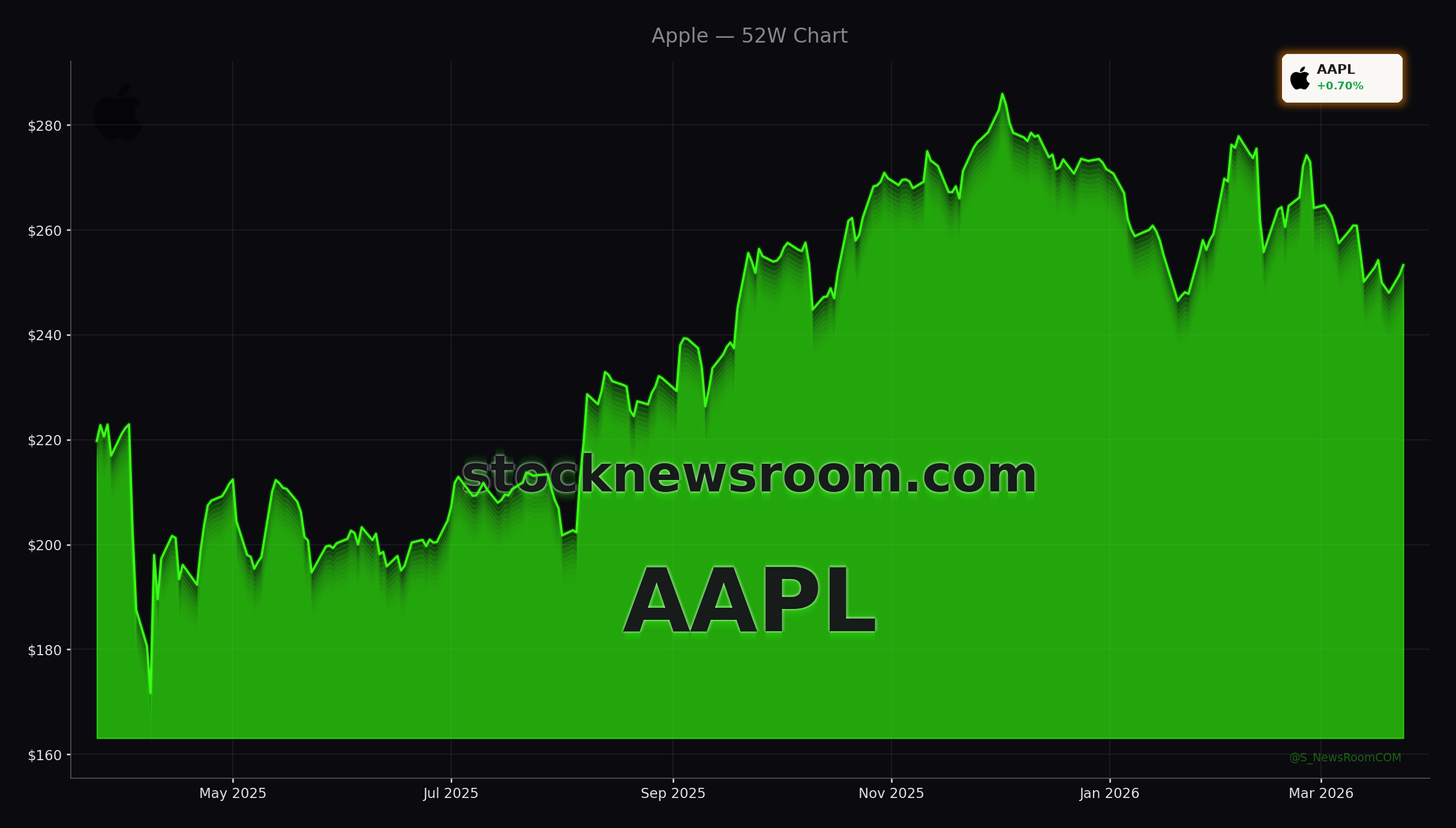
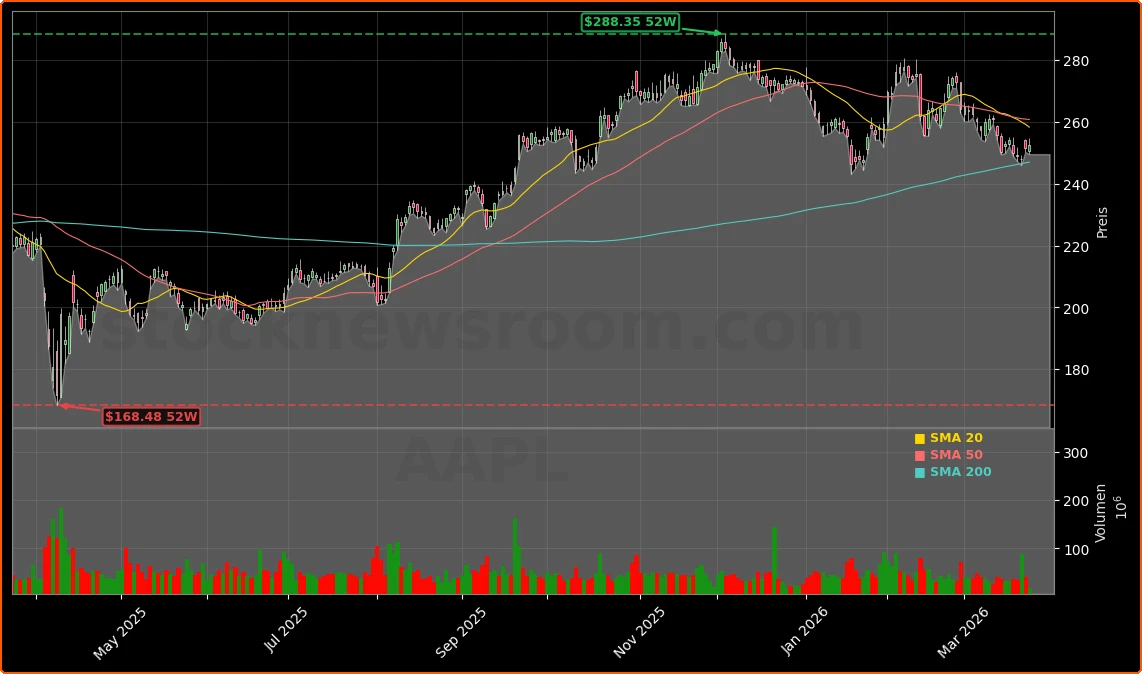
At Tuesday’s price of $252.62, the stock is down about 7% year to date and trades roughly 12% below its 52‑week high of $288.35, but still up more than 15% over the past 12 months. Berkshire Hathaway has trimmed but not abandoned its massive stake, which still represents its single largest holding, signaling continued conviction in Apple as a durable compounder despite the rich multiple.
Related Coverage
For a closer look at how Apple’s AI investments affect its valuation and recent share price volatility, readers can review our deep dive on Apple’s AI strategy and the recent stock pullback. For broader tech context beyond consumer devices, see how enterprise‑focused cloud players are navigating similar AI optimism and volatility in our analysis of Oracle’s AI cloud forecast and the risks of an overextended boom.
Putting it all together, Apple Maps Advertising, record Services revenue, Apple Intelligence and MacBook Neo all point to a deliberate shift toward high‑margin, ecosystem‑driven growth that doesn’t rely solely on premium iPhone pricing. For investors, the combination offers a clearer path to earnings expansion, but from a valuation starting point that demands continued flawless execution. The next WWDC in June—where AI and Maps are expected to take center stage—will be the key catalyst to show whether Apple can turn these initiatives into the next leg of long‑term upside.