Can Apple’s bold new product strategy really justify today’s share-price drop or are investors missing the bigger ecosystem play?
How does Apple Product Strategy hit the stock?
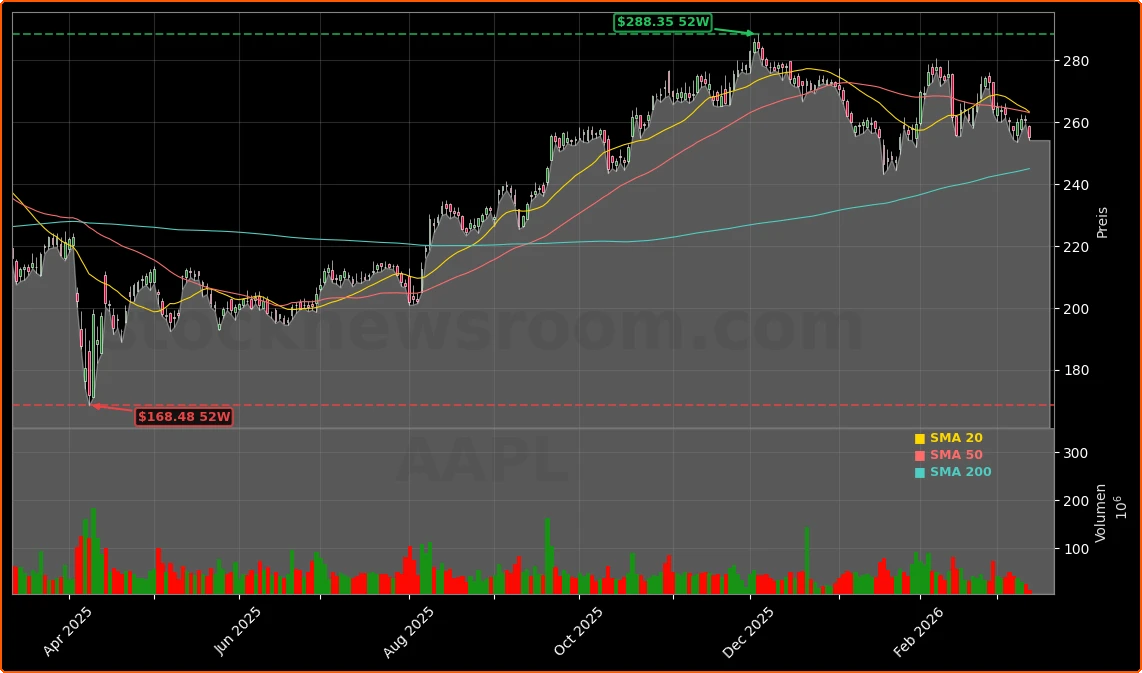
Apple Inc. is modestly softer on Thursday, trading near $255.01 (-2.22%) despite robust fundamentals and growing enthusiasm for its refreshed hardware lineup. The stock remains a core holding in Berkshire Hathaway’s portfolio, and long-term bulls like Zacks still highlight Apple as a top growth name thanks to its ecosystem strength and expanding services business. Consensus on Wall Street sits at a “Moderate Buy” with an average target around $297, implying double-digit upside from current levels if execution on the new roadmap holds.
Apple’s latest quarter showed roughly 16% year-over-year revenue growth to about $143.8 billion, helped by an early iPhone 17 cycle that appears stronger than recent generations. That momentum is crucial as Apple Product Strategy now stretches from a $599 education-focused MacBook to a potential EUR 2,400 foldable iPhone, aiming to deepen both the entry-level and ultra-premium ends of its user base.
Is MacBook Neo a real Chromebook challenger?
The headline of the new Mac lineup is the MacBook Neo, priced at $599 for consumers and as low as $499 for education customers. Powered by the A18 Pro chip—the same processor found in the iPhone 16 Pro—the Neo marks Apple’s first Mac with an iPhone-class processor, promising strong efficiency and up to around 16 hours of battery life. It includes USB-C ports and a headphone jack, signaling that Apple is serious about winning budget-conscious buyers and school deployments that have historically favored Chromebooks and low-cost Windows laptops.
Analysts see the Neo as a calculated move in the broader Apple Product Strategy: it opens the door for millions of iPhone users who have never owned a Mac, without completely undercutting the MacBook Air and MacBook Pro. The 15-inch MacBook Air now starts at $1,099 with an M5 chip and 512 GB of storage, while the new MacBook Pro line begins at $1,699 with M5 Pro and M5 Max chips geared toward gaming, programming and other intensive workloads.
By raising the entry price of the MacBook Air and deliberately limiting the Neo to 8 GB of RAM, Apple is clearly segmenting its portfolio to minimize cannibalization. Power users are steered toward M5-based machines, while students and light users get a significantly cheaper door into the ecosystem—an approach that could pay off later through services revenue and higher-margin upgrades.
What does the iPhone 17 cycle signal for investors?
The current iPhone 17 cycle is already delivering a noticeable revenue boost, validating part of the Apple Product Strategy that focuses on frequent, value-driven refreshes rather than radical form-factor changes every year. The introduction of the iPhone 17e at $599 extends the lineup downward, offering a more affordable gateway into the iOS ecosystem. Buyers give up premium features like Dynamic Island and a second camera lens, but still gain access to Apple’s services and app ecosystem.
That trade-off underpins Apple’s long-term model. A broader installed base of active iPhones feeds recurring revenue from iCloud, Apple Music, TV+, Arcade and enterprise offerings, which generally carry higher margins than hardware. Berkshire’s Greg Abel has emphasized that this compounding effect is why Berkshire expects holdings like Apple to grow “over decades,” reinforcing the idea that near-term hardware gross margins matter less than deepening the ecosystem.
How does iPhone Fold fit Apple Product Strategy?
Looking ahead to late 2026, reports of an iPhone Fold illustrate the other end of Apple Product Strategy: an aggressive play in the ultra-luxury segment. The device is expected to adopt a wider, passport-like form factor closer to Google’s Pixel Fold than to Samsung’s Galaxy Z Fold series, signaling a deliberate design differentiation. Early indications point to pricing between EUR 2,000 and EUR 2,400, placing the product above most existing flagship foldables and firmly in “Ultra” territory.
Technical changes are equally notable. To accommodate a thin folding chassis, Apple is said to be dropping the standard Face ID array and reintroducing Touch ID via a fingerprint sensor in the power button. Under the hood, configurations could reach up to 12 GB of RAM and 1 TB of storage, backed by a roughly 5,500 mAh battery designed to power dual displays. Supply-chain partners like Foxconn and TSMC are reportedly ramping component orders by about 20%, with mass production of specialized displays expected to begin mid-2026.
This raises key questions for investors: will consumers in a high-inflation, macro-uncertain environment pay well over $2,000 for a smartphone, and can a halo foldable meaningfully lift margins without cannibalizing high-end slab iPhones? If successful, the iPhone Fold could strengthen Apple’s brand at the very top of the market, much as the Pro and Ultra lines have done in wearables and phones.
Will India and AI keep margins resilient for Apple?
Beyond devices, Apple Product Strategy includes an ongoing diversification of its supply chain. India is preparing fresh incentives tied to export volumes and local content for smartphone production, which could further encourage Apple and rivals like Samsung to expand manufacturing there. That shift mitigates tariff and geopolitical risks while potentially lowering costs over time, a factor Wall Street increasingly values given global tensions and helium-related constraints in parts of the chip supply chain that affect companies from Apple to NVIDIA and Tesla.
“Apple’s ability to reshape its hardware tiers while growing a high-margin services engine is what makes it a rare combination of growth and resilience in big tech.”
— Independent equity analyst comment
Conclusion
On the AI front, Apple’s newer chips—from A18 Pro in the MacBook Neo to M5 in the latest Macs—are designed for on-device AI workloads. While Apple has been quieter than some mega-cap peers in hyping AI, this hardware groundwork positions it to roll out more AI-driven features across iOS and macOS without sacrificing privacy or battery life, a dynamic that could further entrench users and sustain premium pricing.
Further Reading
- Apple Inc. (AAPL) stock data and profile (Yahoo Finance)
- How Apple’s new low-cost MacBook Neo may shake up the market (TechXplore)
- India plans fresh incentives for phone production in boost for Apple, Samsung (Reuters)
- Why Apple (AAPL) is a top growth stock for the long-term (Zacks Investment Research)