
Does the Apple tariff ruling really create billions in leeway – or is the company trapped in geopolitical risk?
Apple Tariff Ruling: How Significant is the Financial Leverage?
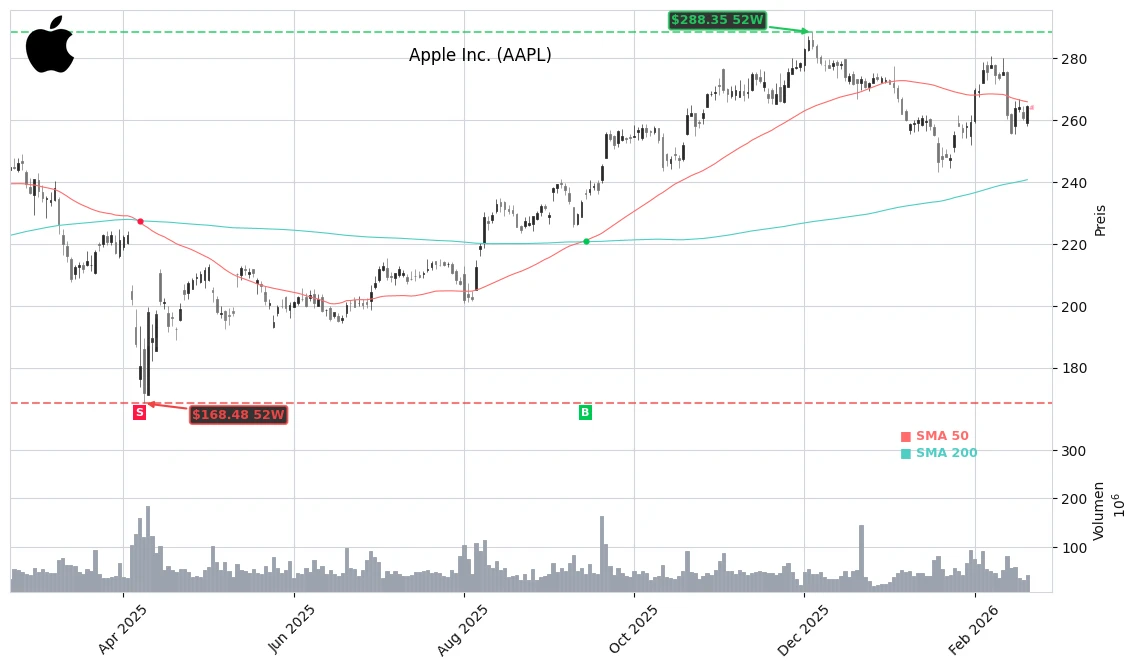
At the center of the Apple tariff ruling is the question of how much the earnings reports of the upcoming quarters can benefit. Since the introduction of the Trump tariffs, Apple Inc. has paid approximately $3.3 billion in duties, most recently about $1 billion per quarter. With the Supreme Court ruling, this ongoing burden will decrease significantly – and a portion of the duties already paid could be refunded. Given the current stock price of $264.58 (previous day: $260.58; +1.53%, pre-market $263.70), the effect per share is manageable, but on a corporate level, it provides a clear tailwind for margins.
At the same time, the situation remains complex: While the ruling opens the door for refunds totaling up to $175 billion for all affected importers, the future of trade policy is uncertain. According to current assessments, Apple has largely absorbed the previous tariff burdens within its supply chain and pricing strategy, meaning the Apple tariff ruling should be viewed more as an additional bonus rather than a lifeline.
Apple: Will iPhone, iPad & Co. Benefit the Most?
The greatest leverage from the Apple tariff ruling lies within the hardware divisions, which rely heavily on extensive supply chains in Asia. The iPhone dominates the global smartphone market: In 2024, Apple accounted for about 46% of worldwide smartphone revenues with only 28% of unit sales, achieving a record average selling price (ASP) of $903. By 2025, Apple also became the best-selling smartphone brand with a 20% market share. Lower import costs directly strengthen the gross margin here.
Other product lines also benefit: AirPods lead the true wireless market with about a 21% share, the Apple Watch controls around 23% of the smartwatch segment, and the iPad dominates the tablet market with about a 45% market share. The strong pricing power of these ecosystem products makes it easier for Apple to either capture cost effects from the Apple tariff ruling in the form of higher margins or selectively pass them on to customers to expand market share.
The MacBook range – from MacBook Air to MacBook Pro – has also made Apple the fourth-largest PC vendor, with a 9% market share and above-average growth of 11.1% in the fourth quarter of 2025. Here too, every percentage point of margin translates directly into higher profit leverage.
Apple Tariff Ruling: Political Risk or Opportunity in China?
The Apple tariff ruling also has a geopolitical dimension. Apple is heavily reliant on manufacturing in China, while investors are increasingly critical of the regulatory risks in the People’s Republic. Many institutional investors avoid direct engagements in China and instead invest in companies like Apple to participate in growth indirectly without holding Chinese securities.
The now-overturned Trump tariffs could give Apple more flexibility to gradually diversify its production locations without increasing margin pressure. At the same time, the environment remains fragile, as discussions about new blanket import tariffs of 15% are already underway. For investors, this means: The Apple tariff ruling reduces costs in the short term but does not change the fact that trade policy tensions could bring new burdens at any time.
Nevertheless, optimism prevails among analysts. Wedbush Securities maintains a price target of $350 and an outperform rating for Apple, pointing to the tariff tailwind alongside structural revenue sources such as the services business and new hardware categories.
Apple and AI: Weakness or Hidden Trump Card?
Alongside the Apple tariff ruling, the AI strategy is coming into sharper focus. Apple spends significantly less on AI infrastructure than other tech giants but relies on the strength of its installed base and edge AI directly on iPhone, iPad, and Mac. The anticipated deal with Google to integrate Gemini into Siri could trigger a new upgrade cycle.
Wedbush expects the first major AI features in the summer and points to new devices like smart glasses and AI-optimized AirPods. Other market observers describe it as a “lazy AI strategy,” which, through its focus on user experience and ecosystem, could put pressure on competitors. Combined with the relief from the Apple tariff ruling, Apple would have additional financial leeway to strategically invest in AI hardware and software.
In the long term, Apple remains a core investment for many large investors – not least for Warren Buffett’s Berkshire Hathaway, which holds the stock as its largest position in the portfolio due to its quasi-oligopolistic market position.
As soon as Apple gets the user experience right with AI agents, the company can leverage its massive installed base.
— Anonymous portfolio manager of a technology fund
Bottom Line
The Supreme Court’s Apple tariff ruling provides the company with a clear, albeit not existential, margin tailwind. For investors, the combination of tariff relief, dominant hardware markets, and a growing AI narrative is attractive, even though the risks associated with China and trade policy remain central concerns. It will be crucial to see whether Apple utilizes the additional financial flexibility from the Apple tariff ruling to accelerate its AI strategy and trigger the next upgrade cycle.
Related Sources
- Apple Inc. (AAPL) on Yahoo Finance (Yahoo Finance)
- Wedbush Maintains Bullish View on Apple Despite AI Delay Concerns (Finviz)
- How Many Markets Does Apple Dominate? The Answer Might Shock You (The Motley Fool)
- Apple Obliterated Tariff Headwinds – The Supreme Court Decision Doesn’t Matter (Seeking Alpha)