
Will the Apple US expansion with billion-dollar investments drive growth – or will legal headwinds eat into returns?
How is the Apple US expansion changing the production landscape?
Apple Inc. is relocating the production of the Mac mini to the United States, making Houston the centerpiece of its new manufacturing strategy. Since 2025, advanced AI servers for US data centers have been rolling off the assembly line there, and now the compact Mac mini is set to be assembled in Texas starting later this year. Concurrently, server production is ramping up – a clear signal that the company wants to bring critical hardware for its AI and cloud infrastructure closer to its home market.
The core of the Apple US expansion is a new Advanced Manufacturing Center covering approximately 20,000 square feet, which is expected to open in 2026. The site will effectively double in size and will be developed as a training hub for skilled workers in high-tech manufacturing and automation. The company speaks of thousands of new jobs and frames this move as part of a comprehensive realignment of its global supply chain: from chips to casings to finished devices, key value creation stages are set to increasingly take place in the USA.
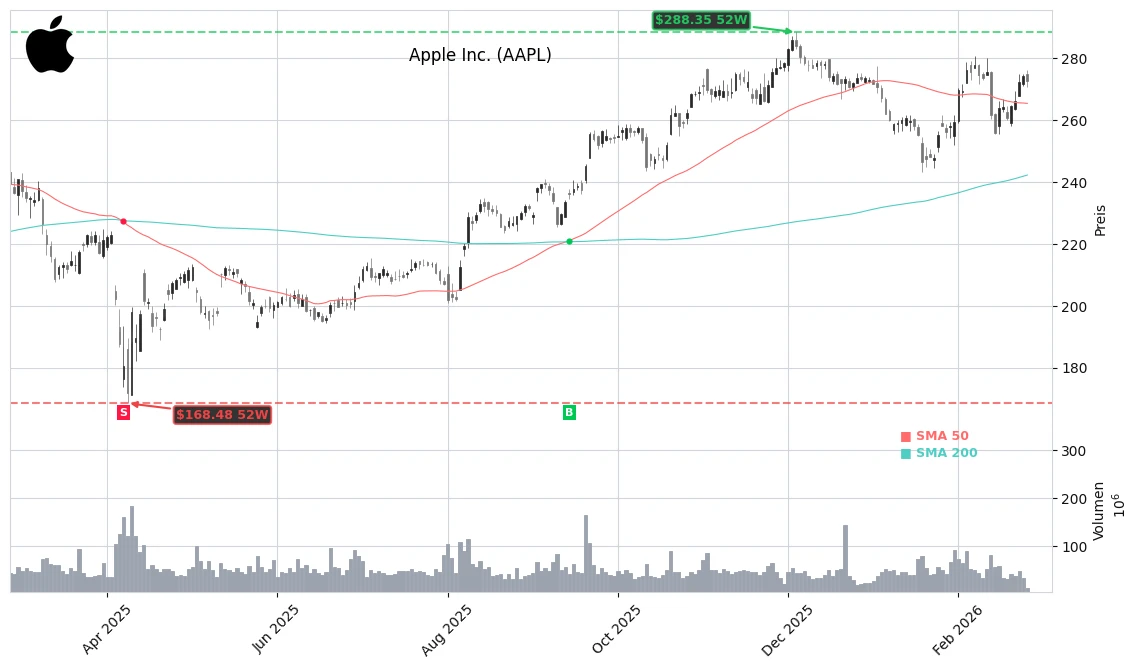
On the stock market, Apple (AAPL) has recently reacted cautiously: The stock price is at $272.50, about 0.63% lower than the previous day and significantly below the 52-week high of $274.22, without marking new highs. For investors, the question arises whether the Apple US expansion can serve as a catalyst for the next growth cycle – or whether legal risks and skepticism about AI may cloud the picture.
What role do chips, AI, and US partners play for Apple?
Financially, the Apple US expansion is embedded in a massive commitment of $600B for the US market. A central lever in this is the semiconductor strategy: Apple plans to source over 100 million modern chips from TSMC in Arizona this year and will also become the primary customer for Amkor’s new semiconductor packaging facility in Peoria, Arizona. This move not only shifts assembly but also essential chip processes back to the USA, reducing dependence on Asia.
At the same time, Apple is trying to redefine its role in the AI era. Instead of pouring double-digit billions into its own data centers like other mega-caps, management is focusing on partnerships – primarily with Google and its Gemini models. Market observers like Jim Cramer refer to this as the “best free ride ever,” as Apple can integrate AI functions without bearing the full investment burden. Financial firms like Wedbush and Evercore ISI maintain price targets of $350 and $330, respectively, with an outperform rating, but emphasize that delays in “Apple Intelligence” and Siri upgrades could test investors’ patience.
Strategically, Apple Inc. aims to embed AI deeply into wearables and services – from AirPods to potential wearables to future glasses. The Apple US expansion in production and the AI offensive in the product portfolio are expected to trigger a new upgrade cycle that boosts hardware sales and margin-rich services simultaneously.
What legal risks are currently affecting Apple?
While the company is aggressively investing in its home market, legal pressure is mounting. In San Jose, Apple is currently pushing for the dismissal of a class-action lawsuit in which shareholders accuse the company of securities fraud. At the center are allegedly exaggerated claims about the AI capabilities of the voice assistant Siri, as well as whether Apple has correctly implemented the requirements from the Epic Games case regarding App Store commissions.
The plaintiffs – led by the South Korean pension giant NPS – estimate potential losses for shareholders in the hundreds of billions of dollars during the period from May 2024 to May 2025. Apple counters that there is no evidence that management could foresee in 2024 how long the integration of new AI features into Siri would take, and points to normal price fluctuations in a volatile market environment. Meanwhile, the commission structure in the App Store remains under scrutiny after a court criticized the 27% fee on external purchases – although an appeals court partially reversed later sanctions.
This presents investors with a dual picture: on one side, the Apple US expansion stands as a long-term location advantage with political tailwind. On the other side, ongoing legal disputes regarding App Store rules and transparency in AI promises could lead to additional price fluctuations.
It is no secret that Apple faced challenges and fluctuations in stock prices in 2025 – like many large companies.
— Company statement in a court case
Bottom Line
Ultimately, the Apple US expansion, with new Mac mini production, AI servers, and massive chip investments, strengthens the company’s strategic focus on its home market. Despite legal risks surrounding Siri and the App Store, as well as still unclear AI plans, Apple remains a core investment for many investors thanks to its strong balance sheet, services business, and institutional demand. The key will be whether management can translate the US offensive and the AI supercycle into sustainably higher growth and more clarity for shareholders in the coming quarters.
Related Sources
- Apple Inc. (AAPL) Stock Price and Data (Yahoo Finance)
- Apple Got The Best Free Ride, Says Jim Cramer (Finviz)
- VanWeelden Wealth Management LLC Purchases New Position in Apple Inc. (MarketBeat)
- Apple seeks dismissal of fraud lawsuit over Siri AI, Epic injunction (Reuters)