
Can Apple’s new US manufacturing push really de-risk its supply chain while powering the next big AI upgrade cycle?

How does Apple US Manufacturing shift the supply chain?
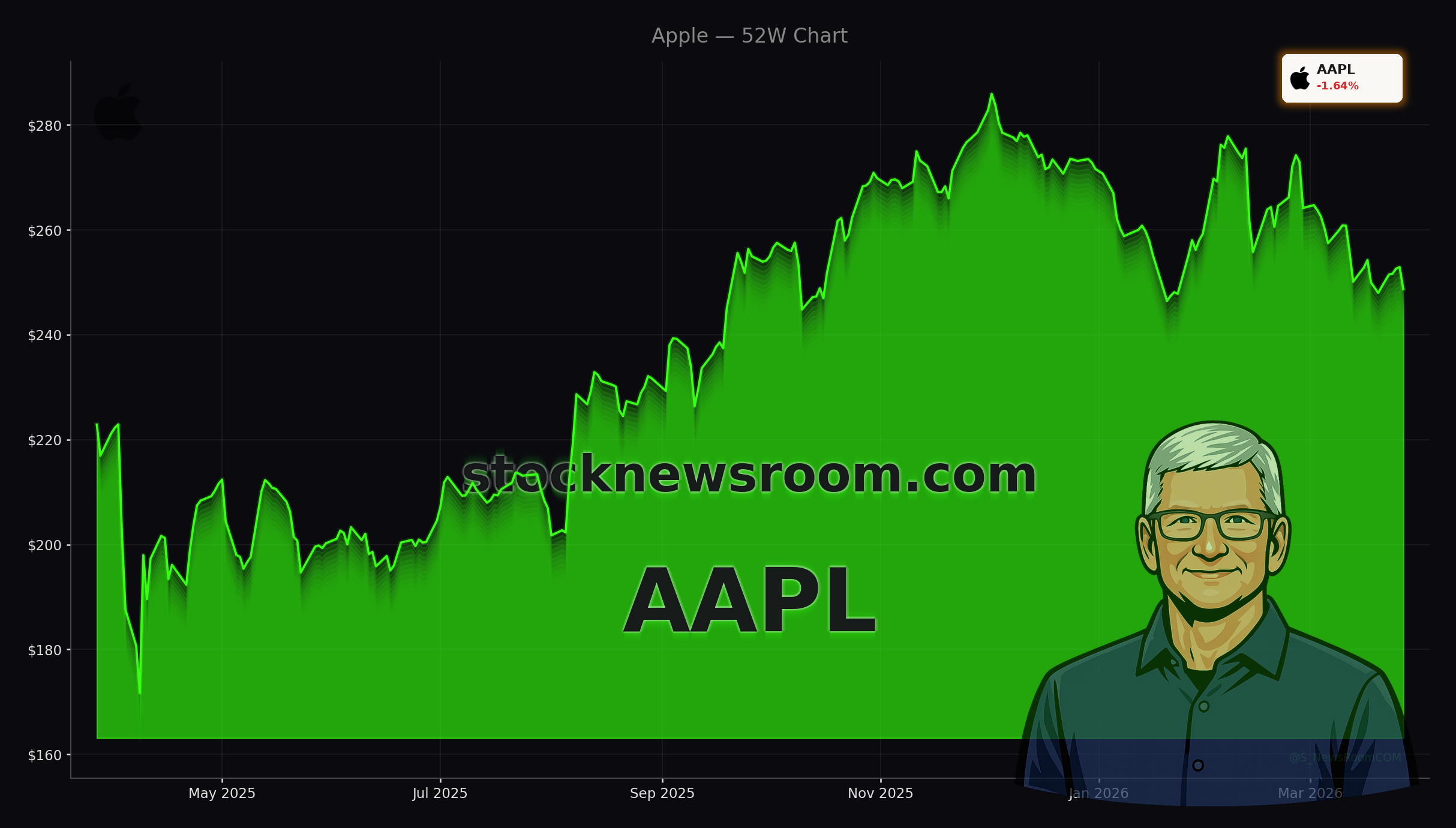
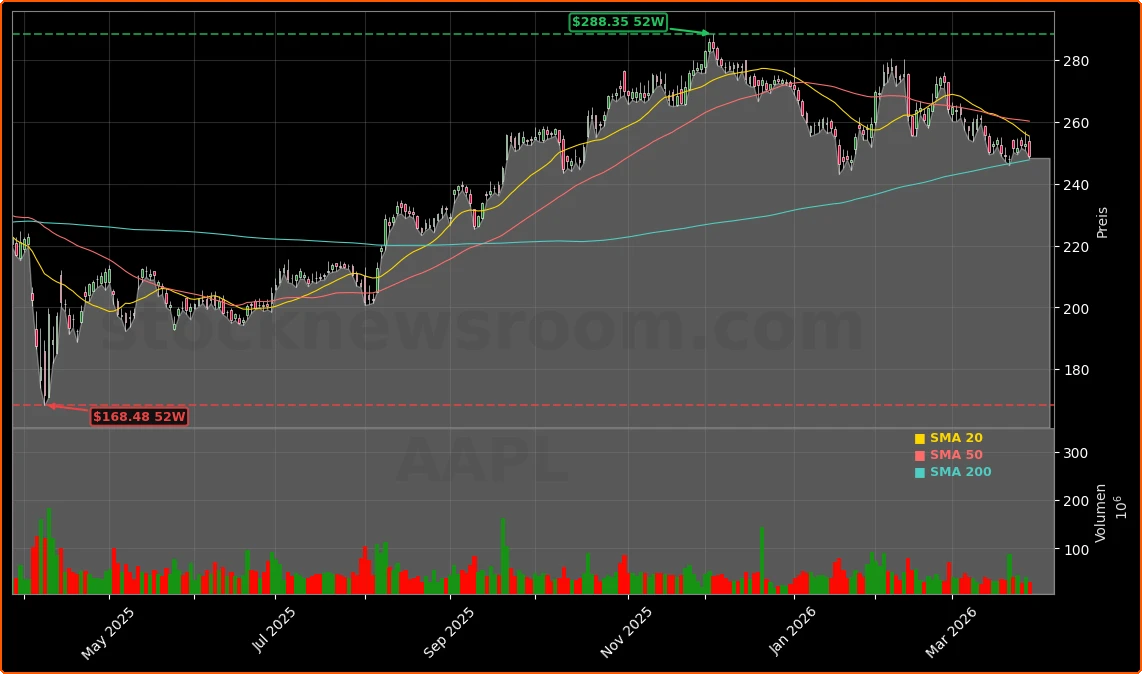
Apple Inc. (AAPL) traded around $249 in Friday’s session, down about 1.5% and lagging the NASDAQ 100 after a volatile week for mega‑cap tech. Yet behind the short‑term weakness, Apple US Manufacturing is accelerating. The company is expanding its American Manufacturing Program by onboarding Bosch, Cirrus Logic, TDK and Qnity Electronics, directing $400 million of fresh spending to U.S. facilities through 2030. These partners will build sensors, integrated circuits and specialty materials for iPhones and other devices shipped worldwide, tightening Apple’s domestic supply chain and partially de‑risking its heavy Asia exposure.
TDK will manufacture tunnel magnetoresistance (TMR) sensors in the U.S. for the first time, supporting core iPhone functions such as camera stabilization. Bosch will work with Apple and TSMC at a Washington state fab on sensing ICs that enable Crash Detection and activity tracking, while Cirrus Logic and GlobalFoundries are co‑developing new mixed‑signal chips and process technologies at Malta, New York.
What’s the link to AI and Siri’s reboot?
The Apple US Manufacturing ramp comes just as the company faces its biggest artificial intelligence test ahead of June’s Worldwide Developers Conference. Bloomberg reporting indicates that Apple plans to make Siri “chatbot agnostic,” allowing users to route certain tasks to external large language models like Google’s Gemini while Apple layers its own on‑device AI. Reuters also notes that Apple has hired former Google executive Lilian Rincon as vice president of product marketing for AI, underscoring how central Siri’s reinvention has become.
Domestic production of sensors, power management chips and custom mixed‑signal silicon is strategically important for these AI features, from always‑on context detection to secure, low‑latency processing on next‑generation iPhones and Macs. With services revenue growing double digits and AI‑driven upgrades looming, bulls argue Apple’s U.S. capacity build could smooth supply for higher‑value devices and protect gross margins.
How do rivals like NVIDIA and Tesla compare?
The renewed focus on Apple US Manufacturing also highlights how different Apple looks versus other “Magnificent Seven” names. NVIDIA continues to dominate AI data‑center GPUs but relies heavily on overseas foundries, while Tesla’s manufacturing base is global and auto‑centric. Apple’s approach centers on tight vertical integration of critical components close to its largest end market, the U.S., while leaning on partners like TSMC for leading‑edge nodes.
Wedbush maintains a $350 price target on Apple and sees WWDC as a pivotal AI catalyst, even as some Seeking Alpha commentary is more cautious on new positions in Apple compared with faster‑growing Mag 7 peers. With the stock still representing a double‑digit weight in many S&P 500 and tech ETFs, any payoff from Apple’s domestic manufacturing and AI strategy will ripple through U.S. portfolios.
Related Coverage: A deeper dive into the strategic risks and upside of the broader build‑out is available in Apple US manufacturing boom: $600B bet on risk, AI and record upside, which examines how reshoring interacts with tariffs and geopolitics. For investors tracking the wider AI complex, NVIDIA AI Valuation -1.9%: Boom Engine Or Bubble Risk? analyzes whether NVIDIA’s premium still holds as rivals and export controls bite.
At Apple, we believe in the power of American innovation and manufacturing, and we’re proud to partner with even more companies to produce critical components and cutting-edge materials for our products right here in the U.S.— Tim Cook, CEO of Apple Inc.
Apple US Manufacturing is evolving into a multi‑year bet on supply‑chain security and AI‑ready hardware, not just a political talking point. For U.S. investors, the combination of domestic capacity, services growth and a high‑stakes AI rollout keeps Apple a core but hotly debated holding. The next real verdict on Apple US Manufacturing and its AI roadmap will arrive at WWDC and in how quickly these new U.S. plants ramp into high‑margin devices.