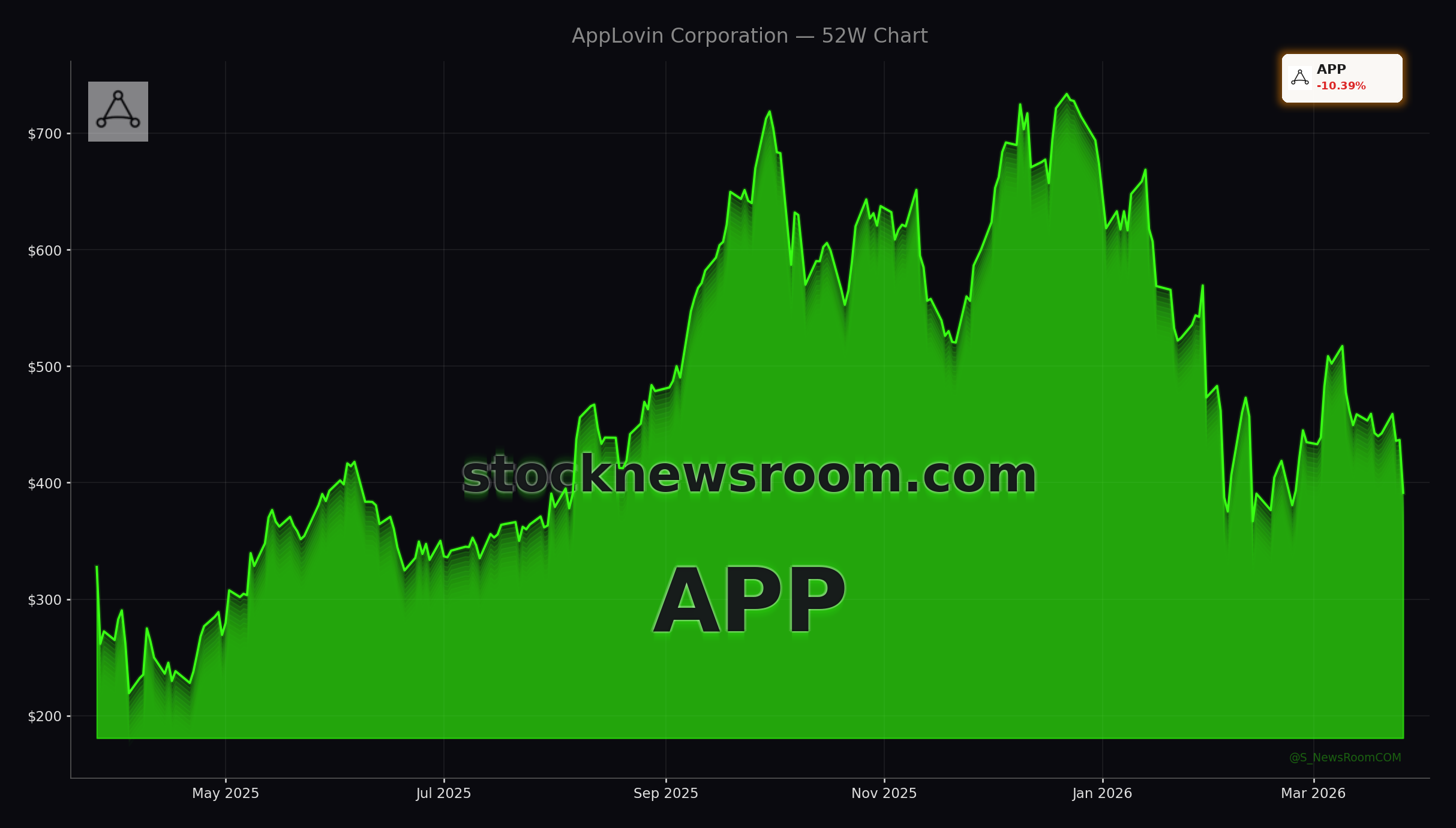

Is the AppLovin AI Competition narrative finally cracking this market darling, or is a brutal -10% plunge just macro noise?

Is AppLovin’s sell-off just macro stress?
Thursday’s slide in AppLovin Corporation (APP) came amid broad weakness in high-growth tech, with chipmakers, data-infrastructure names and megacap software leading declines on the NASDAQ and S&P 500. Concerns over elevated oil prices and the economic fallout from the war in Iran have pushed U.S. recession odds higher, while fresh projections now see U.S. inflation running closer to 4.2% in 2026, well above the Federal Reserve’s most recent forecast.
In that context, high-multiple software and adtech names like AppLovin have been hit disproportionately as investors rotate into perceived safety. The stock is down more than a third year to date and roughly 38% over the last six months, even after reporting a standout Q4 2025 with revenue up 66% and net income jumping 84%. The disconnect underscores how quickly sentiment can swing when macro fear combines with doubts over a hot theme like AI.
Adding to the unease, insider moves have drawn scrutiny: board member Eduardo Vivas recently moved 20,910 Class A shares into an exchange-traded fund vehicle at around $458 per share, relinquishing voting control over those shares. While he still beneficially owns more than 7.1 million shares, the timing has reinforced the sense that management sees a more volatile path ahead.
How serious is the AppLovin AI Competition threat?
The core bear case today centers on AppLovin AI Competition rather than on the company’s own execution. AppLovin’s Axon engine turned the company from a mobile gaming specialist into a broader AI-powered marketing platform, drawing brands looking for better targeting and creative optimization. But rivals now include deep-pocketed platforms such as Meta Platforms, Alphabet and fast-moving infrastructure players like NVIDIA, all racing to commercialize generative AI in advertising.
Industry chatter that Meta could tweak its ad stack in ways that erode AppLovin’s edge recently knocked the stock, even though many in the market still view these fears as exaggerated in the near term. AppLovin’s technology, integrations and domain expertise in performance marketing are not trivial to replicate quickly, and the company continues to tout strong ROI for advertisers in gaming and beyond.
At the same time, short sellers have begun circling the name more aggressively, arguing that the AppLovin AI Competition will compress margins and slow growth as customers test competing tools and push for better pricing. That skepticism has grown louder as investors increasingly differentiate between AI beneficiaries with durable moats and those riding broader hype.
Analyst opinion remains mixed. Zacks Investment Research still highlights AppLovin as a long-term momentum play thanks to Axon and strong recent growth, but other Wall Street voices are more cautious, suggesting that investors demand clearer proof that AI investments are translating into sustainable competitive advantage and not just a temporary boost to multiples.
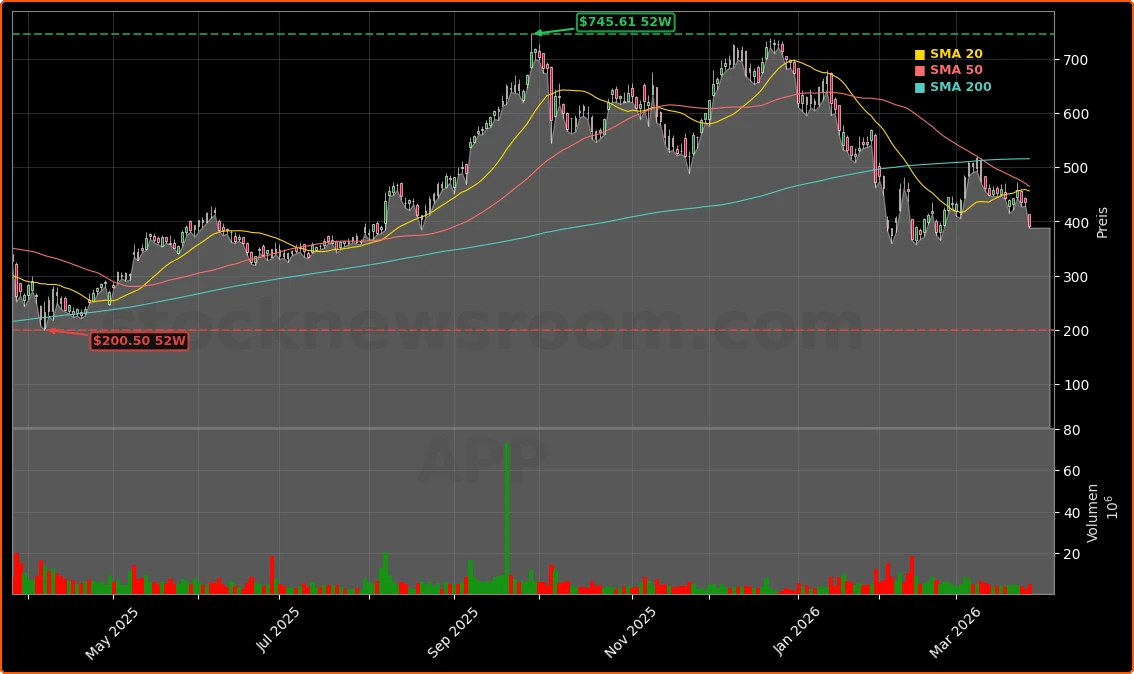
Is e-commerce the weak link in AppLovin’s pivot?
Beyond pure AppLovin AI Competition fears, new data from Cleveland Research’s Q1 2026 e‑commerce checks have turned attention to a more structural issue: the health of AppLovin’s non-gaming verticals. Advertisers across e‑commerce channels are reporting softer digital ad budgets, rising churn and a “scale wall,” where returns on ad spend deteriorate once campaigns ramp beyond initial test levels.
For AppLovin this is problematic. Management has been leaning into e‑commerce as a key diversification driver, extending Axon-powered ads beyond gaming and preparing a broader self-serve platform for the first half of 2026. If brands in that segment are pausing or pulling budgets and not replacing them with new campaigns, AppLovin’s path to re-accelerating growth becomes narrower.
Creative bottlenecks add another layer of friction. Many advertisers simply cannot generate high-performing ad creatives fast enough to take full advantage of performance platforms, limiting both customer acquisition and budget expansion. AppLovin is piloting generative AI tools to automate creative production, and bullish analysts at firms such as Zacks have flagged these initiatives as potential catalysts. Still, until those tools are widely adopted and demonstrably improve ROI at scale, U.S. investors are likely to treat them as optional upside rather than base-case assumptions.
On valuation, some growth-focused managers now see the stock’s slide toward the $400 level and below as an opportunity. Even after the recent drawdown, however, APP remains up dramatically from roughly $39 two years ago, leaving limited margin for error if growth slows from its recent breakneck pace.
What should U.S. investors watch next?
For diversified portfolios exposed to adtech and AI through leaders like Apple, Tesla or NVIDIA, the turbulence in APP is a reminder that individual stock risk remains high even within strong secular themes. AppLovin’s next updates on Q1 trends and 2026 guidance will be crucial in determining whether current worries about the AppLovin AI Competition were overstated or a sign of a more mature, lower-growth phase.
Key indicators to track include: segment-level disclosure on gaming vs. e‑commerce performance; advertiser churn and net dollar retention; the adoption rate and measurable uplift from its generative AI creative tools; and any commentary on competitive dynamics with Meta, Alphabet and other platforms. A more granular roadmap around self-serve rollouts and AI integration could help rebuild confidence among institutional investors who have grown wary of high-level AI buzzwords.
Crucially, macro conditions will shape the near-term share price as much as company specifics. If inflation stays higher for longer and recession probabilities keep climbing, performance ad budgets may come under further pressure, and high-growth names like AppLovin could see continued multiple compression even if fundamentals hold up reasonably well.
Related Coverage
For a deeper dive into the debate over upside versus downside from here, the article “AppLovin Forecast: 47% Upside Gap or Crash Warning Ahead” examines whether recent weakness is a rare mispricing in adtech or a value trap built on record margins and AI excitement. Investors tracking regulatory and competitive risks across the social and advertising landscape may also want to read “Meta Social Media Lawsuits: -6.8% Plunge Jolts Investors”, which looks at how legal headwinds around Meta could reshape sentiment for the broader digital ads sector.
In the end, the story now revolves around whether AppLovin Corporation can translate its AI leadership into durable cash flows in the face of intensifying AppLovin AI Competition, e‑commerce headwinds and macro uncertainty. For U.S. investors, the stock’s sharp reset creates both risk and opportunity, with upcoming quarters likely to decide if APP returns to its former highflyer status or settles into a slower-growth profile. Those willing to navigate the volatility should watch closely how management executes on AI, self-serve and diversification initiatives as the next phase of the AppLovin AI Competition plays out.