Is the bullish AppLovin Forecast a rare mispricing in ad-tech, or a value trap hiding behind record margins and AI hype?

Is AppLovin Forecast mispricing or real risk?
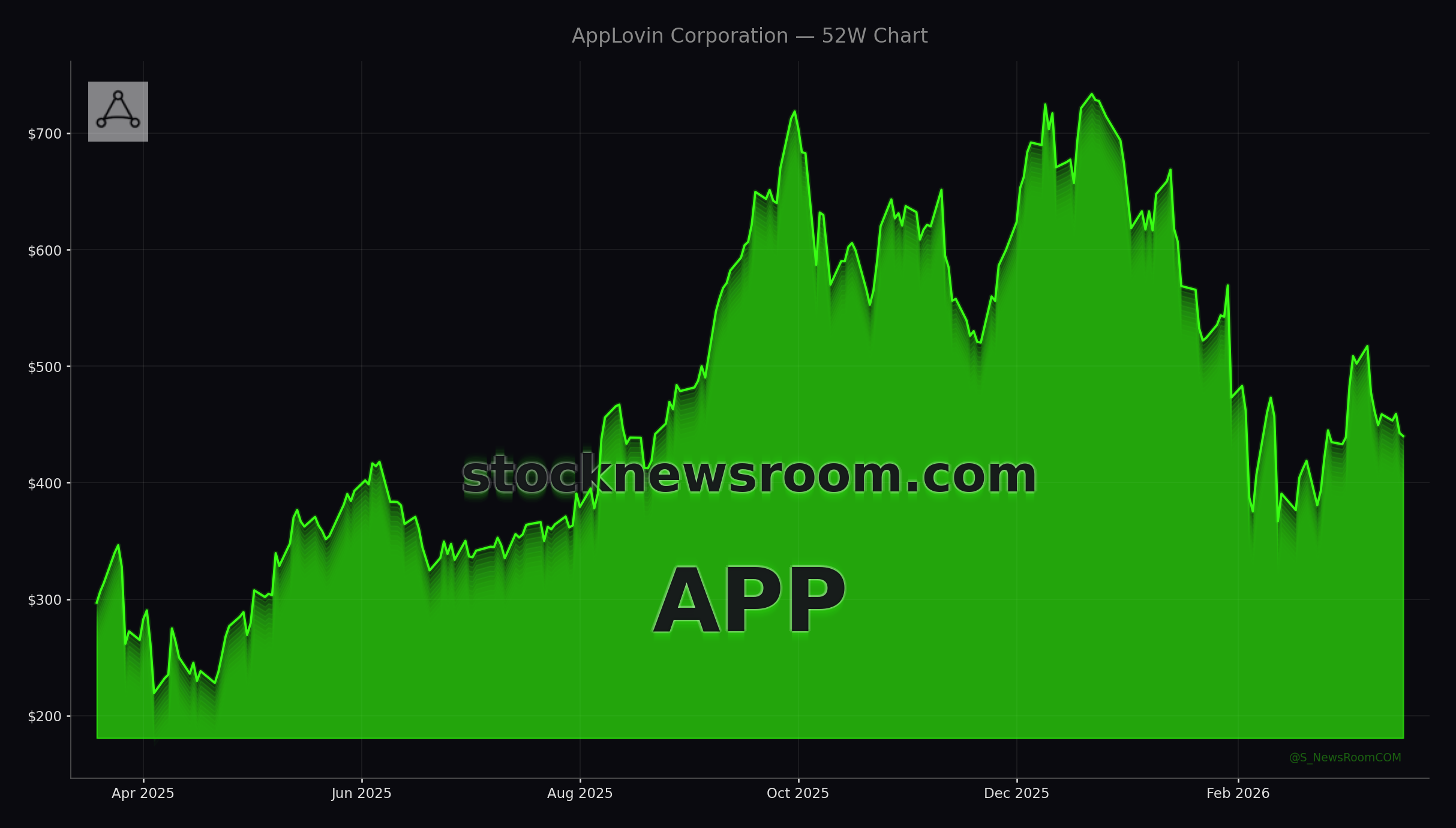
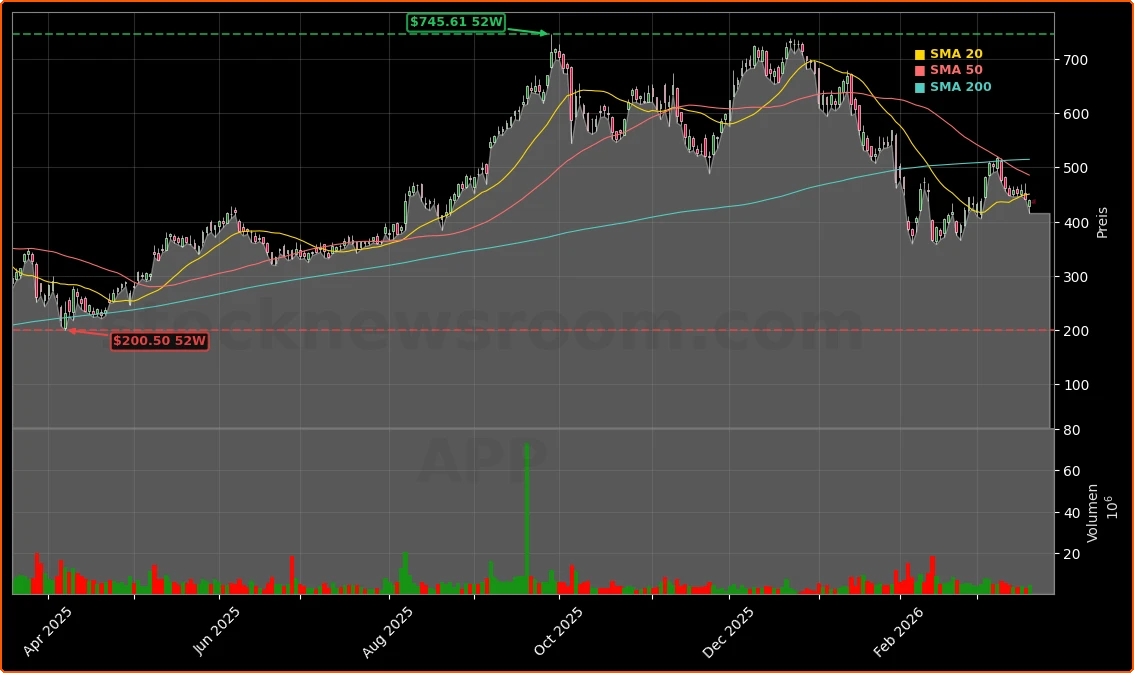
AppLovin Corporation (APP) closed around $439.92 on Friday, slightly below the prior close and well under its 52‑week high of $745.61. Year to date, the stock is down roughly 34.7%, sharply underperforming the S&P 500’s 3.5% decline and reinforcing the narrative that high‑multiple software names like AppLovin and Snowflake have been hit hardest in the post‑AI hype reset. Yet the average Street target of about $648.57 implies 47.4% upside from current levels, a spread more typical of a distressed story than a company posting record profitability.
The heart of the bullish AppLovin Forecast is simple: earnings are ramping much faster than the stock. Trailing P/E has fallen to roughly 44x, while forward P/E near 29x reflects expectations of continued earnings growth through 2026–2027. That multiple is no longer extreme in a market that still pays richer valuations for mega‑cap AI beneficiaries such as NVIDIA and Apple. For growth‑oriented portfolios on Wall Street, the combination of multiple compression and rising profits is exactly what many have been hunting for after the software washout.
How strong is AppLovin Corporation’s core business?
Operationally, AppLovin has rarely looked better. The company finished its transition to a pure‑play ad‑tech platform in mid‑2025 by selling its mobile gaming unit to Tripledot Studios for $400 million in cash plus about a 20% equity stake. That shift unlocked a margin profile that stands out even in the high‑margin world of digital advertising.
In Q4 2025, AppLovin reported revenue of $1.657 billion versus expectations near $1.604 billion and EPS of $3.24 versus $3.11. Adjusted EBITDA margin surged to 84%, up from 77% a year earlier, powered by its AI‑driven AXON 2 engine and dominant position in performance advertising for mobile gaming. Full‑year 2025 revenue reached $5.481 billion—slightly below consensus—but free cash flow soared to roughly $3.95 billion, underscoring the business’s cash‑generating capacity.
CEO Adam Foroughi has been explicit about the disconnect between fundamentals and share price, highlighting what he calls “the strongest operating performance in our history.” CFO Matt Stumpf points to a Rule‑of‑40 score of roughly 150, derived from 66% revenue growth and 84% EBITDA margins, a level that few software or ad‑tech platforms can match. For U.S. tech investors who learned to prize profitable growth after the rate shock of 2022–2023, those metrics anchor the optimistic AppLovin Forecast.
AppLovin Forecast: can e‑commerce be the next growth leg?
The next chapter hinges on whether AppLovin can replicate its gaming success in e‑commerce. Management has opened self‑service access for merchants and aims for a broader general availability launch in the first half of 2026. The thesis: AXON 2’s machine‑learning models, trained on years of gaming data, can extend into retail and direct‑to‑consumer brands, tapping a much larger digital ad pool.
There are early signs of traction, but also clear execution risk. AppLovin currently has data penetration across thousands of e‑commerce sites, compared to over 10 million properties in gaming. That gap underscores both the opportunity and the time required before e‑commerce becomes a second engine of comparable scale. Still, research shops like Zacks highlight the vertical as the key swing factor that could justify the Street’s upside scenario for APP over the next 12–24 months.
On valuation, several U.S. analysts argue that if e‑commerce ramps, earnings growth can outpace any further multiple compression. A recent bullish note on Seeking Alpha upgraded the stock around $450, emphasizing a dramatic P/E contraction through 2026–2027 backed by more than 100% EPS growth in 2025. For long‑only tech funds benchmarked to the NASDAQ and S&P 500, the risk/reward looks compelling—but not without caveats.
What do analyst ratings and insider sales signal?
Street sentiment is overwhelmingly positive. Out of 28 covering analysts, 24 rate APP a Buy (including multiple Outperform and Overweight designations from major U.S. banks such as Morgan Stanley and Goldman Sachs), three are at Hold, and just one is at Sell. That 24‑to‑1 Buy‑to‑Sell ratio is unusually strong for a name that has lost a third of its market value in less than three months. Firms like Citigroup and Bank of America reiterate that the recent drawdown looks like a valuation reset rather than a fundamental break in the story.
However, insider activity sends a more cautious signal. In March, CEO Arash Adam Foroughi sold over 40,000 shares in open‑market transactions totaling more than $18 million, while still retaining millions of shares and a substantial economic stake. Director Eduardo Vivas disposed of roughly 163,910 shares under a Rule 10b5‑1 plan, and trusts linked to CTO Vasily Shikin also trimmed holdings. In total, recent Form 4 filings show a net selling trend across more than a hundred transactions. While such sales can reflect diversification and tax planning, they sit awkwardly beside a bullish AppLovin Forecast and are worth tracking for signs of any shift in insider confidence.
Zacks recently noted that APP has been falling more steeply than the broader market, highlighting heightened volatility and sensitivity to sentiment swings that are common across software‑as‑a‑service peers like Snowflake and Tesla‑adjacent AI beneficiaries. In an environment where investors fear becoming obsolete (FOBO) if they miss the next AI winner, Wall Street is still wrestling with how to value high‑margin, AI‑driven platforms like AppLovin.
Related Coverage
There is a real disconnect between market sentiment and the reality of our business.— Adam Foroughi, AppLovin CEO
For investors looking at platform risk and valuation pressure across fintech and trading apps, it is worth reading how the broader market is reassessing growth stories beyond ad tech. Our recent analysis, Robinhood Strategy Warning as Crypto Slump Bites, explores whether Robinhood’s business model can withstand a harsh crypto downturn, slowing user growth, and rising scrutiny from Wall Street. The article provides useful context on how quickly market sentiment can shift for high‑growth platforms when their core engine comes under pressure.