
Is the latest slide in AppLovin’s AI adtech stock a warning sign—or the entry point bullish forecasts are betting on?

Is AppLovin’s AI slump a buying opportunity?
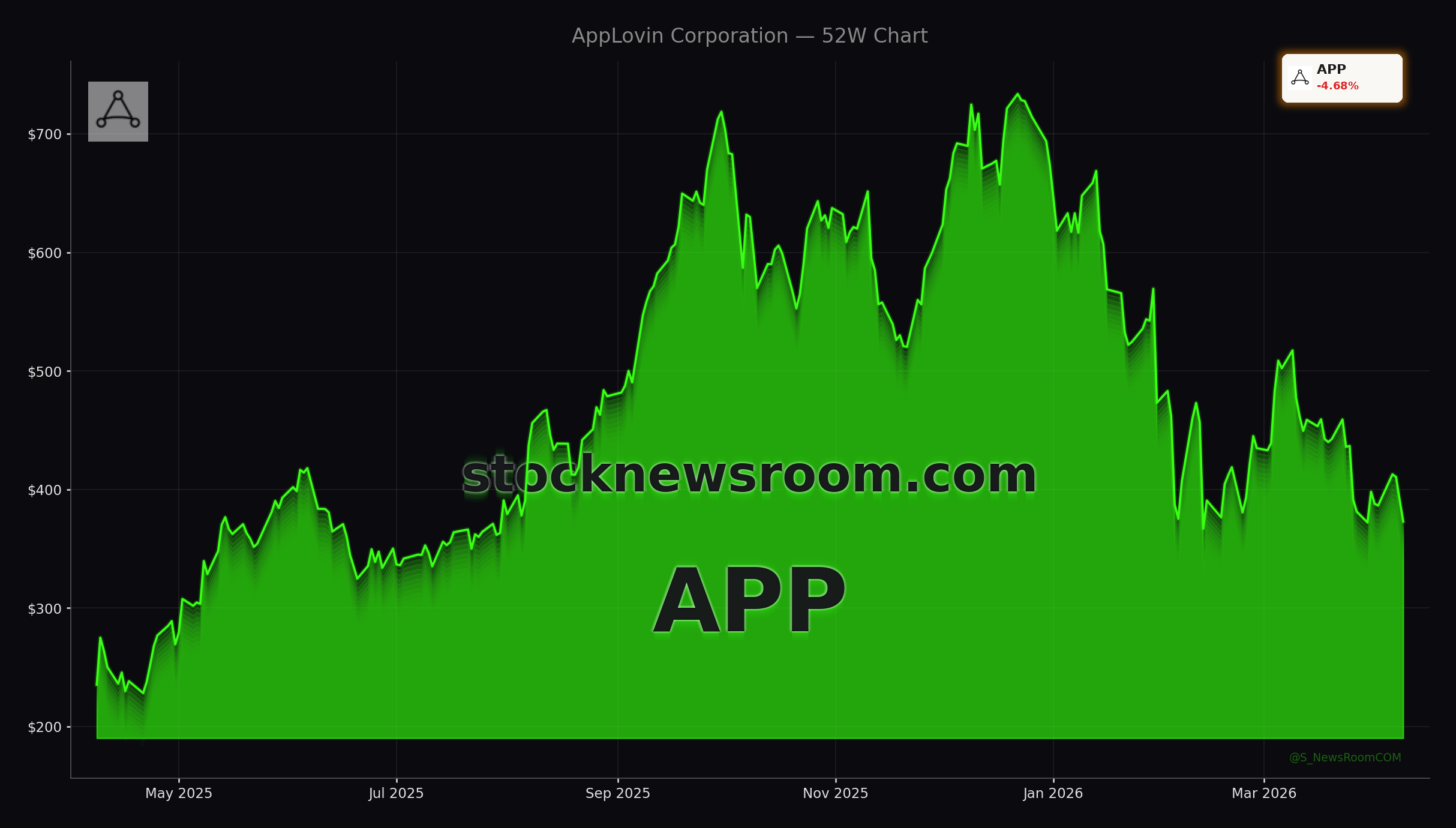
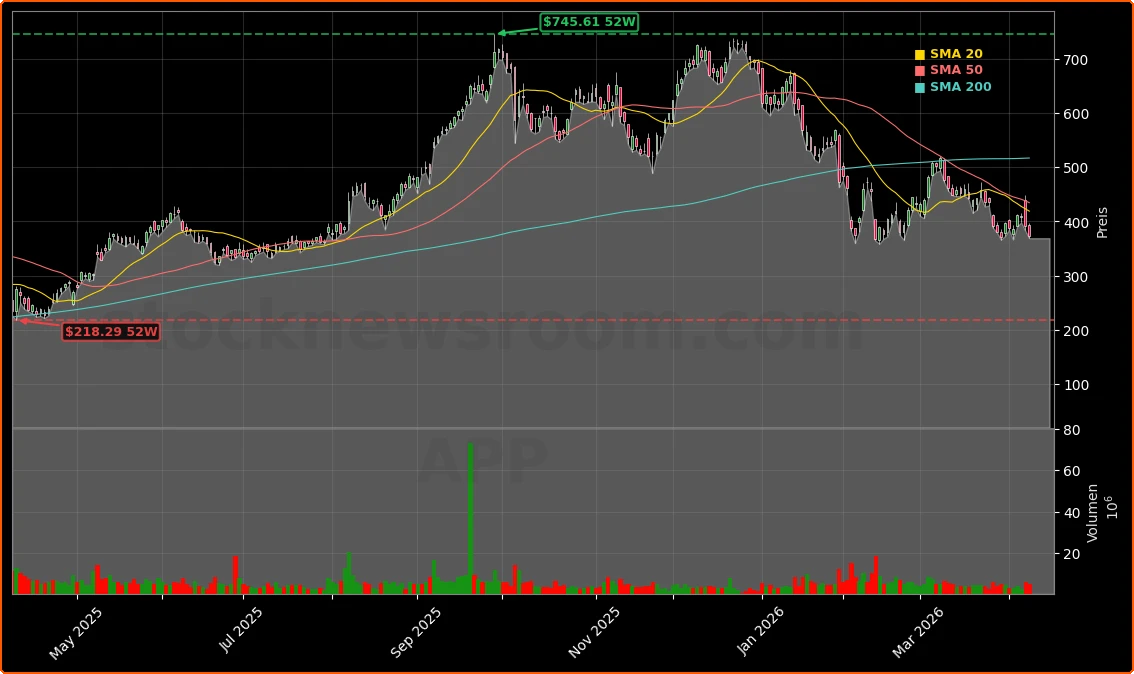
On Thursday, AppLovin closed at $373.60, down 4.5% on the day and far below its 52-week high of $745.61. The move extends a months-long slide that has knocked nearly half of the company’s market value despite standout fundamentals from its adtech pivot. That disconnect is exactly what Macquarie is leaning into with its fresh Outperform rating and $710 price target, implying substantial upside from current levels.
The initiation adds another bullish voice to an already optimistic analyst camp. Wedbush also rates AppLovin Corporation Outperform with an $800 target, arguing that the company’s “significant data moat” and AI-driven AXON 2 engine give it a durable edge in mobile and e-commerce advertising. Across Wall Street, the consensus target sits in the mid-$600s, leaving the new AppLovin Forecast from Macquarie above the pack and signaling elevated conviction despite near-term volatility.
Yet the price action tells a different story. Shares have been whipsawed by profit-taking across high-multiple AI names and growing investor focus on insider selling, regulatory risk, and competition from big platforms like NVIDIA-powered ad infrastructure and privacy shifts affecting the broader digital ad market.
How strong is AppLovin’s adtech transformation?
Since divesting its apps and mobile gaming business to Tripledot Studios in mid-2025 for $400 million in cash plus roughly 20% equity, AppLovin Corporation has emerged as a pure-play software platform. The result: a radically leaner, higher-margin model centered on AXON 2, its machine learning engine that optimizes user acquisition and monetization for app developers.
In Q4 2025, AppLovin generated $1.657 billion in revenue and delivered an eye-catching 84% adjusted EBITDA margin, up from 77% a year earlier. Total costs and expenses dropped to just 23% of revenue, highlighting extreme operating leverage. Free cash flow for 2025 reached nearly $3.95 billion, up almost 89% year-over-year, while capital expenditures were negligible at about $188,000 in Q4.
Management guided Q1 2026 revenue to $1.745–$1.775 billion, with EBITDA margins holding around 84%. That outlook underpins the bullish AppLovin Forecast, especially when paired with a forward P/E near 25x after the selloff—well below peak multiples but still rich versus the S&P 500. For growth-at-a-reasonable-price investors, that combination of top-line expansion, high margins, and strong cash conversion has kept APP on many watchlists.
What are analysts really pricing into the AppLovin Forecast?
Beyond Macquarie and Wedbush, a broad set of Wall Street firms maintain positive stances on AppLovin, with 23 buy ratings and only a handful of holds. Analyst models generally assume continued share gains in performance marketing, particularly as advertisers seek measurable return on ad spend in a more cautious macro backdrop.
Research from ChartMill highlights AppLovin as a textbook “GARP” (growth at a reasonable price) name within software and IT services, thanks to its superior margins and capital efficiency. Their aggregated analyst work recently pointed to a consensus target around the high-$600s, reinforcing that the central AppLovin Forecast still leans heavily bullish despite recent turbulence.
However, not all commentary is upbeat. TradingKey flagged a series of sharp down days in March, citing short-seller allegations about intensifying competition, insider selling, and concerns over premium valuation. Some analysts have trimmed targets, and technical indicators have moved to short-term sell readings, suggesting the path back toward Macquarie’s $710 target could be bumpy.
Do insider sales change the risk profile for US investors?
While the fundamental AppLovin Forecast remains strong, insider activity is complicating the narrative. Over March 2026, director Eduardo Vivas moved more than 180,000 shares via a mix of open-market sales and contributions to an exchange-traded fund, though he still holds over 6.9 million shares. The transactions were largely executed under a pre-arranged Rule 10b5-1 plan, but the size has drawn attention as the stock declines.
Meanwhile, CEO Arash Adam Foroughi sold roughly 40,700 shares in mid-March for more than $18 million while retaining a multi-million-share stake. Additional executive sales, including from the principal accounting officer, have fueled fears that insiders are taking chips off the table near prior highs.
Regulatory risk also looms. An active SEC investigation into data-collection practices adds uncertainty at a time when Washington and Brussels are tightening scrutiny of adtech and user tracking. For US investors used to similar narratives around Apple’s privacy shifts or digital ad concerns at Tesla and other high-profile growth names, this is a familiar—if uncomfortable—overlay on an otherwise stellar growth profile.
Volatility is another factor. With a beta above 2.5, AppLovin trades more like a leveraged play on the NASDAQ than a defensive compounder. In a risk-off tape, it can fall faster than AI peers like NVIDIA, even when fundamentals are intact.
Related Coverage: How does this fit broader AI volatility?
AppLovin’s current pullback follows a pattern seen across AI-linked software names. A recent deep dive, “AppLovin AI Competition: -10.1% Plunge Tests AI Hype”, examined whether a double-digit drop was an early warning sign that the AXON narrative was peaking, or simply macro-driven volatility. That piece underscored how quickly sentiment can flip when expectations are sky-high.
The sector picture matters too. In the workflow and enterprise software space, “ServiceNow AI Strategy -8.5% Crash Tests Investor Nerves” explored how another AI leader saw its stock hammered despite promising product updates. Taken together, these articles show that even best-in-class AI platforms can see their multiples compressed when Wall Street questions how much future growth is already priced in.
AppLovin has become a case study in AI-driven operating leverage, but the market is still trying to reconcile that strength with classic high-beta volatility.— Maik Kemper, Editor in Chief, stocknewsroom.com
For investors tracking the evolving AppLovin Forecast, the key takeaway is that the story now sits at the intersection of elite fundamentals, aggressive price targets, heightened regulatory scrutiny, and classic AI-cycle volatility. If AXON 2 continues to deliver and management proves its moat against new challengers, today’s compressed valuation could mark an attractive entry point. The next few quarters will reveal whether the bull case from Macquarie and peers can overpower market jitters and put AppLovin back on a leadership path in AI adtech.