Can Arm’s bold Arm AGI CPU push from IP licensor to full AI server chip vendor really rewrite the data‑center power map?

How is Arm reshaping its model with Arm AGI CPU?
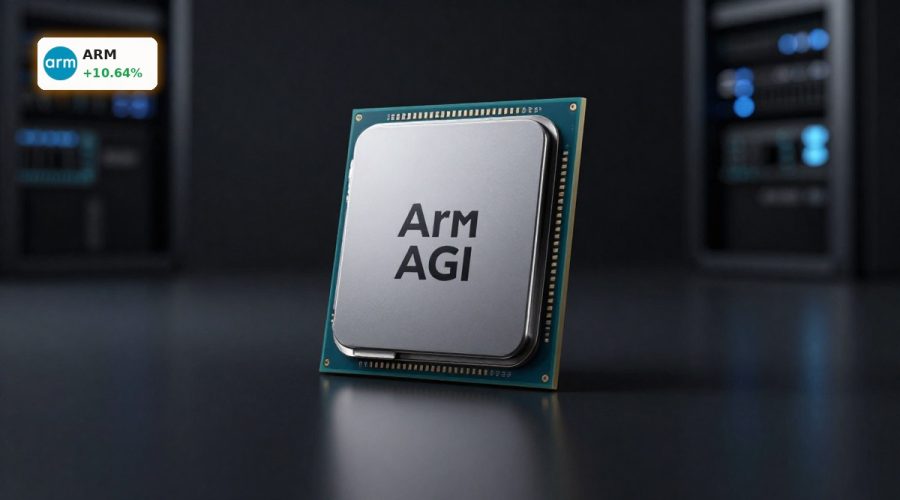
Arm Holdings (ARM) is breaking from its pure licensing playbook by selling a full server chip under its own brand. The Arm AGI CPU is a high‑performance, power‑efficient central processing unit designed specifically for AI inference and so‑called “agentic AI” workloads in hyperscale data centers. Instead of just collecting per‑unit royalties from partners, Arm will now book product revenue on every Arm AGI CPU shipped, with Taiwan Semiconductor Manufacturing reportedly handling fabrication.
Chief Executive Rene Haas told investors that the chip business alone could ramp to about $15 billion in annual sales around 2030–2031, up from roughly $4 billion in total company revenue in fiscal 2025. Management is targeting approximately $25 billion in total annual revenue and $9 in earnings per share over the same time frame, implying that the Arm AGI CPU could contribute a large share of the company’s future profit base while still coexisting with its high‑margin IP licensing engine.
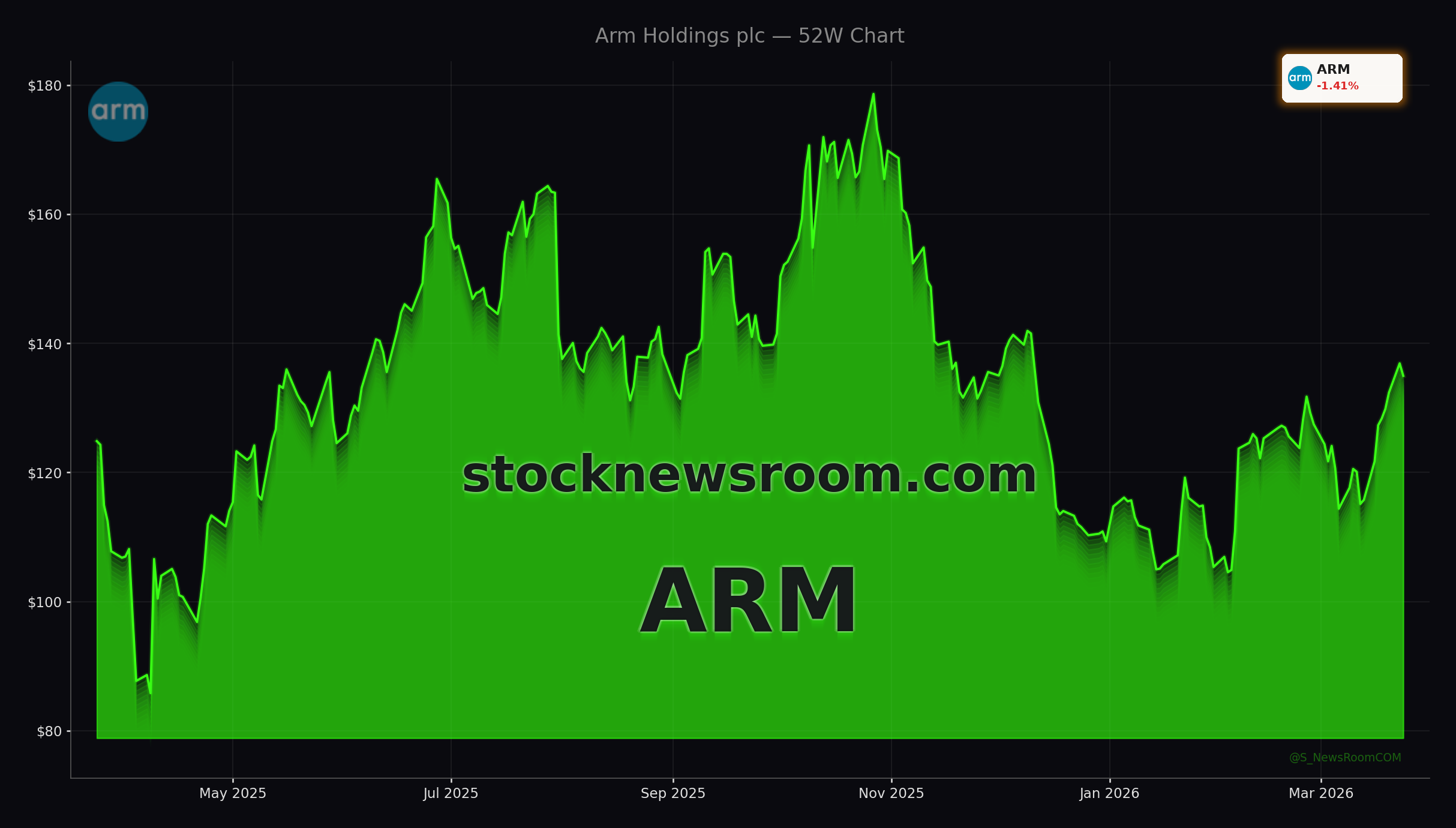
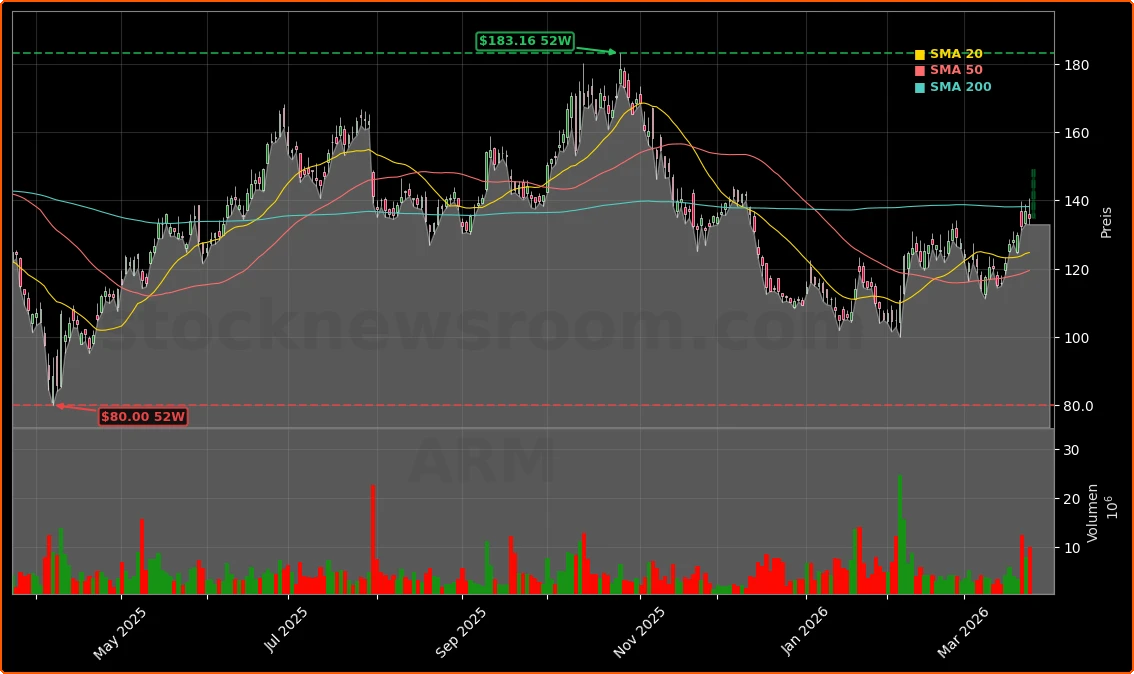
Wall Street is reacting quickly. Arm closed Tuesday at $134.96, down 1.41% on the day, but jumped into the mid‑$140s after hours and recently traded around $149.32 in pre‑market, up more than 10%. That is still well below the 52‑week high of $183.16, leaving room for further upside if the Arm AGI CPU executes on its multibillion‑dollar roadmap.
Which customers are backing Arm’s first AI chip?
Arm is not going into the data‑center CPU market alone. Meta is the lead partner and co‑developer for the Arm AGI CPU and will be the flagship launch customer as it pours over $100 billion into AI‑heavy data‑center build‑outs. Other early adopters include OpenAI, Cloudflare and SAP, which see the Arm AGI CPU as a way to scale AI agents and large language models while holding down power and capex costs.
The chip is designed to deliver roughly double the performance of comparable x86 server platforms for AI workloads, while maintaining Arm’s hallmark energy efficiency. That combination is critical as hyperscalers look to pack more compute into the same power envelope. Arm expects the rise of agentic AI to drive more than a fourfold increase in CPU demand per gigawatt of data‑center capacity, which would structurally favor Arm‑based architectures over more power‑hungry designs.
For now, the Arm AGI CPU is positioned as a complement, not a replacement, for AI accelerators from NVIDIA and other vendors. It is meant to handle orchestration, reasoning and data movement alongside GPUs rather than compete head‑on with them on raw matrix math. Still, by selling its own silicon into the rack next to those accelerators, Arm is stepping closer to the value pool that has powered the AI boom.
What does this mean for Nvidia, Intel and AMD?
The competitive implications of the Arm AGI CPU are nuanced for U.S. tech portfolios. For NVIDIA, the immediate threat is limited; analysts at Barron’s highlight that the new Arm chip primarily overlaps with Nvidia’s Grace/Vera CPU line, not its core GPU franchise that still drives the bulk of profits. KeyBanc’s John Vinh even called Arm’s server CPU push “constructive” for the ecosystem, broadening the Arm total addressable market with manageable channel conflict.
By contrast, Intel and AMD face a more direct challenge in their core x86 server CPU strongholds. Arm has already grabbed share in cloud infrastructure via custom chips at Apple, Amazon and Google; a standardized Arm AGI CPU gives operators that don’t design their own silicon an off‑the‑shelf alternative to Xeon and EPYC. HSBC expects Arm’s server CPU revenue to overtake smartphones as the company’s dominant segment by fiscal 2029 and maintains a Buy rating with a $205 price target.
Citigroup is also bullish. Its analysts describe the move into full server CPUs as the most significant strategic shift in Arm’s history and estimate that the projected $15 billion in annual Arm AGI CPU revenue could generate about $7.5 billion in incremental gross profit and $5 billion in operating profit versus prior expectations. That profit potential, in Citi’s view, should ease concerns about lower margins from moving into product sales and support a premium multiple versus traditional chipmakers.
How are SoftBank and other stakeholders positioned?
SoftBank Group still owns roughly 87% of Arm, making this pivot into the Arm AGI CPU a high‑stakes bet for the Japanese conglomerate. SoftBank shares rallied more than 7% in Tokyo trading as investors priced in a new, potentially higher‑growth revenue stream from Arm’s chip sales. If the Arm AGI CPU ramp unfolds as projected, Arm could emerge as a more vertically integrated AI infrastructure supplier, narrowing the strategic gap with NVIDIA and other fabless leaders.
Arm’s valuation remains rich: U.S. shares trade around 60–65 times forward earnings estimates, ahead of AMD and only slightly below Intel on a multiple basis despite Arm’s much faster projected growth. Raymond James recently upgraded Arm to Outperform with a $166 price target, citing the long‑term upside from AI data‑center exposure and the monetization potential of the Arm AGI CPU line.
Related Coverage
For a deeper dive into how this product could transform hyperscale infrastructure, readers can explore Arm Holdings AGI CPU Boom Shakes Up AI Data Centers, which analyzes whether the Arm AGI CPU can really rewrite the rules in AI data centers and challenge entrenched x86 incumbents. That piece examines performance claims, power metrics and early customer feedback to assess how disruptive Arm’s new chip might be to existing server CPU players.
The $15 billion in revenue forecast would drive such a significant increase in profit that the market should not worry about the change in margin structure.— Citigroup equity research
Overall, the Arm AGI CPU marks a decisive expansion from IP licensor to AI chip supplier, with management targeting $15 billion in annual chip revenue and $25 billion in total sales within about five years. For U.S. investors, the move puts Arm in more direct competition with Intel and AMD while deepening its strategic relevance alongside NVIDIA in the AI stack. The next milestones will be silicon availability at the end of this year and initial deployment data from Meta and other customers, which will show whether the Arm AGI CPU can live up to its billing as a new growth engine for Arm’s long‑term story.