Can the new Arm Holdings AGI CPU really turn a royalty-focused chip designer into a dominant force in AI data centers?

Is ARM’s new AI chip a game changer for Wall Street?
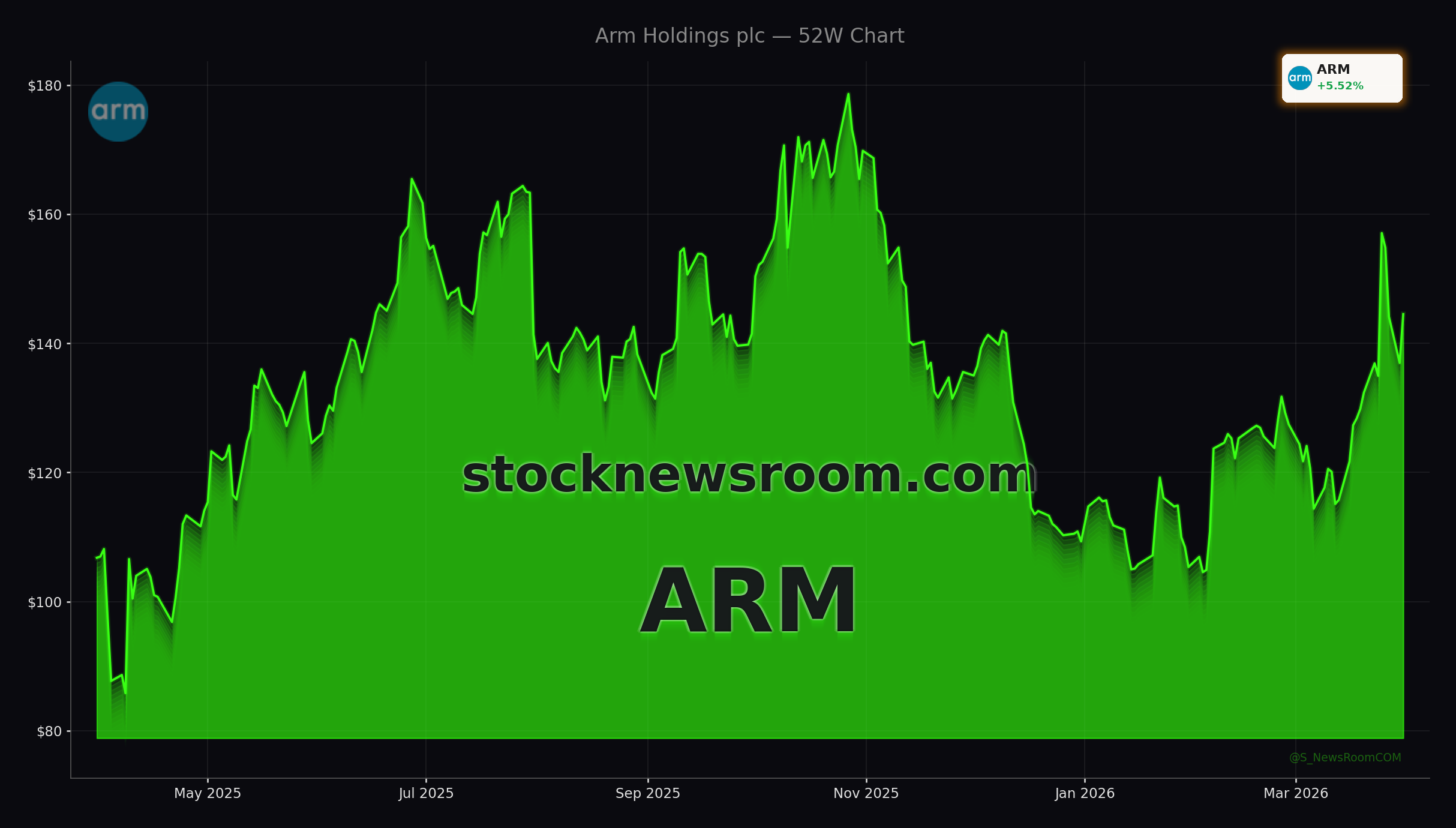
Arm Holdings plc (ARM) jumped to about $145.54 in recent trading, up roughly 6% on the day and extending a dramatic run since its IPO. The catalyst: management’s decision to build and sell its own data-center CPU, the Arm Holdings AGI CPU, designed specifically for agentic AI systems that operate more autonomously than today’s large language models. That strategic pivot turns ARM from a royalty-centric IP vendor into a hybrid model that also competes in the fiercely contested server-chip market.
For portfolios tilted toward AI beneficiaries like NVIDIA or cloud software names, the new Arm Holdings AGI CPU offers a differentiated angle on the same secular theme. Instead of another GPU story, ARM is betting that CPUs will play a growing role as AI shifts toward agents that plan, reason, and interact with external tools over long time horizons. These workloads can be more control-flow heavy and less purely matrix-math intensive, giving efficient CPUs a larger slice of the data-center silicon budget.
At the same time, the stock already trades at a rich multiple near 60 times forward earnings, leaving little room for missteps. Recent sessions saw a double-digit pullback on profit-taking and valuation concerns before today’s rebound, underscoring how sensitive ARM has become to headlines around its AI strategy.
How does the Arm Holdings AGI CPU change the business model?
Historically, ARM generated most of its revenue by licensing its instruction set and core designs to partners and collecting royalties on every chip shipped. The Arm Holdings AGI CPU adds a new layer: ARM will now ship complete server CPUs into data centers, while still running its core IP business in parallel. That means higher potential revenue per unit, but also higher capital intensity and more operational complexity, from tape-out risk to supply-chain management.
The initial customer list is a who’s who of AI infrastructure and enterprise tech. Meta Platforms has signed on as a lead partner, alongside specialized AI players like Cerebras and hyperscale-oriented infrastructure companies such as Cloudflare and OpenAI. Telecom and enterprise software partners, including SK Telecom and SAP, broaden the use-case landscape beyond hyperscale cloud to telco and mission-critical business workloads.
ARM is not building fabs; it continues to rely on foundry partners such as Taiwan Semiconductor Manufacturing for production. On the systems side, server makers including Quanta and Lenovo are expected to integrate the Arm Holdings AGI CPU into complete racks and platforms. This ecosystem-heavy approach mirrors how ARM conquered the smartphone space, but this time the company is closer to the end product and potentially to the pricing power.
What growth targets are management and analysts setting?
At its recent Arm Everywhere event on March 24, management projected that the Arm Holdings AGI CPU line could generate about $15 billion in annual revenue by 2031. That would lift total company revenue to roughly $25 billion and earnings to around $9 per share, versus an expected ~$5 billion in revenue this fiscal year. If achieved, that transition would turn ARM into one of the most important CPU vendors in the AI data-center space and significantly close the gap with incumbents.
Wall Street research is already recalibrating its models. Needham upgraded ARM to a “Buy” rating and set a $200 price target, implying meaningful upside from current levels. Analysts at Needham highlighted that ARM’s earlier high-stakes decisions—raising royalty rates, moving into subsystems, and now making its own silicon—are beginning to pay off and could disrupt the existing chip landscape in a positive way. Rosenblatt Securities, via analyst Kevin Cassidy, has reiterated a bullish stance with a $175 target, reinforcing the notion that major firms see ARM as a credible long-term AI winner.
However, valuation remains front and center. Some market commentary notes that, even with aggressive growth baked in, the stock’s premium multiple reflects near-perfect execution on the AGI CPU roadmap. Concerns include the risk of lower blended margins from chip sales compared with high-margin IP licensing, as well as the competitive response from x86 players and other Arm licensees.
How does ARM stack up against U.S. AI chip rivals?
For U.S. investors used to viewing NVIDIA as the core AI infrastructure holding, the Arm Holdings AGI CPU adds a CPU-centric complement rather than a direct GPU challenge. NVIDIA’s GPUs dominate training and many inference workloads, but agentic AI could increase demand for energy-efficient CPUs that orchestrate long-running tasks, host tools, and manage reasoning-heavy pipelines. That could also intersect with AI efforts by Apple in on-device intelligence and with autonomous systems developed by companies like Tesla, where Arm-based designs are already common in lower-power contexts.
ARM’s move also has implications for legacy CPU leaders. Intel and AMD have been pushing their own AI-optimized server CPUs to defend share against Arm-based alternatives in the cloud. By entering the market with a branded Arm Holdings AGI CPU, ARM is no longer just a neutral IP supplier; it is also a direct competitor in certain segments. That shift raises strategic questions for some existing licensees, but it could widen the overall Arm ecosystem if the AGI CPU accelerates software optimization for Arm architectures in the data center.
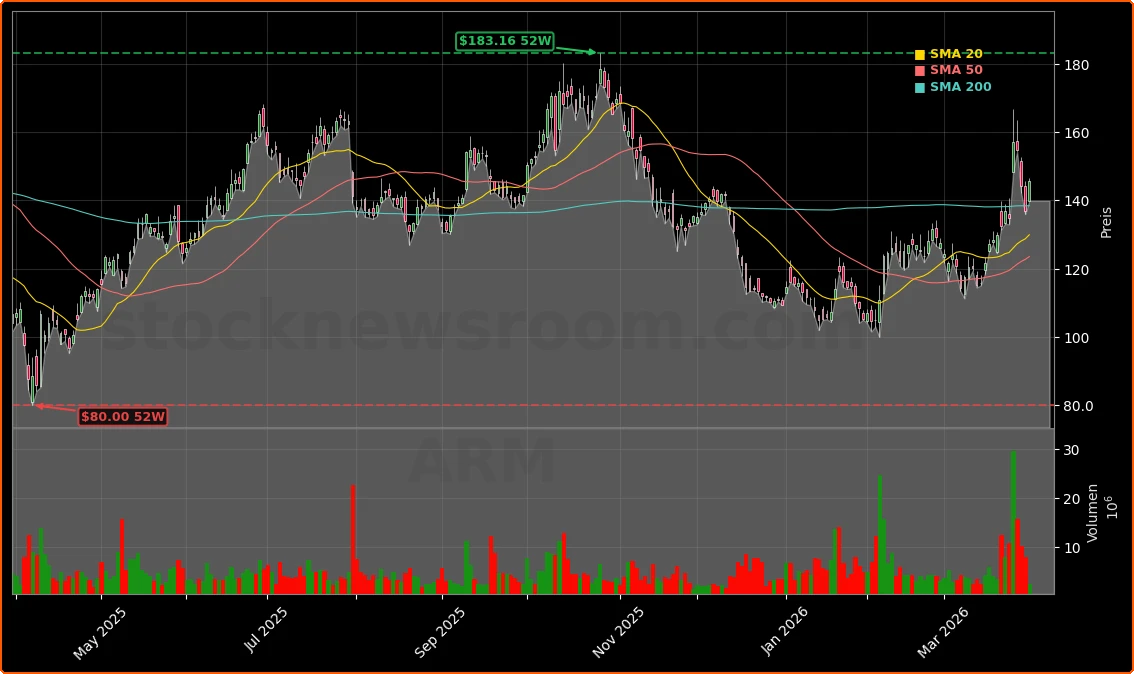
Technically, the stock has shown classic momentum behavior: a breakout on high volume following the AGI CPU announcement, a pullback toward key moving averages, and now an attempt to reclaim the $140–$145 area that traders are watching as a potential support-turned-resistance zone. With volatility elevated and short-term oscillators mixed, position sizing and time horizon will be critical for retail investors.
Related coverage for ARM-focused investors
Investors looking for a deeper dive into the strategic pivot behind the Arm Holdings AGI CPU can review the analysis at Arm AI Strategy -6.9%: Bold AI Chip Pivot Shock. That piece examines whether ARM’s in-house AGI CPU initiative can turn recent share-price weakness into a long-term multi-billion-dollar payoff, and how the shift from pure licensing to silicon sales may reshape risk and reward for shareholders.
With the rise of agentic AI and the growing role of CPU in AI data centers, we think ARM has become a credible AI play.— Needham analyst team on upgrading ARM to Buy
In summary, the Arm Holdings AGI CPU marks a decisive shift that could transform ARM from an IP toll collector into a front-line player in AI data-center hardware. For U.S. investors, the opportunity lies in ARM’s potential to capture a large slice of agentic AI spending, while the risk centers on valuation and flawless execution against entrenched rivals. The next milestones—initial deployments at customers like Meta and the pace of revenue ramp—will show whether this ambitious CPU push can justify ARM’s premium status in AI-focused portfolios.