Is Arm’s first in-house AI server CPU the move that finally turns its architecture dominance into full-blown data center profit power?

How is Arm reshaping its AI business model?
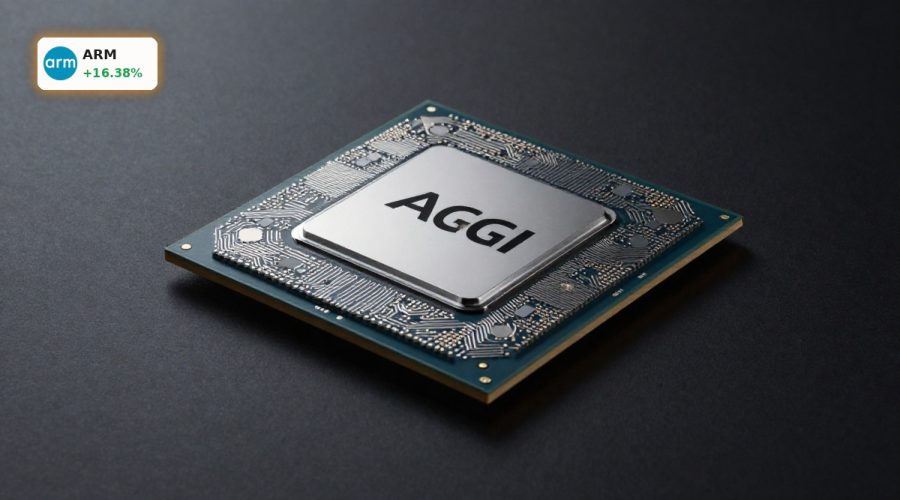
Arm Holdings erster eigener KI-Serverchip marks a fundamental break from the company’s asset-light past. Instead of only licensing architectures for others to manufacture, ARM is now selling its own merchant silicon, the AGI CPU, aimed squarely at agentic AI and inference workloads in hyperscale data centers. Management is effectively betting that the Arm Holdings AI Strategy Shift will allow the company to capture a much larger slice of the AI compute value chain.
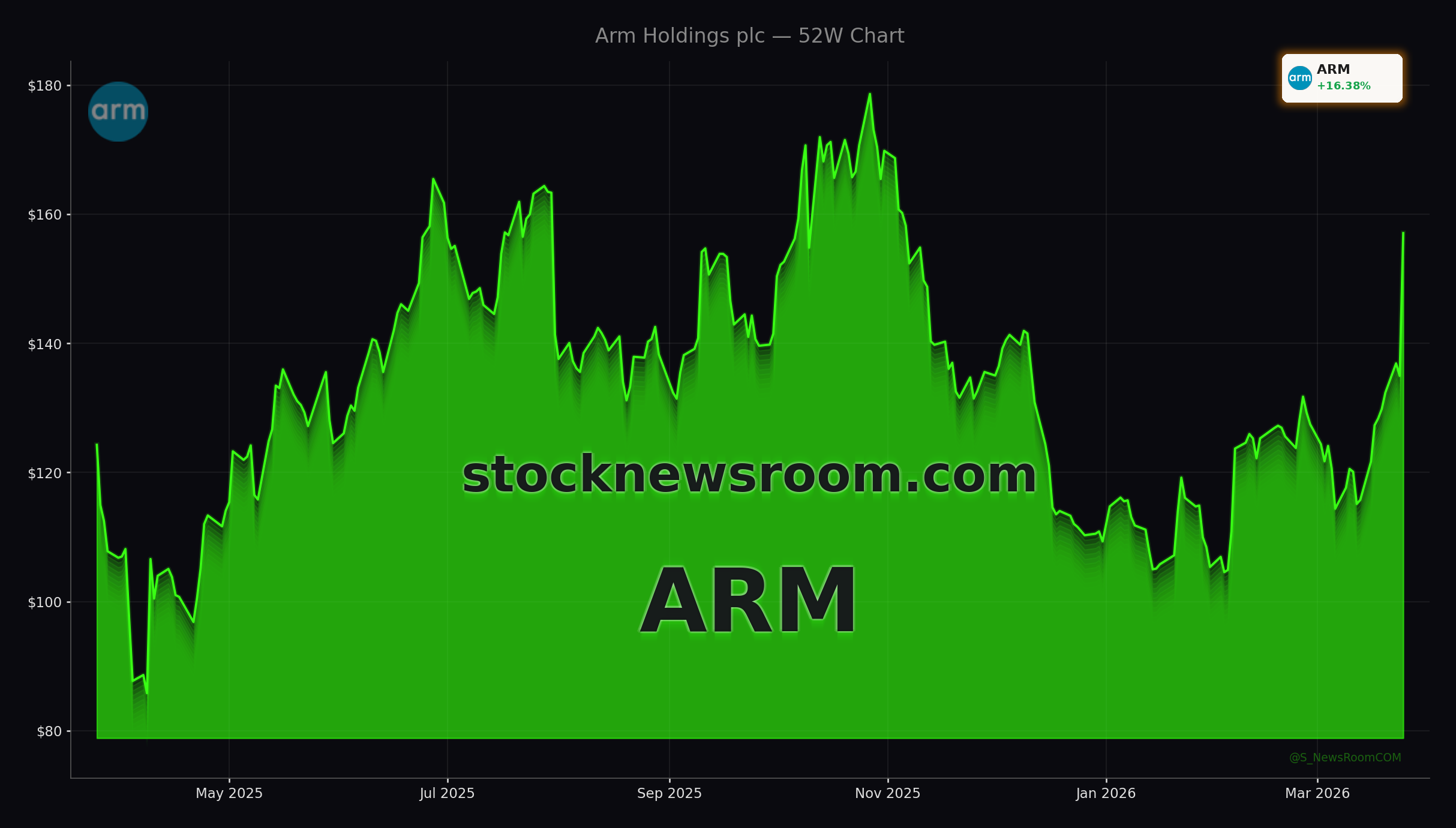
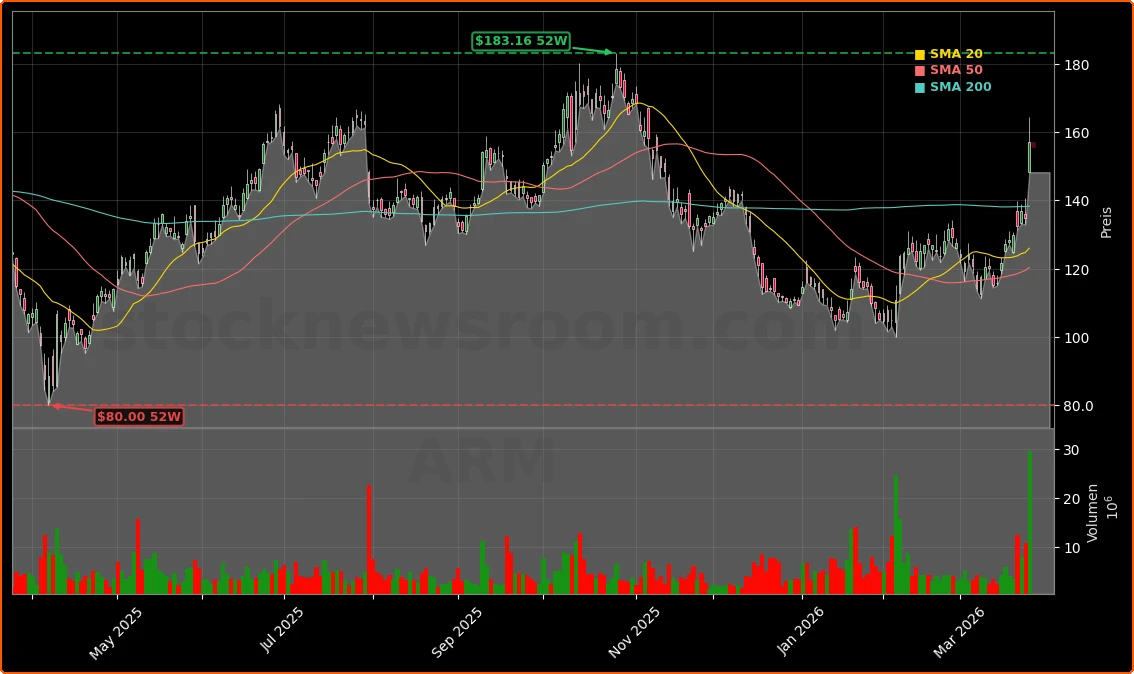
The stock reaction has been immediate. Shares of Arm Holdings plc (ARM) closed at $157.07 on Wednesday, up 16.38% on the day, with a slight pullback in early pre-market trading around $155.56 as of Thursday morning ET. That surge reflects investors’ enthusiasm for the new revenue stream layered on top of an already fast-growing royalty and licensing business.
CEO Rene Haas has framed this as a defining moment for the company, arguing that delivering production-ready silicon gives cloud and enterprise customers more choice while preserving ARM’s traditional emphasis on performance-per-watt efficiency. The Arm AGI CPU is fabricated by Taiwan Semiconductor Manufacturing on an advanced 3-nanometer process node, targeting more than double the performance per watt of competing x86-based platforms from Intel and AMD in key AI workloads.
Which customers are backing Arm’s new AI chip?
Early customer momentum has helped legitimize the Arm Holdings AI Strategy Shift in the eyes of Wall Street. Meta Platforms, which co-developed the AGI CPU, is the lead anchor customer and has reportedly committed to multiple chip generations for its expanding AI data center footprint. That puts ARM’s design at the heart of Meta’s multi-billion-dollar infrastructure build-out.
Beyond Meta, major AI ecosystem players are already lining up. OpenAI, Cerebras, Cloudflare and SAP are among the first adopters, underscoring the chip’s relevance for both AI model providers and cloud-native infrastructure companies. ARM is also targeting deep collaborations with the large US cloud platforms run by Amazon, Microsoft and Alphabet, where Arm-based server instances are already gaining traction.
Initial systems with the AGI CPU are available now from early hardware partners, with broader server availability expected in the second half of the year. That timing positions ARM to participate directly in the current AI data center investment supercycle, which has seen hyperscalers collectively commit hundreds of billions of dollars to new compute capacity. For US investors watching the AI arms race driven by NVIDIA GPUs and custom accelerators, ARM’s move fills in the CPU side of the equation.
What revenue and margin targets is Arm signaling?
The financial ambition behind the Arm Holdings AI Strategy Shift is aggressive. Haas is guiding for AGI CPU server revenue to ramp from roughly $1 billion in fiscal 2028 to about $15 billion in fiscal 2031. For context, total company revenue for fiscal 2026 is estimated around $4.9 billion, and ARM generated roughly $4 billion in fiscal 2025, so the chip business alone could exceed today’s entire company by a wide margin.
At the consolidated level, management is targeting about $25 billion in total revenue by fiscal 2031, with the new CPU line playing a central role. While margins from selling physical chips will be lower than ARM’s extremely high-margin royalty streams (recent adjusted gross margin was around 98%), the company still expects the AGI line to deliver at least 50% gross margin and operating margins above 30%. Those levels are attractive compared with many semiconductor peers and help justify the premium valuation investors are assigning to the stock.
ARM’s core business remains solid in the background. In its latest reported quarter, revenue climbed roughly 26% year over year to $1.24 billion, powered by 27% growth in recurring royalties and 25% growth in license and other revenue. The new AI chip effort is being layered atop that momentum rather than substituting for it, another reason the Arm Holdings AI Strategy Shift resonates with growth-focused portfolios.
How does this impact competition and analyst sentiment?
For US investors, the strategic implications stretch beyond ARM itself. By entering the server CPU market directly, ARM is challenging entrenched x86 vendors Intel and AMD in data centers, while also expanding its long-running partnership with NVIDIA, which uses ARM designs in several platforms. This adds another competitive vector to an AI infrastructure market that already includes custom silicon from hyperscalers and specialized accelerators from companies like Cerebras.
Wall Street research desks have responded positively. Guggenheim’s John DiFucci reiterated a Buy rating and lifted his ARM price target to $240 from $201, citing confidence in execution but acknowledging the risks inherent in a transformational launch. RBC Capital Markets analyst Srini Pajjuri kept an Outperform rating and raised his target to $175 from $130, noting strong early interest among “neoclouds” and enterprise customers, even as large hyperscalers continue to develop in-house chips. Raymond James went a step further, upgrading ARM to Outperform from Market Perform with a $166 target, highlighting the company’s move from pure IP licensor to fabless semiconductor vendor.
Other firms, including Evercore ISI, have argued that the AGI CPU is likely just the first chapter in a broader physical integrated circuit strategy. At least seven analysts have upgraded ratings or price targets following the announcement, even as some caution that ARM’s lofty forward price-to-earnings multiple in the 70s leaves little room for execution missteps.
From a trading perspective, the stock’s 16%+ jump has created a textbook breakaway gap on the NASDAQ, forcing short-sellers to reassess their positions. One trader example making the rounds involved closing a short as ARM pushed into resistance, just before the latest surge. With shares still well below some of the most bullish long-term targets, momentum-focused investors may continue to see the name as a central AI infrastructure play alongside Apple-ecosystem chip suppliers and high-profile AI beneficiaries like Tesla.
Related Coverage
For a deeper dive into how the AGI CPU could reshape the server landscape and challenge incumbent x86 vendors, readers can explore Arm AGI CPU $15B Boom: Can Arm Shock x86 Giants?. That analysis examines scenario-based revenue outcomes, competitive responses, and what a successful rollout could mean for long-term shareholders.
Today marks the next phase of the Arm compute platform and a defining moment for our company.— Rene Haas, CEO of Arm Holdings
The Arm Holdings AI Strategy Shift now ties together soaring AI data center demand, a new high-margin server CPU line, and expanding partnerships with some of the most influential names in tech. For US investors, ARM is evolving from a behind-the-scenes architecture provider into a direct player in AI compute, with the potential to become a core holding for those betting on long-term AI infrastructure growth. The next few product cycles and customer deployments will show whether this first in-house AI server chip can justify the premium valuation and cement ARM’s role at the center of the AI era.