
Can ASML’s EUV monopoly on cutting-edge AI chips outshine a sharp share-price pullback and rising legal and geopolitical risks?

Why is ASML under pressure while AI surges?
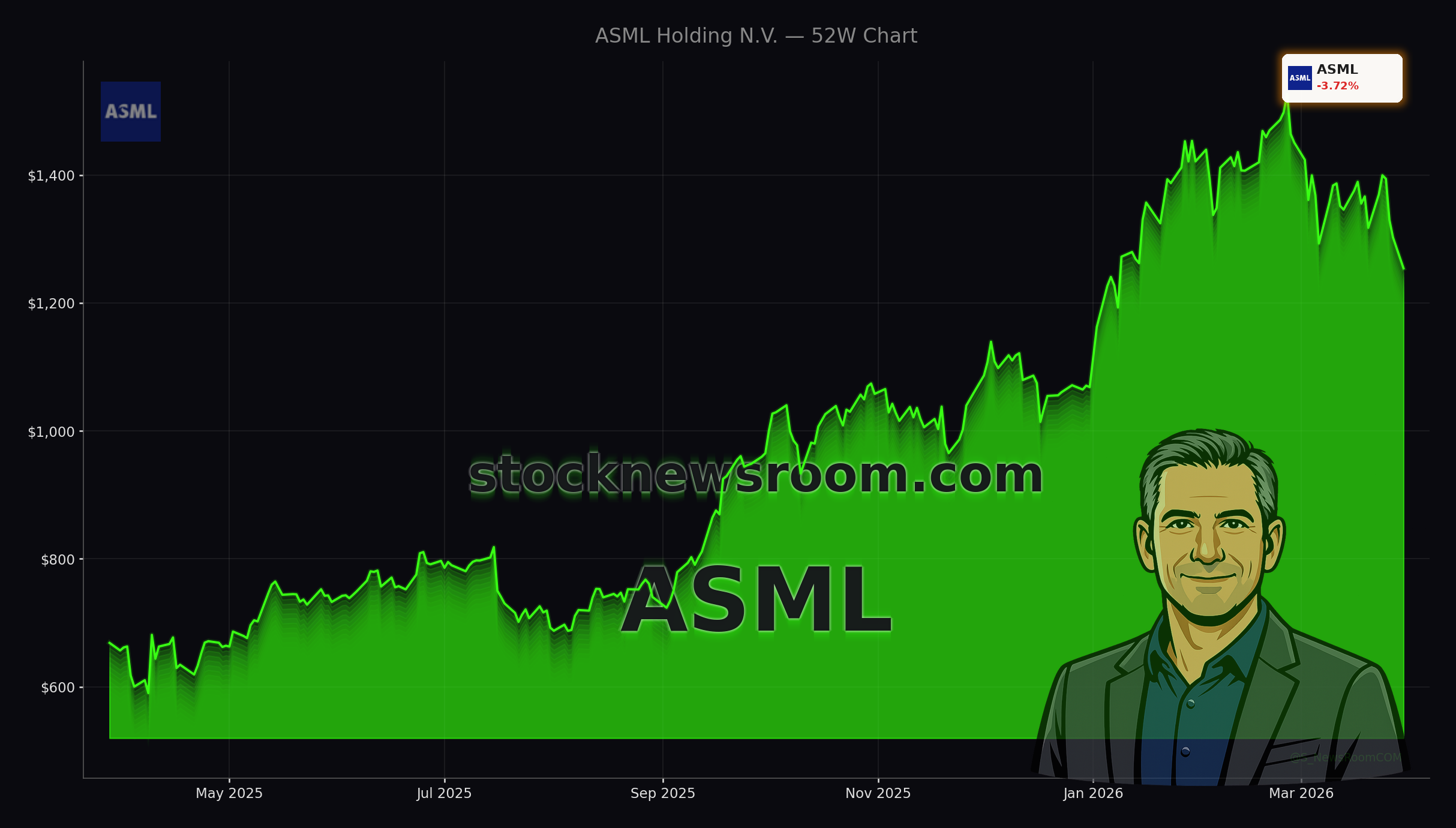
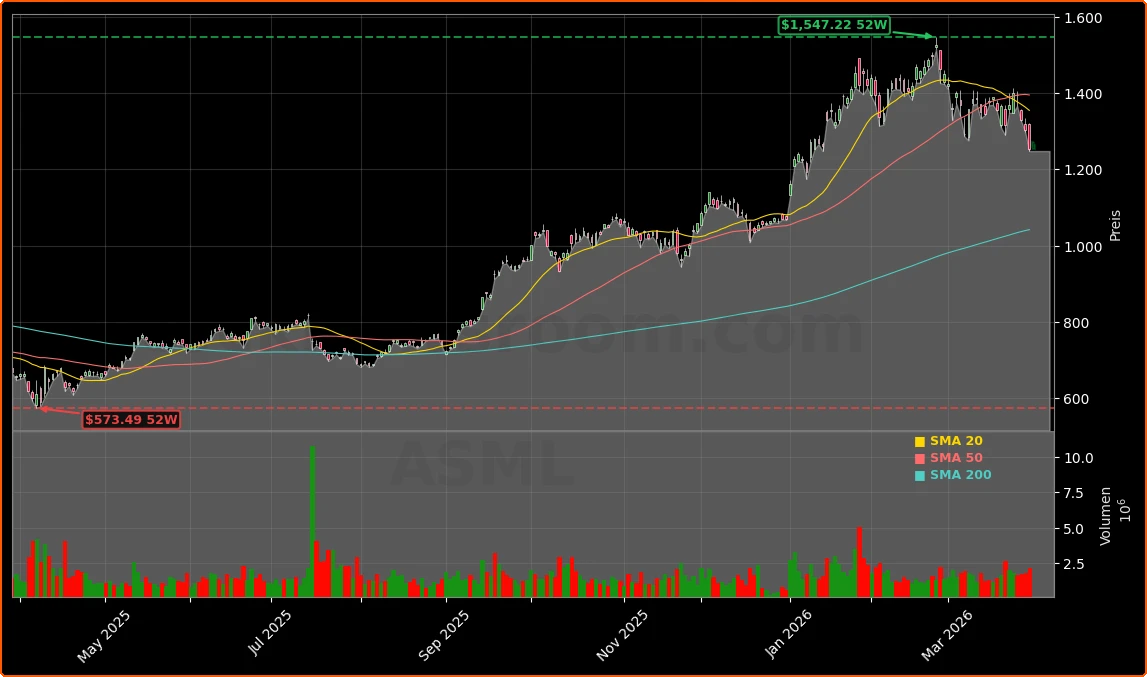
ASML shares fell about 3.7% on Monday to $1,253.96, extending a March correction of roughly 14% even as the broader AI theme continues to dominate Wall Street. The drop came alongside weakness in chipmakers and AI infrastructure stocks, with memory and equipment peers sliding sharply and weighing on the Nasdaq 100. Pre-market indications on Tuesday show ASML up about 1.3%, hinting at tentative dip-buying after the latest sell-off.
The move lower reflects several overlapping pressures: a sector-wide reset in expectations for 2026 growth, higher-for-longer interest rate worries and escalating geopolitical tensions that often hit export-sensitive European tech hardest. At the same time, investors are digesting a securities-fraud suit in the U.S. that accuses ASML of misrepresenting its 2025 outlook and recovery path; a judge recently allowed those claims to proceed, adding another layer of uncertainty around the stock.
Despite the pullback, the strategic story has not changed: ASML EUV Technology remains the only way to mass-produce the most advanced 7nm-and-below chips that power AI accelerators from leaders like NVIDIA. That tension between short-term volatility and long-term indispensability is now defining the risk-reward for U.S. portfolios.
How dominant is ASML EUV Technology in AI chips?
ASML Holding N.V. is the sole supplier of extreme ultraviolet (EUV) lithography machines used to etch ultra-fine patterns on silicon wafers for leading-edge semiconductors. Every modern AI processor, from data center GPUs to advanced smartphone SoCs, depends on chips fabricated with this ASML EUV Technology. Each EUV tool is roughly the size of a bus, can cost around $400 million, and requires multiple cargo jets or dozens of trucks to deliver and assemble, underscoring both the complexity and the high barriers to entry.
While a Chinese consortium has unveiled an EUV-like prototype, it is not expected to be ready for meaningful production until at least 2028–2030. By then, ASML plans to boost the power and throughput of its own EUV systems by roughly 50%, effectively widening its technological lead. Older deep ultraviolet (DUV) tools, some supplied by competitors like Applied Materials and Lam Research, remain relevant for mature nodes, but they cannot match the precision required for cutting-edge AI chips.
This monopoly-like grip on ASML EUV Technology has translated into robust fundamentals: 2025 revenue reached about EUR 32.6 billion, up 15% year over year, with earnings per share jumping 28% and a net margin close to 29%. The balance sheet remains conservative, with a debt-to-equity ratio near 0.22, giving management firepower to keep investing and returning cash to shareholders.
What do orders, backlogs and buybacks signal?
Momentum in demand is clearly visible in ASML’s booking trends. Net bookings more than doubled from 5,399 in Q3 2025 to 13,158 in Q4, driving full-year orders from 18,899 in 2024 to 28,035 in 2025. The current order backlog stands around EUR 38.8 billion, effectively locking in years of future revenue and providing rare visibility in a volatile sector.
Major customers are committing billions to secure capacity. Memory giant SK Hynix recently placed roughly $8 billion of orders for EUV systems to ramp production of advanced DRAM and high-bandwidth memory, both critical for AI servers. That follows aggressive capex plans from U.S. and Asian logic foundries that serve hyperscalers and chip designers such as NVIDIA and Apple.
Management is reinforcing its confidence with capital returns. Under a share repurchase program launched in late January, ASML has bought back more than 100,000 shares in recent days, spending about EUR 125 million. The company has also raised its dividend, with the latest quarterly payout implying an annual yield near 1%, modest but notable for a high-growth tech equipment name.
How are Wall Street and regulators reacting?
On the sell-side, the tone is mixed but generally positive over the medium term. Several European houses, including Barclays, Santander, Mizuho, Erste Group and Morgan Stanley, have turned more cautious on near-term revenue growth into 2026, contributing to the March downdraft in the stock. However, broader consensus still sits at a “Moderate Buy,” with an average price target around $1,480 and the most bullish calls approaching $2,000 per share, implying meaningful upside from current levels if ASML executes its roadmap.
Large options trades flagged by institutional “whale” activity show that sophisticated investors are actively positioning around the volatility. Some are using puts and spreads to hedge further downside, while others are buying longer-dated calls in anticipation that the AI and data center build-out will reassert itself as the dominant driver of value for ASML EUV Technology.
On the legal front, the U.S. securities-fraud case will likely remain an overhang until resolved or settled. Still, past experience in the semiconductor industry suggests that, barring evidence of systemic wrongdoing, long-term stock performance tends to track earnings and backlog more closely than courtroom headlines.
Related Coverage
For a deeper dive into how recent volatility fits into the broader AI narrative for ASML, readers can explore ASML AI Growth -4.5%: Correction as an Opportunity in the AI Boom?, which examines whether earlier pullbacks already reset expectations enough for long-term investors. Those tracking AI valuations beyond hardware should also read Palantir Forecast: -3.9% Crash Tests Its AI Premium for context on how software names with rich multiples are handling similar market pressure.
ASML EUV Technology remains a unique asset at the center of the global AI supply chain, and the latest correction looks more cyclical than structural. For U.S. investors comfortable with legal noise and macro-driven swings, the combination of monopoly economics, a EUR 38.8 billion backlog and accelerating innovation suggests ASML can stay a core long-term AI infrastructure play. The next few quarters of orders and execution will show whether the stock’s recent weakness was a brief detour on a longer AI-driven uptrend.