
Is the latest Beiersdorf Forecast a temporary stumble for a defensive staple or the start of a deeper rerating story?
Beiersdorf AG: Why a Defensive Staple Suddenly Looks Risky
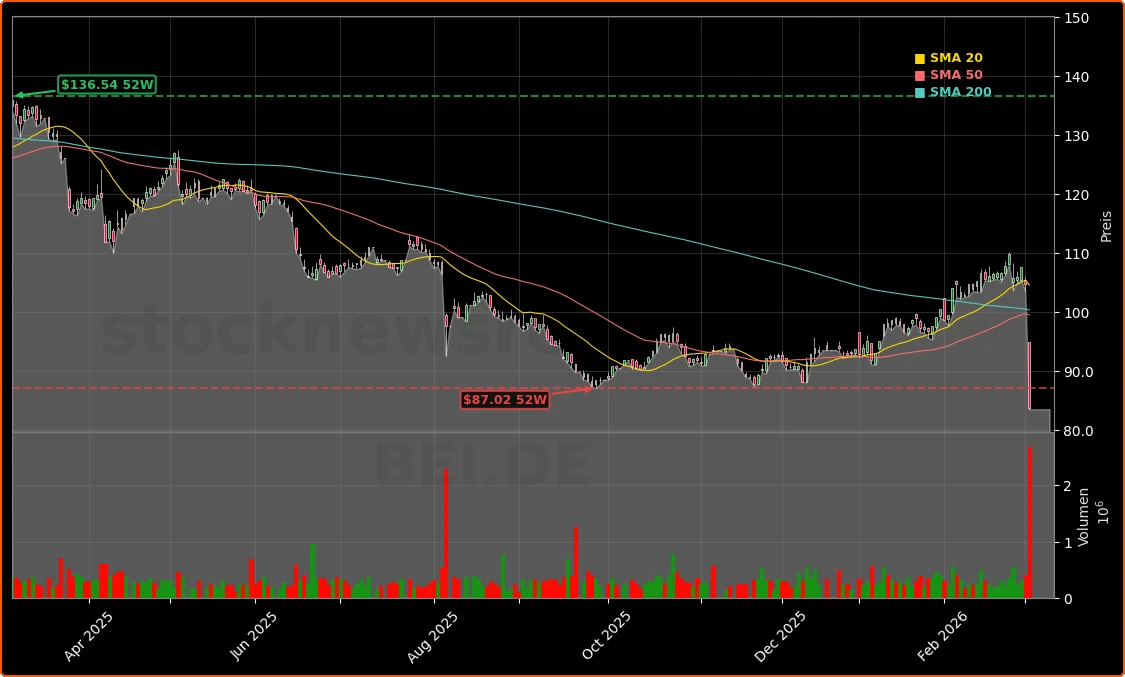
Beiersdorf AG, the German owner of Nivea, Hansaplast and Labello, has long been viewed as a textbook defensive stock: strong brands, everyday products, and steady demand even in downturns. That narrative has been shaken by the latest Beiersdorf Forecast, which signals that the group is now struggling with slowing growth, margin pressure and softer consumer demand. Following the guidance update, the stock slumped roughly 20% to about $83.66 from a previous close of $104.75, at one point being down nearly 13% intraday and hitting its lowest level in roughly four years.
The immediate trigger was not geopolitics or a one-off shock, but a structurally weaker outlook. After already moderating growth in 2024 and 2025, Beiersdorf now expects 2026 to bring only marginal revenue expansion and a declining operating margin. In a market environment where Wall Street has been rewarding predictable earnings compounders, this is exactly what investors did not want to hear. For U.S. and global portfolios, the question is whether this is company-specific execution risk or an early warning signal for the broader consumer-staples complex.
Beiersdorf Forecast: What Exactly Has Changed in the Outlook?
The core of the Beiersdorf Forecast problem lies in its growth and profitability profile. In 2025, the company generated sales of about EUR 9.9 billion. Management now expects that for the current year revenue will rise only marginally from that level, with growth described as likely lower than in previous years. Even more worrying for equity markets, the company signaled that operating profit may edge down rather than up, implying a contraction in margins rather than the expansion many investors had penciled in.
Looking at the recent growth trajectory underscores why the guidance hit sentiment so hard. Organically, Beiersdorf’s revenue grew 2.4% in 2024 but slowed to just 0.9% in 2025. The new Beiersdorf Forecast for 2026 points to another year of subdued top-line momentum and an explicit expectation of a declining margin. That is the opposite of the classic consumer-staples playbook, where high brand equity and pricing power usually translate into at least modest, steady growth and stable or improving profitability.
Compounding the issue, management has already had to trim guidance several times in the recent past, eroding confidence in their ability to deliver. In the current environment—characterized by higher funding costs, cautious retail investors, and quantitative screens that penalize negative earnings revisions—serial downgrades tend to trigger outsized share-price reactions. For Beiersdorf, the latest downward tilt in the Beiersdorf Forecast was enough to spark a broad re-rating of the stock’s valuation multiple.
Beiersdorf AG: Brand Power vs. Slowing Demand
From a fundamental perspective, Beiersdorf’s challenges are emerging at the core of its value proposition: its brands. Nivea, Hansaplast and Labello are widely recognized around the globe and have historically been considered almost “recession-proof” due to their low price points and everyday usage. Yet, the company now acknowledges that demand for these core brands weakened over the past year. This suggests that even basic personal-care products are not fully insulated from consumer belt-tightening when inflation and higher interest rates squeeze disposable incomes.
The shifting demand picture also hints at broader sector dynamics. In many regions, especially in Europe, consumers are increasingly trading down to private labels or cheaper alternatives, particularly in non-luxury categories. At the same time, input costs and logistics expenses have remained elevated, putting additional pressure on margins. Beiersdorf has been trying to balance price increases with volume retention, but the latest numbers suggest the trade-off has become more difficult to manage.
For U.S. investors accustomed to the resilience of large-cap consumer names like Apple’s services ecosystem or the pricing power seen at premium brands, Beiersdorf’s predicament is a reminder that not all defensives are created equal. In the personal-care category, where the product is often perceived as a commodity, brand loyalty can weaken when consumers are forced to scrutinize every dollar or euro spent. This is precisely what appears to be happening to Beiersdorf’s core portfolio.
Beiersdorf AG vs. Global Consumer Giants: How Does It Stack Up?
In a global context, Beiersdorf is a mid-sized player compared with mega-cap consumer and tech names that dominate Wall Street indices. While companies like NVIDIA or Tesla capture headlines with hyper-growth narratives, Beiersdorf has historically appealed to a different investor profile: those seeking stability, not explosive expansion. The current Beiersdorf Forecast undermines that stability thesis by signaling decelerating growth and rising earnings risk.
Relative to multinational consumer-goods leaders, the company now looks less compelling. U.S. and global peers have, in many cases, managed to sustain top-line growth in the low- to mid-single digits while pushing through price hikes to protect or expand margins. By contrast, Beiersdorf’s projected organic growth of around 1% or less, coupled with shrinking margins, lags this benchmark. That raises questions about its pricing power, product mix, and geographic footprint at a time when investors can increasingly choose among global staples listed on the NYSE or NASDAQ.
From a portfolio-construction angle, the stock also competes with high-quality, cash-generative U.S. names that offer reliable dividends and buybacks. Although Beiersdorf’s balance sheet and brand portfolio remain solid, the guidance reset makes it harder to justify a premium valuation multiple versus peers that are better aligned with the prevailing “quality growth” theme. The market’s swift reaction shows that global investors are willing to rotate quickly away from European staples when the risk-reward equation deteriorates.
Beiersdorf Forecast and Valuation: Is the Sell-Off Overdone?
With Beiersdorf’s share price now down more than 20% on the day to around $83.66 and touching its lowest level in four years, valuation naturally comes into focus. The key question for Wall Street and international investors is whether the new Beiersdorf Forecast is fully reflected in the current price, or whether further downside is likely as estimates continue to drift lower. The sharp one-day drop suggests a significant portion of the bad news has been rapidly priced in, but much depends on how analysts revise their sales and margin assumptions for 2026 and beyond.
Pre-guidance, the market implicitly treated Beiersdorf as a reliable, low-volatility compounder worthy of a relatively rich earnings multiple. The new outlook, featuring near-stagnant organic growth and a declining operating margin, is more akin to a mature, ex-growth franchise. If consensus earnings forecasts are cut meaningfully and the market applies a lower price-to-earnings multiple to reflect higher execution risk, there could still be room for additional downside. On the other hand, for contrarian investors comfortable with European exposure, the current discount might start to look appealing if they believe management can stabilize margins and reignite low-single-digit growth.
The fact that the company already had to reduce its expectations several times is a critical input for valuation. Forward multiples in such cases often remain capped until the market sees at least one or two quarters of guidance stability and operational delivery. For now, the Beiersdorf Forecast reset suggests that a “show-me” phase has begun, during which the stock is likely to trade more on realized results than on long-dated promises.
Beiersdorf AG and Analyst Perspectives: What Are the Street’s Key Concerns?
Sell-side analysts and institutional investors are focusing on three main issues in the wake of the new Beiersdorf Forecast: the durability of brand strength, the visibility of margins, and the risk of further guidance cuts. Major investment banks such as Citigroup, JPMorgan and UBS typically emphasize consistency in earnings for consumer-staples names. A pattern of slowing growth and repeated forecast downgrades usually prompts them to revisit ratings and price targets, even if they still regard the underlying franchise as solid.
While detailed, bank-specific rating changes for Beiersdorf have not yet all been disclosed in public market commentary following this latest move, the direction of travel is clear: the Street is increasingly concerned about the ability of the company to defend profitability in a world of sticky cost inflation and cautious consumers. Should institutions like Goldman Sachs or RBC Capital Markets revise their stance from bullish to more neutral tones such as “Hold” or “Sector Perform,” that would likely cement a lower valuation regime for the stock.
For active managers on Wall Street, another concern is opportunity cost. With U.S. indices like the S&P 500 and NASDAQ 100 still supported by earnings momentum in sectors such as semiconductors, cloud, and premium consumer electronics, holding a lagging European staples name becomes harder to justify unless the risk-reward is compelling. That puts pressure on Beiersdorf’s management to provide a more convincing medium-term framework at upcoming capital-market events and earnings calls.
Beiersdorf AG: Macro Headwinds, Supply Chains and What Comes Next
The broader macro backdrop helps explain why the Beiersdorf Forecast turned so cautious. Global consumer-goods manufacturers are grappling with a combination of weaker economic growth, ongoing supply-chain frictions and elevated input costs. Even as some logistics pressures have eased compared with the peak of pandemic-era disruptions, bottlenecks and regional cost spikes still complicate inventory management and pricing decisions.
For Beiersdorf, these factors translate into tighter margins and pressure on volumes. The company has indicated that supply-chain challenges and higher costs remain important headwinds. In a more benign macro environment, strong brands can often offset such pressures through incremental price increases and solid volume trends. But when the macro picture is fragile and consumers are trading down, that strategy loses effectiveness. The current situation suggests that Beiersdorf is caught in the middle: not weak enough to face existential risk, but not strong enough to sail smoothly through the turbulence without sacrificing either volume or margin.
Looking ahead, investors will watch closely for any signs that demand is stabilizing for key products and that cost pressures are normalizing. Specific KPIs to monitor include organic sales growth in the mid-single-digit aspiration range (if management reiterates such a target), gross margin trends, and the trajectory of operating expenses as a percentage of sales. Any evidence that volumes are starting to recover without eroding margin further would be a positive signal that the worst of the guidance downgrades might be behind the company.
What the Beiersdorf Forecast Means for U.S. and Global Portfolios
The implications of the Beiersdorf Forecast extend beyond a single European stock. For international investors, it raises questions about the traditional playbook of rotating into consumer staples as a safe harbor when growth sectors become volatile. If even household-name brands in basic personal care are seeing demand soften and margins slip, the defensive character of the sector could be less robust than previously assumed.
For U.S.-based investors, the situation also highlights the importance of selectivity within international allocations. While some European consumer names may still offer attractive combinations of yield and stability, Beiersdorf’s recent experience demonstrates that regional macro weakness, cost inflation and changing consumer habits can undermine even well-known franchises. This may incentivize investors to lean more heavily on globally diversified or U.S.-centric staples and to consider whether the expected return from stocks like Beiersdorf justifies the added complexity of currency and political risk.
Conclusion
At the same time, long-term investors with a contrarian bent may see opportunity in the current dislocation. A four-year low in the share price, coupled with enduring brand recognition and potential for operational improvements, could set the stage for a gradual recovery if management executes well. However, any such thesis must explicitly incorporate the lessons of the latest Beiersdorf Forecast: slower growth, margin compression and the real possibility that the company remains in a repair phase for several quarters before a convincing turnaround emerges.
Further Reading
- Beiersdorf AG company profile and financials (Reuters)
- Beiersdorf AG overview (Bloomberg)
- Beiersdorf AG annual report and investor information (Beiersdorf)
- Beiersdorf AG bei Yahoo Finance (Yahoo Finance)