
Are Best Buy earnings signaling a durable margin boom or just a short-lived pop driven by cautious guidance and short covering?
Best Buy Earnings: What Exactly Drove The 7% Pop?
The latest Best Buy Earnings report landed firmly on the side of profits over growth. For the holiday quarter, Best Buy posted adjusted earnings per share (EPS) of $2.61, ahead of Wall Street estimates around $2.46. That upside came despite revenue of about $13.8 billion missing consensus and showing flat to slightly negative year-over-year trends. The market reaction was immediate: the stock closed up roughly 7% on the day and logged its biggest single-session jump since October.
Behind the EPS beat was a powerful improvement in profitability. Operating income for the quarter roughly tripled to around $721 million, amid better-than-expected margins and tight cost control. Full-year net income rose about 15% to $1.07 billion on essentially flat sales of $41.7 billion, underlining how much of the current story is about efficiency rather than top-line acceleration. In the context of a cautious U.S. consumer pulling back from big-ticket electronics, that margin resilience carried more weight than the modest revenue shortfall.
At the same time, the guidance embedded in these Best Buy Earnings was intentionally conservative. For the new fiscal year, management projected revenue between $41.2 billion and $42.1 billion and adjusted EPS of $6.30 to $6.60. Both ranges bracket the prior year’s performance but sit slightly below where many analysts had been modeling; Street consensus for EPS had been closer to $6.67. Even so, several research desks characterized the outlook as “better than feared” rather than truly bearish, especially given weak high-frequency sales data going into the print that had spooked some investors.
Layered on top of all this is a relatively elevated short interest, around 11% of float. JPMorgan has flagged Best Buy as a top short within its coverage universe, and the combination of an upside EPS surprise, no guidance disaster, and an increased dividend created a textbook setup for a short-covering rally. That backdrop is why some on Wall Street see the initial reaction to these Best Buy Earnings as at least partially driven by positioning rather than purely by long-term buyers stepping in.
Best Buy: How Sustainable Is The Margin Story?
The standout feature of the Best Buy Earnings release was margin strength in a difficult retail climate. Operating income percentage improved meaningfully as Best Buy leaned into cost discipline, optimized inventory, and benefited from a lower effective tariff rate after a favorable Supreme Court ruling. That tariff relief helped blunt some inflationary pressures in the electronics supply chain and was a quiet but important tailwind to holiday profitability.
In addition, the company’s U.S. digital marketplace contributed to margin stability. While overall revenue hovered roughly flat, the shift toward higher-margin services and platform-like marketplace sales supported earnings. Operating income more than tripled in the quarter relative to the prior year period, a sign that the management team is successfully extracting more profit from each dollar of sales even as unit volumes soften in categories like TVs, PCs, and appliances.
Looking ahead, the question for investors is whether these margin gains are cyclical or structural. Some elements, such as the tariff benefit, may fade or at least stop being incremental drivers. Others, like process improvements and a leaner cost base, can endure and compound. Best Buy is explicitly steering the business toward profitability and cash returns, as evidenced by its capital allocation: in fiscal 2026, the company returned about $1.07 billion to shareholders through dividends and buybacks.
The guidance range for adjusted EPS of $6.30 to $6.60 implicitly assumes that current margin levels can be held or even modestly improved while revenue remains roughly stable. This is not a high-growth story; it is a cash-flow and yield story. That dynamic differentiates Best Buy from high-multiple tech hardware names such as Apple or high-growth AI infrastructure players like NVIDIA, which rely more on top-line acceleration than incremental margin optimization.
Best Buy: What Does The Dividend Hike Tell Investors?
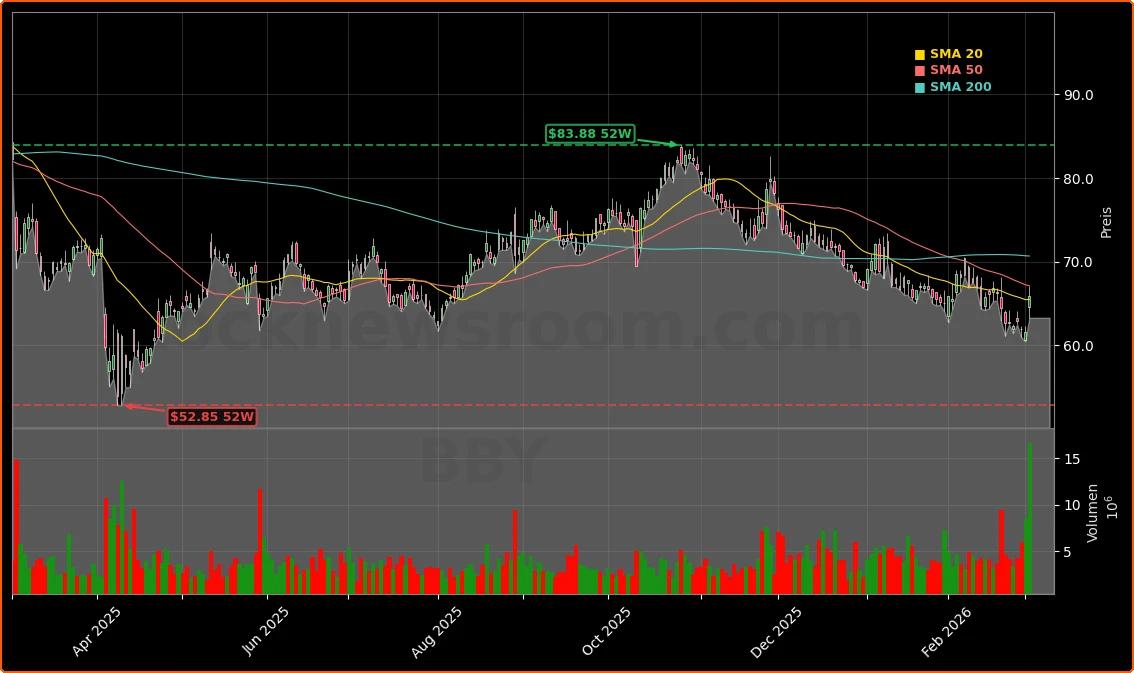
One of the more underappreciated signals in the Best Buy Earnings release was the board’s decision to raise the quarterly dividend by about 1% to $0.96 per share. On an annualized basis, that represents $3.84 per share. With the stock trading near $66 after the post-earnings rally, the indicated dividend yield sits comfortably above 5%, placing Best Buy squarely in high-yield territory for a consumer electronics retailer.
For income-focused investors, this is significant. The new payout appears well covered by the company’s EPS guidance of $6.30 to $6.60, implying a payout ratio in the 58–61% range at the midpoint. That leaves room for continued buybacks and selective reinvestment, even if earnings growth remains modest. The fact that management felt confident enough to raise the dividend despite flattish revenue underlines its belief that cash generation will remain robust.
That said, not everyone on Wall Street is enthusiastic. A recent downgrade on Best Buy argued that the roughly 6% dividend yield (pre-rally) reflects a lack of compelling growth initiatives relative to e-commerce competitors and big-box peers. The critique is that Best Buy has become more of a bond proxy than a growth stock, with limited differentiation versus online giants and retailers with broader ecosystems. From a portfolio-construction standpoint, that may still be acceptable for investors seeking stable income and moderate total return instead of aggressive capital appreciation.
Viewed through that lens, these Best Buy Earnings reinforced the company’s identity as a mature, cash-generating retailer rather than a disruptive tech platform. The modest dividend hike is a message to long-term shareholders: expect steady, not spectacular, but count on being paid while you wait.
Best Buy: How Healthy Is The Consumer And The In-Store Model?
Beyond the headline numbers, management commentary around customer behavior adds nuance to the Best Buy Earnings story. CEO Corie Barry emphasized that the U.S. consumer remains resilient but highly selective. Best Buy’s core customer skew is toward higher-income households, particularly those earning above $100,000 per year. That cohort has held up relatively well in the current macro environment and has been a stabilizing force for big-ticket spending.
Interestingly, Barry highlighted that younger shoppers are actually visiting physical stores more frequently, not less. In an era where Amazon and other e-commerce players dominate narrative headlines, this suggests there is still a meaningful role for a high-touch, experiential store footprint in categories such as home theater, gaming, and connected home. Being able to speak to knowledgeable staff, test products, and get installation support remains a differentiator that pure online platforms cannot fully replicate.
However, comparable-store sales were down modestly, and overall revenue dipped around 0.8% in the quarter as customers deferred or traded down on large purchases. That tension—between stable high-income demand and broad-based caution on expensive items—is likely to persist into fiscal 2027. Best Buy’s strategic bet on AI, smarter recommendation systems, and its digital marketplace is partly aimed at increasing conversion and basket size even when traffic is not booming.
Compared with other consumer-facing giants like Tesla on the auto side or device ecosystems such as Apple, Best Buy plays more of a channel and service-enabler role. It is leveraged to upgrade cycles in TVs, PCs, smartphones, and home electronics, but it doesn’t control the underlying product roadmaps. That makes demand somewhat lumpy and cyclical, driven by new product introductions, housing trends, and macro confidence. Investors in Best Buy need to be comfortable with that cyclicality, even if the balance sheet and cash profile are relatively solid.
Best Buy: Is The Stock Rally Just A Short Squeeze?
With short interest around 11% of float heading into the report, positioning was clearly skewed toward pessimism. Concerns were centered on weak high-frequency data, ongoing softness in big-ticket categories, and the perception that e-commerce competitors were steadily eroding Best Buy’s share. JPMorgan’s designation of Best Buy as a “top short” in its sector further underscored the bearish consensus.
The outcome of the Best Buy Earnings report undercut the more dire bearish theses. The company did not issue a profit warning; guidance suggested stable to slightly improving EPS; and margin performance was stronger than most had modeled. That was enough to force at least some shorts to cover, contributing to the sharp upward move in the stock. Citi pointed out that pre-earnings fears driven by recent data had been overstated, and Evercore ISI characterized the guidance as signaling moderate growth relative to prior anxious expectations.
The critical issue now is whether fresh long money will follow the covering rally. At around $66, Best Buy trades at roughly 10–11x the midpoint of its EPS guidance range. That is a discount to many growth retailers and miles below the multiples accorded to high-profile tech names like NVIDIA or platform companies built around ecosystems like Apple. On a pure valuation basis, the stock looks inexpensive, especially considering its healthy dividend and buyback program.
Yet a low multiple alone does not guarantee outperformance. Skeptics argue that without clear, durable growth catalysts—such as a breakthrough services platform, unique subscription ecosystem, or differentiated omnichannel technology—Best Buy may remain a value trap, bouncing between attractive yield and structural headwinds from online competition. The next few quarters will be crucial in showing whether AI-driven personalization, marketplace expansion, and services can move the needle beyond simple cost-cutting.
Best Buy: Portfolio Role And Risk/Reward After The Latest Earnings
For U.S. and international investors weighing exposure after these Best Buy Earnings, the stock falls into a hybrid category: part value, part income, part cyclical consumer play. At the current price near $65.95, shares remain well below prior cycle highs, and the post-earnings move does not represent a new 52-week high. The roughly 7% jump has reset sentiment closer to neutral, but positioning is unlikely to have fully normalized given the still-elevated short interest.
On the positive side, Best Buy offers a compelling combination of yield, reasonable valuation, and operational competence. The company has demonstrated an ability to protect and even expand margins in a low-growth environment, supported by tariff relief, cost optimization, and a growing marketplace. The balance sheet supports ongoing shareholder returns, and management’s focus on higher-income consumers provides some insulation against macro volatility.
On the risk side, the structural challenges are real. Revenue growth is essentially flat; comparable sales remain under pressure; and the brand’s differentiation versus pure-play e-commerce and big-box generalists is not ironclad. If big-ticket demand weakens further, or if the AI and marketplace investments fail to materially accelerate growth, investors could be left with a 5–6% yield but limited capital appreciation over time. Moreover, if interest rates stay higher for longer, high-yield equities may face valuation pressure as investors can obtain similar income from safer fixed-income instruments.
Conclusion
From a portfolio-construction standpoint, Best Buy may make sense as a tactical holding for dividend and value investors who believe that the U.S. consumer will avoid a deep downturn and that electronics demand will gradually normalize. Growth-oriented investors focused on secular trends in software, AI, and EVs may still prefer names like NVIDIA, Apple, or Tesla for long-term compounding, using Best Buy more as an income diversifier rather than a core growth engine.
Further Reading
- Best Buy Co., Inc. (BBY) on Yahoo Finance (Yahoo Finance)
- Best Buy (BBY) Climbs 7% as Earnings Impress (Finviz)
- Best Buy (BBY) Turns Tariff Break, Digital Marketplace Into Earnings Beat (Benzinga)
- Best Buy (NYSE: BBY) posts Q4 FY26 EPS jump and sets FY27 outlook (Stock Titan)