
Can BioNTech’s surprise leadership change and deepening losses turn a Covid-era star into a long-term oncology value play or a value trap?
How did markets react to BioNTech Leadership Change?
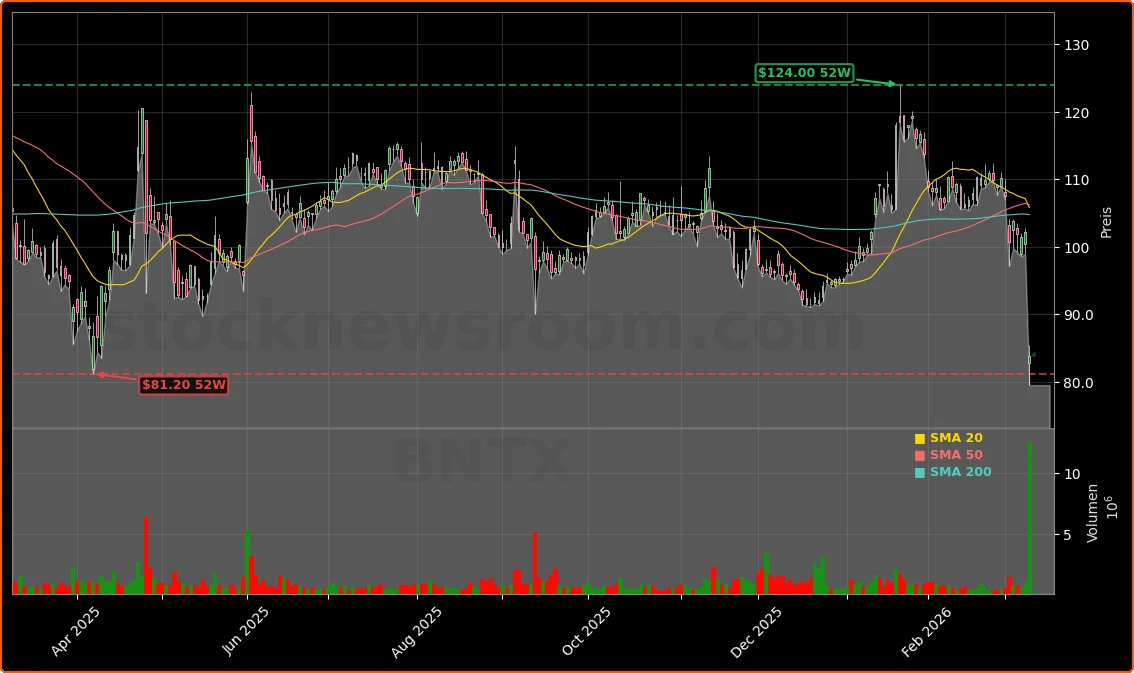
On Wall Street, BNTX was the clear underperformer on Tuesday. The stock closed at $83.89, down 17.9% from the prior close of $102.24, after trading as much as 21% lower intraday and marking a new 52‑week low. After-hours, the stock stabilized slightly around $84.30. The drop stands in stark contrast to the broader NASDAQ, which was roughly flat on the day, underscoring how company‑specific the sell‑off was.
Investors were forced to digest three shocks at once: a wider‑than‑expected quarterly loss, a cautious full‑year 2026 outlook, and the surprise announcement that Sahin (CEO) and Türeci (Chief Medical Officer) will exit the C‑suite by the end of 2026 to build a new mRNA‑focused startup. While the company stressed continuity in strategy and governance, the market treated the BioNTech Leadership Change as a clear negative, repricing the stock as if its Covid halo had definitively evaporated.
For context, BNTX is now trading dramatically below its pandemic peak and has underperformed high‑profile innovators like NVIDIA and Tesla over the past year, despite a sizeable cash war chest and a broad oncology pipeline. That disconnect is at the core of the current debate: is this a broken growth story, or a volatile deep‑value biotech opportunity?
What is driving the financial setback at BioNTech?
For 2025, BioNTech SE swung to a net loss of about EUR 1.12–1.14 billion, almost double the prior-year deficit of roughly EUR 665 million, even as revenue ticked up to around EUR 2.87 billion from EUR 2.76 billion. The top line benefited from upfront payments tied to a potentially $11.1 billion oncology collaboration with Bristol Myers Squibb, but that was more than offset by heavy research and development spending and shrinking Covid‑19 vaccine sales.
In Q4 2025, revenue fell to EUR 907.4 million from EUR 1.19 billion a year earlier, while adjusted earnings dropped into the red at –EUR 0.33 per share, missing consensus that had expected a smaller loss. Some commentary on Wall Street highlighted that the loss itself was not a major surprise given the expected Covid headwinds. The real disappointment came from guidance.
For 2026, management now sees revenue between EUR 2.0 and 2.3 billion, well below analyst expectations near EUR 2.7–2.75 billion. At the same time, BioNTech SE plans to spend EUR 2.2–2.5 billion on R&D as it pushes more than 20 oncology candidates through mid‑ and late‑stage trials, targeting up to 15 late‑stage studies by year‑end. That means cash burn will remain high, even though the company still holds an impressive liquidity position of roughly EUR 14.5 billion to fund its transition from Covid winner to diversified cancer‑focused biotech.
What exactly changes under the BioNTech Leadership Change?
The BioNTech Leadership Change centers on founders Ugur Sahin and Özlem Türeci, who created BioNTech SE in 2008 and became global figures during the pandemic through their mRNA Covid vaccine program with Pfizer. The pair will leave operational roles by the end of 2026, when their current service contracts expire, to build a new independent biotech company focused on next‑generation mRNA medicines.
Importantly for shareholders, Sahin and Türeci intend to remain long‑term investors in BioNTech SE, currently holding about 15% of the company. BioNTech, in turn, plans to contribute selected mRNA rights and technologies to the new venture in exchange for a minority equity stake, potential milestone payments, and sales royalties. A binding agreement is expected by mid‑2026. The new company will be separate, not a subsidiary, but cross‑licensing and collaboration are explicitly on the table.
BioNTech’s supervisory board has already launched a search for a new CEO and medical chief to ensure a “smooth transition.” Some analysts, including Deutsche Bank Research’s Emmanuel Papadakis, have characterized the founders’ exit as a mixed signal: on one hand, it could create a future competitor in mRNA; on the other, it may make BioNTech more digestible as a potential strategic target for large pharma if key oncology assets like the tumor antibody Pumitamig deliver strong data.
How does BioNTech stack up vs. U.S. biotech peers?
For U.S. investors used to the volatility of biotech names such as Apple’s health‑adjacent partners, Moderna, or oncology specialists on the NASDAQ, BioNTech’s current pivot looks familiar. Like Moderna, BioNTech must now prove that its mRNA platform can generate sustainable oncology and infectious‑disease revenue in a post‑Covid world, while justifying multibillion‑euro annual R&D spend.
On valuation, the post‑crash share price implies that a large portion of Covid cash flows are behind the company and that the success probability of its cancer pipeline is being discounted heavily. Some bullish voices argue the sell‑off is overdone, pointing to the strong balance sheet, the Bristol Myers Squibb partnership, and the prospect of multiple oncology approvals by 2030. Others remain cautious, emphasizing execution risk around the BioNTech Leadership Change, the absence of non‑Covid products on the market today, and the time lag before any late‑stage oncology candidates can drive material revenue.
For diversified U.S. portfolios, BNTX now screens as a high‑beta, high‑uncertainty exposure in the healthcare sleeve—more akin to an early‑stage platform biotech than to stable large‑cap pharma. Position sizing, time horizon, and risk tolerance will be critical for any new entries around current levels.
Özlem and I want to once again be pioneers breaking new ground.
— Ugur Sahin, co‑founder of BioNTech SE
Conclusion
In summary, the BioNTech Leadership Change, weak 2026 guidance, and the stock’s slide to a 52‑week low crystallize the company’s transition risks, but they also reset expectations to a point where future clinical and partnership milestones could again surprise to the upside.
Further Reading
- BioNTech SE (BNTX) stock quote and news (Yahoo Finance)
- BioNTech Stock Tanks As Outlook, Founder Exit Rattle Bulls (Benzinga)
- BioNTech Plunges as Drugmaker Swings to a Loss. More Than Earnings Are Weighing on the Stock. (Barron’s)
- BioNTech Cofounders to Leave to Form New Company (Wall Street Journal)