
Is the latest Bitcoin All-Time High push just another hype cycle, or the start of a new macro-hedge era for crypto?
Is Bitcoin really back at a record level?
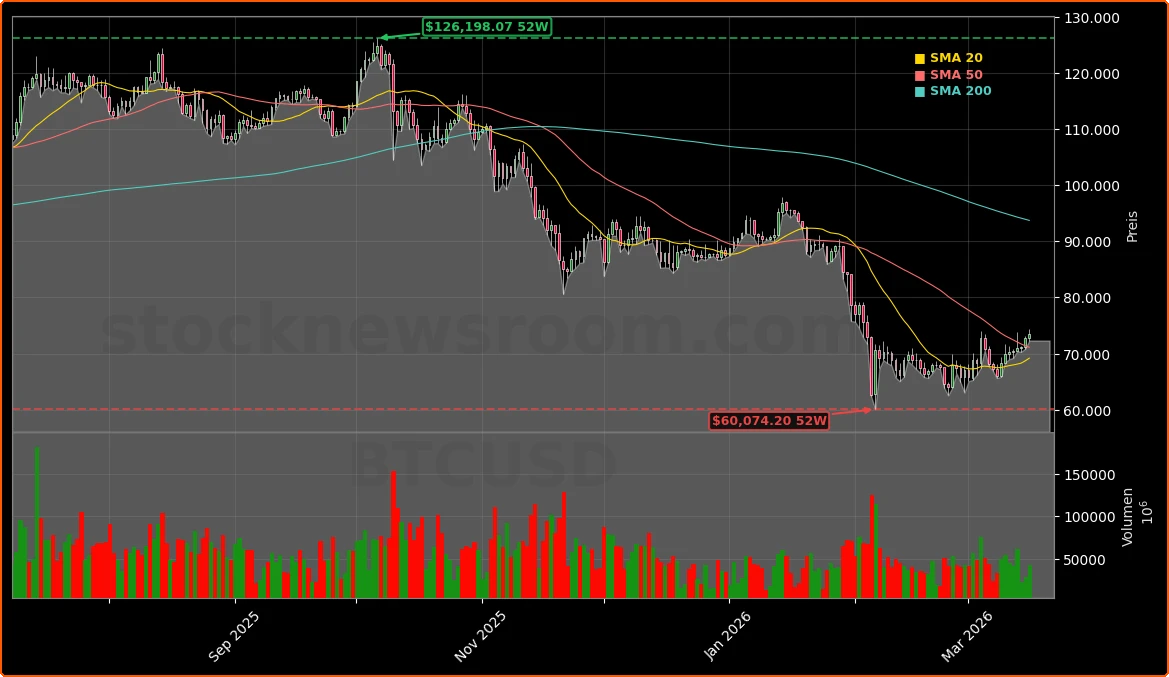
The latest surge has pushed Bitcoin to about $73,573.73 against the dollar, up from a prior close of $72,779 and marking a gain of roughly 2.6% in 24 hours. In recent sessions, BTCUSD briefly spiked above $74,000, tagging its highest levels since early February and bringing the market within striking distance of the current Bitcoin All-Time High in the mid-$74,000s. While the intraday move has not yet printed a clearly confirmed new record close, traders widely view the zone between $73,000 and $74,500 as the battleground that will decide whether a fresh high is imminent.
From a technical standpoint, Bitcoin has reclaimed and held above key moving averages on the hourly chart. The price has pushed decisively through the $72,000 resistance area, with bulls defending that level as initial support. Momentum indicators back the bullish case: the hourly MACD is gaining strength in positive territory, and the RSI is above 50, signaling that buyers currently have the upper hand. On the upside, short-term resistance is clustered near $72,800 and $73,000, with a more significant ceiling around $73,800 to $74,000. A sustained close above $73,000, and especially above the prior peak near $74,000, would likely confirm the next phase of the rally.
Below the market, traders are watching a zone between $72,000 and $71,200 as a first line of defense. If that area fails, deeper support sits around $70,350 and then the psychologically important round number of $70,000. A break below $70,000 would not invalidate the broader uptrend but would raise the risk of a more meaningful correction toward the low- to mid-$60,000 range. For now, however, the price structure remains broadly constructive, and the proximity to a potential Bitcoin All-Time High is fueling renewed speculation about whether the next leg could carry toward $80,000 or beyond.
What role do spot ETFs play now?
The most striking structural driver behind the current rally is the ongoing wave of capital into U.S.-listed spot Bitcoin ETFs. After a quieter patch earlier in the year, flows have reaccelerated. In just one recent week, U.S. spot products absorbed around $586–$619 million of net inflows, even as traditional risk assets wobbled amid geopolitical headlines and swings in oil prices. Over a five-day stretch in mid-March, Bitcoin spot ETFs added another roughly $767 million in net inflows, underlining persistent institutional demand.
The breadth of adoption is notable, but the concentration is even more so. A single fund, BlackRock’s flagship spot vehicle, has been responsible for close to 78% of some weekly net flows. For Wall Street, this is a powerful signal that large, long-horizon investors—rather than only retail traders or short-term hedge funds—are increasingly comfortable expressing their thesis on Bitcoin through regulated ETF wrappers. These are not the speculative, high-fee vehicles of the 2017 bull market, but mainstream products that sit alongside S&P 500 and Treasury bond funds in model portfolios.
Flows are not confined to Bitcoin alone. Ethereum spot ETFs have recorded roughly $161 million in net inflows over comparable periods, while products tied to Solana and XRP have also turned positive. Still, the dominant story for U.S. investors remains Bitcoin’s role as the anchor of the crypto allocation. With millionaire and ultra-high-net-worth portfolios increasingly holding Bitcoin and Ethereum side by side, the ETF complex acts as the bridge between traditional wealth management and the digital asset world. The renewed push toward a Bitcoin All-Time High is amplifying that bridge, as every new inflow into an ETF translates into underlying spot purchases.
For equity markets, the ETF boom also has clear spillovers. Custody, trading and market-making businesses at major Wall Street firms are slowly becoming more important profit centers, while crypto-exposed stocks such as miners and exchanges now trade partly as leveraged proxies on Bitcoin ETF demand. That includes companies with broader tech exposure like NVIDIA, which indirectly benefit from both AI and crypto infrastructure demand, and trading platforms that the market increasingly perceives as highly correlated with the Bitcoin cycle.
How is war risk changing Bitcoin’s behavior?
The renewed approach toward a Bitcoin All-Time High is playing out against one of the most tense geopolitical backdrops in years. The conflict involving the U.S., Israel and Iran has spooked global markets, especially in energy. The partial closure of the Strait of Hormuz—through which roughly 20% of the world’s liquefied natural gas and at least 31% of global crude oil shipments normally pass—has stoked fears about a potential global recession if the disruption becomes prolonged.
Despite that, Bitcoin has shown surprising resilience. When the U.S. and Israel attacked Iranian targets, BTCUSD briefly dipped to slightly above $63,000 per coin but quickly bounced back into the low $70,000s. While risk assets from high-yield credit to emerging-market equities struggled, Bitcoin spot ETFs still pulled in more than $600 million of net inflows in that period. The key reason: the network’s infrastructure and custody footprint are broadly diversified, with minimal concentration in the immediate war zones of Iran, Israel, Lebanon or the Gulf states, limiting the risk of direct physical disruption.
At the same time, investors are using Bitcoin in ways that differ from previous geopolitical flare-ups. Historically, market panic pushed capital toward the U.S. dollar, Treasuries and gold, often at the expense of Bitcoin and other risk assets. This time, as gold futures tumbled from recent peaks and slipped below the $5,000-per-contract area—giving up about 4.9% over the month—Bitcoin has gained roughly 12.5% over the same timeframe. Energy prices, which initially spiked, have since given back part of their gains, while Bitcoin has continued to grind higher.
This divergence has led some macro traders to treat Bitcoin as a partial hedge against specific geopolitical and monetary risks, rather than as a pure risk-on speculative bet. The asset’s independence from any single government, its non-sovereign monetary policy and its global, censorship-resistant transfer network are increasingly seen as features in a world where sanctions, capital controls and commodity chokepoints can emerge rapidly. In that sense, the approach toward a Bitcoin All-Time High is not just a speculative event, but a test of whether the asset is maturing into a macro-hedging instrument that can sit alongside gold and the dollar in diversified portfolios.
Is Bitcoin still just a risky asset?
Despite the macro-hedge narrative, investors should not forget that Bitcoin remains volatile and, in many respects, behaves like a high-beta risk asset tied to global liquidity conditions. Historically, recessions have triggered forced selling across equities, credit and crypto, as margin calls, risk-off sentiment and tighter credit conditions drive broad de-risking. If the Middle East conflict escalates to the point of causing a deep global downturn, there is no guarantee that Bitcoin would be spared.
Recent price action underscores that point. Not long ago, Bitcoin suffered a drawdown of nearly 45% from a prior peak in October, reminding investors how quickly sentiment can flip. Technical analysts warn that the current breakout attempt could still morph into a bull trap if the $72,000–$74,000 zone fails to hold. Some see the recent spike above $74,000 as a classic liquidity grab at the highs, with a non-trivial probability of a reversal that could drive prices back toward $60,000—or even lower—before a sustained run at a new Bitcoin All-Time High.
On-chain and derivatives data also show how fragile positioning can be. A large share of open interest in futures and options is concentrated around key strike prices between $70,000 and $80,000, creating the potential for violent short squeezes or long liquidations. One trading desk points to a term-structure driven signal indicating the possibility of a short squeeze toward $78,000, driven by traders who were heavily short and are now being forced to cover. While such a move could catapult Bitcoin quickly above its previous high, it would not necessarily signal a stable, long-term price floor at those levels.
For U.S. investors, the takeaway is that Bitcoin may be gaining new roles in multi-asset portfolios, but its risk profile still resembles that of a speculative growth asset. Allocations should be sized accordingly, and lump-sum purchases at or near a potential Bitcoin All-Time High may carry considerable near-term drawdown risk if macro conditions or sentiment deteriorate.
What about ETFs for Ethereum and other coins?
The institutionalization trend extends beyond Bitcoin. Ethereum, the second-largest cryptocurrency by market capitalization, has also benefited from spot ETF demand, with funds raking in around $161 million in net inflows over a recent stretch. Ether’s price has rallied in sympathy, gaining as much as 6.9% during some sessions to trade near $2,280. Meanwhile, Solana and XRP have posted gains of about 6.1% and 4.7%, respectively, underscoring a broader risk-on tone across the digital asset complex.
Nonetheless, Bitcoin remains the focal point for Wall Street, in part because it is the asset most often referenced by major policymakers and central bankers. Federal Reserve Chair Jerome Powell has previously acknowledged that many investors see Bitcoin as a kind of “digital gold,” even if the Fed itself does not endorse it as money. Surveys of crypto-owning millionaires show that nearly 60% hold Bitcoin, while about 55% hold Ethereum, signaling that both coins have secured a foundational role in high-net-worth portfolios. However, Bitcoin’s longer track record, relative regulatory clarity and simpler value proposition continue to give it the edge as the primary macro asset in the crypto universe.
For comparison, traditional risk assets like high-growth tech stocks on the NASDAQ remain tightly tied to earnings, discount rates and AI narratives. Names such as NVIDIA and Tesla can experience dramatic swings based on quarterly reports or guidance revisions. By contrast, Bitcoin’s price is driven more by macro liquidity, regulatory evolution and structural demand through vehicles such as ETFs. That difference makes Bitcoin an attractive complement but not a substitute for growth equities in diversified portfolios.
Investors considering Ethereum and other altcoins should remember that these assets, while potentially offering higher upside, also exhibit even greater volatility and regulatory uncertainty. Bitcoin’s proximity to a Bitcoin All-Time High is a reminder that the blue-chip of crypto has historically recovered from deep drawdowns, while many smaller tokens have not. For asset allocators, that history informs a common approach: concentrate the bulk of crypto exposure in Bitcoin and Ethereum, with only a modest satellite allocation to higher-risk names.
Are miners under threat from AI data centers?
A less-discussed factor shaping Bitcoin’s medium-term outlook is the evolving economics of mining. On a per-megawatt basis, current estimates suggest that Bitcoin mining revenues range between roughly $57 and $129, depending on hardware efficiency and electricity costs. By contrast, AI-focused data centers can generate between $200 and $500 per megawatt, up to eight times higher than some mining operations. This disparity has led to claims in some corners that “AI has killed Bitcoin forever” by outbidding miners for energy and hardware resources.
Reality is more nuanced. The profitability metric many miners track, often called hashprice (revenue per unit of hash rate), is indeed hovering near historical lows. Yet the Bitcoin protocol’s built-in difficulty adjustment automatically squeezes out the least efficient miners when prices or revenues fall. Over time, this leaves a more resilient cohort of miners with access to low-cost or stranded energy, who can still operate profitably even at lower hashprice levels.
In addition, Bitcoin mining can tap energy sources that are less accessible or attractive to AI data centers. Examples include remote hydroelectric facilities, flared natural gas at oil fields, or off-peak power in grids with high penetration of wind and solar. Because mining rigs can be turned on and off relatively quickly, their load is far more flexible than the constant, high-availability demands of AI compute clusters. That flexibility enables miners to serve as a kind of shock absorber in power grids, monetizing otherwise wasted energy and potentially improving grid stability.
For Wall Street, the convergence between mining and AI infrastructure creates both risks and opportunities. Some miners are diversifying into AI hosting or high-performance computing, leveraging their access to cheap power and data center expertise. Others are doubling down on Bitcoin, betting that future price appreciation—potentially well above today’s near-record levels and any upcoming Bitcoin All-Time High—will more than compensate for short-term margin pressure. Equity investors in listed miners should therefore evaluate not just Bitcoin’s price path, but also each company’s energy contracts, hardware strategy and willingness to pivot into adjacent compute markets.
How are correlated stocks like Robinhood behaving?
Beyond miners, several traditional equities have traded as quasi-proxies for Bitcoin’s fortunes. One notable example is Robinhood, the commission-free trading platform that became synonymous with the retail trading boom. Chart comparisons since October show that Robinhood’s stock has frequently moved almost in lockstep with Bitcoin, underscoring how the market currently treats the company as a de facto crypto or risk-on asset. When Bitcoin rallies toward a Bitcoin All-Time High, Robinhood often benefits from increased trading volumes and risk appetite among retail investors; when Bitcoin slumps, Robinhood tends to follow.
This tight correlation poses a strategic challenge for Robinhood’s management, which has tried to reposition the company as a more diversified financial platform, offering everything from options and equities to retirement accounts and cash management. The persistence of the crypto narrative, however, suggests that investors still primarily price the stock on its sensitivity to Bitcoin and broader speculative activity. Breaking that perception may require clearer progress on higher-margin, less cyclical business lines, alongside more robust earnings through quieter trading periods.
Other U.S. stocks, including large-cap tech names like Apple and mega-cap platforms in the S&P 500, have more diversified drivers but still display periodic co-movements with Bitcoin due to sentiment spillovers. During intense risk-on episodes, capital flows into both high-growth tech and crypto, while sharp risk-off episodes often pressure both segments simultaneously. For diversified investors, this means that Bitcoin exposure should not be viewed as fully independent of equity risk, even if its underlying value drivers—such as digital scarcity and decentralized security—are quite different from those of corporate earnings.
At the same time, some institutional allocators are experimenting with Bitcoin as part of a barbell strategy: pairing relatively defensive, cash-generating assets with a small but meaningful allocation to highly convex assets like Bitcoin. In this framework, Bitcoin’s correlation with specific stocks matters less than its potential to deliver outsized gains in certain macro scenarios, even at the cost of significant volatility in others.
What are traders seeing in sentiment and positioning?
Sentiment indicators around Bitcoin paint a contradictory but often bullish picture. On the one hand, popular fear-and-greed gauges show readings consistent with extreme fear or at least heightened caution, despite the price hovering near historical peaks around $70,000–$74,000. Such negative sentiment at elevated price levels is unusual and, in the eyes of contrarian investors, often a sign that the rally could have further to run.
On-chain data supports that view, showing continued outflows of Bitcoin from centralized exchanges into private hardware wallets. This pattern is typically interpreted as bullish, as it suggests investors are moving coins into long-term storage rather than keeping them on exchanges for near-term trading or sale. Combined with steady ETF inflows, these withdrawals tighten the available liquid supply of Bitcoin on exchanges, potentially amplifying upside moves if demand accelerates.
Derivative markets, meanwhile, reveal substantial short positions accumulated by traders betting on a pullback near the prior high. As the spot price grinds higher, some of these shorts are being forced to cover, contributing to what appears to be a term-structure-driven short squeeze. One structured-product desk, for example, has positioned for an extension of the move toward $78,000 using a certificate with a knock-out threshold far below current prices, reflecting confidence that the recent lows may already be in.
Still, not all technical analysts are convinced. Some warn that the setup resembles previous episodes where Bitcoin appeared to break out, only to reverse sharply and erase months of gains. They point to the risk of a “fake-out” above $72,000–$74,000 that could lure in late buyers before sending the market back down as much as 50% from the highs. While such a scenario is far from the base case for most Wall Street strategists, it is a reminder that Bitcoin price history is littered with violent reversals immediately after euphoric moves.
How do taxes and regulation affect U.S. investors?
For American investors chasing the excitement of a potential Bitcoin All-Time High, the Internal Revenue Service (IRS) looms large in the background. In the U.S., cryptocurrencies like Bitcoin and Ethereum are taxed similarly to securities. That means capital gains and losses must be reported, and the IRS expects detailed records of purchase dates, sale dates, cost basis and proceeds. Many newer investors still mistakenly treat crypto trading as a casual hobby and fail to report activity, but enforcement is tightening rapidly.
A key development is the rollout of Form 1099-DA for digital asset transactions. Starting with the current filing cycle and evolving further in 2026, this form requires trading platforms and brokers to report customer crypto activity both to investors and to the IRS once specific thresholds are reached. The intent is to recreate, for digital assets, the same standardized reporting framework that already exists for stocks and bonds.
Complicating matters, not all crypto-related events fit neatly into traditional securities tax concepts. Income from airdrops, forks, staking rewards and certain forms of decentralized finance (DeFi) can have complex tax implications that differ from simple buy-and-hold strategies. Investors who actively trade or earn yield in crypto should be aware that each taxable event can affect their overall liability, sometimes in unexpected ways. As Bitcoin flirts with a new all-time high and trading volumes rise, these issues move from theoretical to very practical.
On the regulatory front, U.S. policy continues to evolve unevenly. While the approval of spot Bitcoin ETFs has been a watershed moment, providing a clear, regulated investment channel on major exchanges like the NYSE and NASDAQ, other areas of crypto—particularly certain tokens and DeFi activities—remain under scrutiny from regulators such as the Securities and Exchange Commission (SEC) and the Commodity Futures Trading Commission (CFTC). For mainstream portfolio managers, the availability of spot ETFs means they can gain Bitcoin exposure without directly handling wallets or private keys, while staying within existing compliance frameworks.
How does Bitcoin compare to gold and the dollar?
One of the most important questions for macro investors is how Bitcoin fits relative to traditional safe havens such as gold and the U.S. dollar. Historically, periods of acute market stress have driven flows into the dollar and Treasury bonds, as investors seek liquidity and credit quality. Gold has typically served as a hedge against inflation, currency debasement and geopolitical upheaval. Bitcoin, by contrast, was long pigeonholed as a speculative tech asset correlated with NASDAQ growth stocks.
The current environment suggests a more complex picture. With gold futures slipping below $5,100 and logging nearly a 5% monthly loss, and with U.S. equity markets experiencing bouts of volatility, Bitcoin’s roughly 12.5% gain over the same period looks striking. While one month is far too short to draw definitive conclusions, the divergence indicates that some investors are starting to treat Bitcoin as a differentiated store of value that responds to a different set of catalysts than gold or the dollar.
Moreover, the persistence of high interest rates has made the opportunity cost of holding non-yielding assets more visible. Gold, which pays no yield, faces direct competition from short-term Treasuries yielding comfortably above the pre-pandemic norm. Bitcoin also pays no yield in its base form, but investors can access yield-like exposures through lending platforms, futures-based strategies or covered-call products. In addition, the prospect of asymmetric upside to a new Bitcoin All-Time High and beyond arguably compensates some investors for the lack of inherent yield, especially when they view Bitcoin as a long-duration digital asset.
Bitcoin is increasingly trading less like a fringe tech play and more like a macro instrument, even as its volatility reminds us it’s still far from a conventional safe haven.
— Independent digital asset strategist
Conclusion
That said, the dollar’s dominance as the world’s reserve currency remains unchallenged for now, and gold’s track record as a crisis hedge is much longer than Bitcoin’s life span. For most diversified investors, the question is not whether to replace gold or the dollar with Bitcoin, but whether to carve out a small allocation within the alternatives sleeve to capture its unique risk-reward profile. As correlations evolve, the answer increasingly appears to be yes for many institutional allocators, even if they move incrementally.
Further Reading
- Bitcoin price and market data (CoinGecko)
- Spot Bitcoin ETF flows and holdings (Bloomberg)
- Global crypto asset management report (CoinShares)
- Bitcoin bei Yahoo Finance (Yahoo Finance)