
Is Bitcoin Governance about to turn a technical tweak into a full‑blown identity crisis for the world’s largest cryptocurrency?
Is Bitcoin’s price signaling calm or a storm?
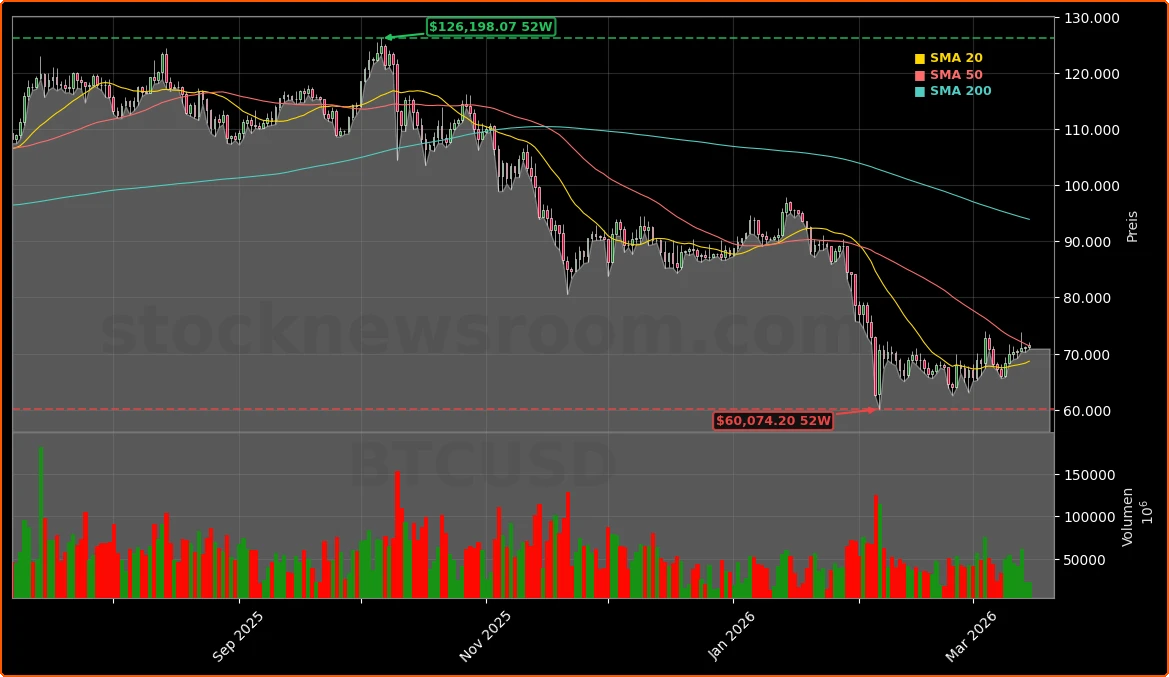
Bitcoin (BTCUSD) is trading near $71,504, up about 1.09% on the day and modestly above the prior close of roughly $71,236. That keeps the leading cryptocurrency within sight of its recent range rather than at a fresh record, but the apparent calm on the tape masks growing tension under the surface. Over the last three years, BTC has surged roughly 236%, handily beating the S&P 500’s approximate 83% gain over the same period. Yet in the most recent 12‑month stretch it has fallen about 15%, badly lagging a roughly 22% advance in the broader U.S. equity market. That combination of explosive long‑term upside and painful intermediate‑term drawdowns is exactly why Bitcoin’s volatility is often cited as three to four times that of large‑cap U.S. stocks.
Recent geopolitical shocks have not changed that basic volatility profile. Since the latest outbreak of conflict in Eastern Europe at the end of February, BTC has climbed roughly 7%, echoing a risk‑on rotation that also lifted large altcoins like Ethereum and Solana. With the spot price near $71,500, Bitcoin remains well below the very top of its recent range but comfortably above key support levels that options traders are watching around the $60,000 area. For U.S. investors, the move has been strong enough to reinforce Bitcoin’s reputation as a high‑beta macro asset, but not strong enough to silence growing concerns about regulation, energy use, and now Bitcoin Governance itself.
This backdrop matters because the next major move may be decided less by macro headlines and more by internal network politics. The BIP‑110 proposal, designed to curb on‑chain “spam” from Ordinals, Runes and other arbitrary data, is transforming a long‑running theoretical debate about governance and censorship into a concrete decision with potentially immediate consequences for price, liquidity and institutional adoption. If Bitcoin takes a wrong step here, the market could be forced to reprice not just risk, but the very narrative that has underpinned its rise as “digital gold.”
How does BIP‑110 reshape Bitcoin Governance?
BIP‑110 is a new Bitcoin improvement proposal that aims to limit the amount of arbitrary data—such as images, videos and other non‑financial content—written into the blockchain via protocols like Ordinals and Runes. The mechanism relies on a temporary 12‑month soft fork, giving miners and nodes rules to filter out transactions deemed to be “spam” at the consensus level. On the surface, that sounds like a relatively narrow technical change, but it cuts straight to the heart of Bitcoin Governance: who decides what counts as a legitimate transaction, and how easy should it be to change the rules?
The proposal has triggered a sharp split inside the Bitcoin community. Supporters argue that the network is being clogged by non‑monetary usage that drives up fees, bloats the chain, and undermines Bitcoin’s primary function as a global, neutral settlement layer for value. In their view, a time‑limited soft fork that curbs abuse is a pragmatic response that protects ordinary users and institutional investors from unpredictable spikes in transaction costs. They also claim that failing to act could open up opportunities for rival smart‑contract platforms to capture use cases and liquidity that might otherwise remain on Bitcoin.
Opponents see it very differently. They warn that once the community accepts content‑based filtering at the consensus level, Bitcoin Governance will have taken a decisive step toward centralized rule‑making, where a narrow group of developers and miners can decide which transaction patterns belong on the network. They also highlight serious side effects: under some interpretations of BIP‑110, certain existing unspent transaction outputs (UTXOs) could become incompatible with the new rules and effectively frozen. That raises the specter of de‑facto confiscation and undermines one of Bitcoin’s core promises—that properly signed transactions are always valid, regardless of politics or prevailing moral judgments about their purpose.
This clash is not just an internal debate among coders and early adopters. For institutional investors in New York, London, and Singapore, the outcome is a live governance test. If a censorship‑leaning fork went through with only a 55% activation threshold—far below the roughly 95% consensus used in the past—it would signal that even Bitcoin’s rules are less immutable than many assumed. That could have downstream effects on risk models, regulatory interpretations, and the conviction behind large corporate or sovereign allocations.
Why is Adam Back opposing BIP‑110?
One of the loudest voices against BIP‑110 is Adam Back, CEO of Blockstream and one of the most well‑known figures in the Bitcoin ecosystem. Back’s early cryptographic work, including Hashcash, was cited in the original Bitcoin white paper by Satoshi Nakamoto, which gives his stance on Bitcoin Governance extra weight for many market participants. He has come out strongly against the soft fork proposal, warning that attempts to block specific transaction types at the protocol level do more harm to the network than any spam or speculative craze ever could.
Back’s central argument is that Bitcoin’s primary value proposition is its resistance to censorship and arbitrary rule changes. In his view, if developers and miners start making content‑based decisions, then regulators and political actors will next demand that they filter out other categories of transactions—whether related to sanctioned addresses, certain industries, or politically sensitive speech. That slippery slope, he argues, would turn Bitcoin into just another programmable financial system subject to the whims of power, rather than a neutral piece of global monetary infrastructure.
His critics, including prominent pseudonymous Bitcoiner Hodlnaut, accuse him of ignoring the real governance problems that emerge when spam floods the network and ordinary payments get priced out. They argue that refusing to engage with pragmatic trade‑offs in Bitcoin Governance is a form of arrogance that risks alienating new users and institutional partners who need more predictable transaction environments. To them, Back’s absolutist stance on censorship resistance may be out of step with the practical realities of running a scalable, multi‑trillion‑dollar payment and settlement system.
This rhetorical battle is not merely reputational; it has concrete market implications. If the community sides with Back and BIP‑110 is rejected, Bitcoin will reaffirm its hard‑line stance against censorship at the base layer, but it will also leave the spam issue to be managed via fee markets, wallet‑level filters or second‑layer solutions. If the community overrides Back’s warnings and activates the soft fork with low consensus thresholds, Bitcoin will be seen as more flexible but also more politicized. Either path will send a signal to regulators, asset managers and corporates evaluating whether Bitcoin belongs on their balance sheets or in their ETFs.
Could BIP‑110 split the Bitcoin blockchain?
Beyond principles, the most direct market risk from BIP‑110 is the possibility of a chain split. Historically, major soft forks have targeted near‑total miner consensus—around 95%—to ensure that almost all economic activity moves in lockstep to the upgraded rules. BIP‑110’s backers have floated activation thresholds closer to 55%, arguing that waiting for near‑unanimity gives blockers an effective veto and leaves the network vulnerable to exploitation by spam and opportunistic actors.
That lower bar comes with serious dangers. If a substantial minority of miners and full nodes reject BIP‑110, the blockchain could bifurcate into multiple competing branches: one enforcing the new spam‑filtering rules and one continuing to accept all valid transactions regardless of content. In such a scenario, users who do not carefully manage their wallets and transaction settings could see funds become stuck or replayed across chains. Exchanges would need to halt deposits and withdrawals while they assess which chain carries the dominant “economic majority”—the version of Bitcoin that the bulk of capital, liquidity providers and merchants decide to support.
For Wall Street investors, this would introduce a layer of idiosyncratic protocol risk that rivals, and in some ways exceeds, typical macro and regulatory uncertainties. During past splits like Bitcoin Cash, U.S. brokers and custodians had to invest significant resources just to ensure that clients’ balances remained accurate and legally compliant. A BIP‑110‑driven fork in the mid‑2020s, with billions of institutional dollars now parked in spot Bitcoin ETFs and trust products, would be even more complex.
On the other hand, if the community navigates the controversy without a fork—either by abandoning BIP‑110, revising it to preserve more backward compatibility, or achieving overwhelming consensus—Bitcoin Governance will have passed a difficult stress test. That outcome could reassure allocators that even when emotions run high, the ecosystem can still converge on rule changes without breaking the asset’s monetary identity. In the short term, however, just the threat of a messy fork could be enough to increase risk premiums, widen futures basis spreads, and encourage traders to neutralize exposure around key governance decision dates.
How does Bitcoin’s risk/return profile look for U.S. portfolios?
Amid the governance drama, Bitcoin’s remarkable long‑term performance continues to draw new investors. Over the past three years, its roughly 236% total return has surpassed the S&P 500 and even many of the market’s most celebrated growth stocks. Yet portfolio managers are increasingly looking beyond raw returns to examine how adding BTC affects overall risk and diversification.
Research from Grayscale indicates that introducing Bitcoin into a traditional 60/40 portfolio of stocks and bonds can materially improve risk‑adjusted returns. Simulations show that the Sharpe ratio rises as BTC allocation increases from 0% up to about 5%, beyond which the incremental benefits begin to flatten out. In that optimal window, Bitcoin acts as a high‑conviction satellite position rather than a core holding, offering significant upside potential while keeping overall portfolio volatility within acceptable bounds for many institutional mandates.
Separate analysis from Galaxy Asset Management covered the period from 2020 to 2025, comparing a vanilla 60/40 portfolio to one that devotes 5% to Bitcoin. In their hypothetical, adding that relatively small BTC slice boosted annualized returns from about 10.2% to 14.1%, with only a modest increase in volatility. For multi‑asset investors and registered investment advisors on Wall Street, those numbers are compelling enough to warrant a serious conversation about strategic Bitcoin allocations, especially now that U.S.‑listed spot ETFs have simplified operational and custody challenges.
Crucially, these portfolio studies assume that investors are comfortable with Bitcoin’s underlying governance and monetary policy. They rest on the premise that the 21 million hard cap, four‑year halving schedule, and censorship‑resistant transaction layer remain robust. That means the current BIP‑110 controversy is not just a technical sideshow; it directly feeds back into the investment case. If Bitcoin Governance drifts toward ad‑hoc, politically sensitive interventions, risk‑adjusted return models based on past behavior may become less reliable guides for the future.
What role does ‘digital gold’ play amid macro tensions?
Macro conditions continue to underpin Bitcoin’s “digital gold” narrative, even as short‑term price action swings with risk sentiment. The asset’s supply is capped at 21 million coins, with nearly 20 million already mined. Every four years, the block reward cuts in half, making it progressively more difficult for miners to earn new coins and reinforcing long‑term scarcity. That structure draws direct comparisons to precious metals like gold and silver, which cannot be printed at will by central banks or finance ministries.
Geopolitical tensions, energy price spikes and recurring inflation scares have all contributed to the perception that fiat currencies face structural debasement risks. In this environment, wealthy individuals, family offices and even some corporates have looked to Bitcoin as a hedge against long‑term monetary dilution and potential capital controls. The chief investment officer of crypto asset manager Bitwise recently argued that a long‑term price target of $1 million per BTC is conceivable, not as a short‑term trading call but as a reflection of Bitcoin’s growing share of the global store‑of‑value market.
That market is massive. Estimates put the current global size of store‑of‑value assets—combining gold, other precious metals, high‑end real estate, and similar vehicles—at around $38 trillion. Importantly, it is not static: over the past two decades, it has expanded dramatically as emerging‑market wealth has grown and as investors sought protection from currency and political instability. If concerns about fiat devaluation intensify, that pool could grow even larger, opening a wider addressable market for Bitcoin.
Within this narrative, Bitcoin Governance matters because any perception of centralization or confiscation risk could undercut the asset’s appeal as a neutral store of value. If long‑term holders begin to suspect that certain transaction patterns or address types might be censored or frozen, they may gravitate toward other hard assets or even competing crypto networks perceived as more credibly neutral. Conversely, if the community resolves the BIP‑110 dispute in a way that reinforces censorship resistance while addressing spam through market‑based mechanisms, Bitcoin’s store‑of‑value thesis could emerge even stronger.
Are we in a new crypto spring?
Sentiment in the digital asset space has improved markedly from the depths of the last bear market, often described as a “crypto winter.” After the collapses and scandals that defined the early 2020s—culminating in episodes like the FTX bankruptcy—liquidity drained from many exchanges, venture investment dried up, and token prices collapsed across the board. That environment produced significant consolidation, both among service providers and among investors, with many retail traders exiting the market entirely.
Now, signs of a “crypto spring” are emerging. Major tokens such as Bitcoin, Ethereum and Solana have staged robust recoveries from their lows, while institutional infrastructure has matured. Regulated custodians, on‑exchange surveillance tools, and the advent of spot Bitcoin ETFs have made it easier for traditional finance players to access the asset class within existing compliance frameworks. Volatility remains high, but it is increasingly being channeled through options, futures, and structured products rather than through opaque offshore leverage.
In this context, BIP‑110 and other governance debates represent a new phase in Bitcoin’s evolution. Rather than existential questions about whether the network can survive a major exchange failure, the focus is shifting to how it should scale, what types of usage it should prioritize, and how to balance economic freedom with network health. For U.S. investors who only began paying attention once Bitcoin entered mainstream financial products, these governance discussions may seem esoteric. Yet they function much like shareholder votes at large public companies: they reveal who really has power and how that power might be exercised under stress.
The notion of a budding crypto spring also underscores why timing and position sizing matter. Those who view Bitcoin as still early in a multi‑cycle adoption curve may tolerate significant drawdowns in exchange for exposure to a potentially transformative monetary asset. Others, particularly institutional allocators bound by risk limits and fiduciary constraints, may prefer smaller, heavily risk‑managed positions that can be scaled up or down as governance and regulatory clarity improve.
What are derivatives telling us about Bitcoin risk?
Options and derivatives markets are sending mixed but intriguing signals about Bitcoin’s near‑ to medium‑term path. On major crypto derivatives platforms such as Deribit, gamma exposure data shows aggressive positioning around key strikes. Dealers are reportedly net short at the $75,000 strike while end‑clients are net long, suggesting that sophisticated traders are buying upside optionality in case Bitcoin can punch through that resistance level. At the same time, there is significant hedging activity around the $60,000 region, which marked the February lows, indicating that market participants are also wary of renewed downside volatility.
Risk reversals—comparing implied volatility between calls and puts—are especially telling. For longer‑dated Bitcoin options, risk reversals have been priced at deeply bearish levels not seen since the aftermath of the FTX collapse. This skew shows that traders are willing to pay a premium for downside protection relative to upside bets, reflecting caution about potential catalysts ranging from regulatory actions to governance shocks like a contentious soft fork. Yet, for contrarian investors, such extreme skews can present opportunities, as historically periods of heavy downside demand have sometimes preceded sharp relief rallies.
Implied volatility for 30‑day Bitcoin options is also in an elevated regime reminiscent of prior crisis phases, including the early COVID‑19 shock. High implied volatility increases option premiums but also makes strategies that exploit volatility mean reversion or skew imbalances more attractive. Given Bitcoin’s history of sudden, powerful upside moves—similar to those seen in commodities like gold, silver, platinum and oil—some traders are focusing on inexpensive call structures that profit from a surprise breakout while using other instruments to hedge systemic risk.
These derivatives dynamics intersect with Bitcoin Governance because a major protocol event such as the activation or rejection of BIP‑110 can serve as a volatility catalyst. Traders will watch closely for timeline announcements, signaling from large mining pools, and code release milestones. Each step could shift probabilities of a fork or a clean upgrade, feeding back into implied volatility, skew and open interest distribution across strikes.
How are leveraged products changing the game?
U.S. traders increasingly access Bitcoin exposure not just through spot markets and futures, but via leveraged ETFs and structured products. One notable comparison is between iBit, a spot‑tracking Bitcoin ETF, and BITX, a 2x leveraged Bitcoin ETF. Since trading in these vehicles began in January 2024, iBit has risen about 43.41%, roughly mirroring Bitcoin’s underlying trend, while BITX has actually fallen around 38% over the same period, despite being designed to deliver twice the daily performance of its reference index.
This divergence illustrates a key structural risk of leveraged ETFs: compounding and path dependency. In choppy, high‑volatility markets where prices swing violently up and down, a 2x product like BITX repeatedly rebalances its leverage. Losses are realized from a larger base than gains are earned, causing a drag that can significantly erode value even if the underlying asset ends flat or slightly higher over time. For sophisticated investors, that decay can create opportunities on the short side, particularly when paired with long optionality elsewhere in the capital structure.
One strategy discussed by professional traders involves buying upside calls or call spreads on the spot ETF iBit—essentially cheap optionality on Bitcoin’s potential breakout—while simultaneously shorting the 2x leveraged ETF BITX to capture its expected tracking error over time. If Bitcoin rallies sharply, the long options can deliver asymmetric gains that more than offset any losses on the short BITX position. If Bitcoin chops sideways or sells off, the structural decay of BITX and its amplified downside can provide a buffer or even net profit.
However, such strategies are complex and carry their own risks, including borrow costs, liquidity constraints, and the possibility of regime changes in volatility. They also highlight a broader lesson for U.S. investors: the growth of leveraged products around Bitcoin means that governance events, regulatory announcements and macro shocks can have amplified effects as mechanically rebalancing vehicles adjust their exposures. That increases the importance of understanding both the protocol‑level debates of Bitcoin Governance and the market microstructure that translates those debates into price action.
Is U.S. demand for Bitcoin finally stabilizing?
One closely watched indicator of American demand for Bitcoin is the so‑called Coinbase Premium Gap, which measures the price difference between BTC on Coinbase—popular with U.S. investors—and other large global exchanges. When the gap is negative, it usually signals that U.S. traders are selling more aggressively than their overseas counterparts, putting localized pressure on prices. After an extended period of negative readings, the metric has recently begun to turn modestly positive, hinting that domestic spot demand may be returning.
While the current premium is still relatively small, its persistence suggests a shift toward accumulation among U.S. investors, possibly driven by improved macro sentiment, rising comfort with ETF vehicles, or growing conviction in Bitcoin’s long‑term store‑of‑value role. For Wall Street desks and market‑making firms, a sustained positive premium can justify allocating more capital to arbitrage, lending, and liquidity provision around U.S. venues, which in turn can tighten spreads and lower execution costs for retail and institutional participants alike.
Technical analysts are also monitoring longer‑term indicators such as the 300‑week exponential moving average (EMA), currently hovering around $57,100. Historically, deep deviations below this EMA have been associated with macro bottoms in Bitcoin’s price cycle. Some chartists have noted that a similar pattern today could imply a potential downside probe to roughly $50,000—around 15% below the 300‑week EMA—before a more durable floor is established. While no single indicator is reliable in isolation, these long‑horizon metrics shape how leveraged traders size positions and where they place stop‑loss orders.
In the context of Bitcoin Governance, renewed U.S. demand is a double‑edged sword. On one hand, it increases the economic weight of American ETFs, custodians and trading venues in any future protocol debates, potentially giving regulators and large asset managers more de facto influence over network decisions. On the other, a more geographically diversified holder base can make it harder for any single jurisdiction or political bloc to push Bitcoin toward a censorship‑heavy or centrally controlled governance model.
How big could Bitcoin’s store‑of‑value market become?
The long‑term bullish case for Bitcoin rests heavily on its potential share of the global store‑of‑value market. With a current estimated size of around $38 trillion—spanning gold, silver, other precious metals, high‑end property and similar assets—this market offers enormous headroom if Bitcoin can continue to establish itself as “digital gold.” Importantly, the store‑of‑value pool has grown substantially over the last twenty years and is likely to keep expanding as global wealth increases and as concerns about inflation, fiscal deficits and currency debasement persist.
Crypto asset managers argue that Bitcoin’s design gives it unique advantages for absorbing a portion of that market. Unlike physical gold, it can be transferred globally in minutes without reliance on traditional financial intermediaries. Its supply schedule is fully transparent and not subject to surprise changes in mining output or new discoveries. And unlike real estate, it can be subdivided almost infinitely without losing liquidity, making it accessible to both small savers and large institutions.
However, this thesis assumes that the rules governing Bitcoin’s monetary policy and transaction validation remain predictable and credibly neutral. If Bitcoin Governance evolves toward activist interventions—toggling content filters, changing activation thresholds or freezing certain categories of UTXOs—the asset’s claim to be a non‑political store of value could be weakened. In that scenario, gold and other traditional hard assets, as well as alternative cryptocurrencies designed with more explicit on‑chain governance, might capture a larger slice of the expanding store‑of‑value pie.
From a U.S. investor standpoint, this means that monitoring governance debates is as important as tracking ETF flows or halving cycles. A future in which Bitcoin successfully secures even a modest, say 10%, share of the global store‑of‑value market would imply multi‑trillion‑dollar capitalization and much deeper integration into portfolios ranging from sovereign wealth funds to corporate treasuries at firms like Tesla and Apple. Conversely, a mismanaged governance crisis that undermines trust could cap Bitcoin’s adoption and leave it as a permanently niche, high‑volatility asset.
What does Bitcoin Governance mean for Wall Street?
For Wall Street, Bitcoin Governance is increasingly analogous to corporate governance at major technology companies such as NVIDIA or Apple. Just as shareholders scrutinize board decisions, voting structures and executive incentives at those firms, Bitcoin investors must understand who exerts real influence over protocol upgrades, default software clients, and mining policy. Yet unlike a traditional corporation, Bitcoin has no central board or CEO; its governance emerges from a complex interplay between developers, miners, node operators, exchanges, custodians and end‑users.
In practical terms, this creates a new category of risk that doesn’t fit neatly into standard equity or bond frameworks. When an investment bank like Goldman Sachs or a large asset manager builds a Bitcoin allocation product, it must consider not only market and counterparty risk but also protocol risk: the possibility that a contentious fork, a buggy upgrade, or a governance capture event could disrupt the asset’s continuity. That is why some institutions favor indirect exposure via companies with strong governance track records—such as Tesla, which holds Bitcoin on its balance sheet, or chipmakers like NVIDIA that benefit from mining infrastructure demand—rather than holding BTC directly.
Analysts at major banks have begun to differentiate between governance regimes when evaluating digital assets. A cryptocurrency whose rules can be easily changed by a small committee might be treated more like a high‑risk venture project than a hard monetary asset. Bitcoin’s historical advantage has been its relative predictability and the high social cost of pushing through major protocol changes. The current BIP‑110 debate is therefore a pivotal test: if Bitcoin can resolve it in a way that reinforces both censorship resistance and transactional usability, it will strengthen its appeal to institutional investors; if not, some may conclude that protocol risk is higher than previously modeled.
As of now, there has been no sweeping wave of new analyst ratings specifically tied to BIP‑110 from firms like Citigroup, Morgan Stanley, or RBC Capital Markets. But their digital asset research desks are watching closely. Any clear sign that Bitcoin Governance is drifting toward centralized or politicized decision‑making could trigger revisions to long‑term price targets, risk weightings, or even suitability guidelines for certain classes of clients. Conversely, a demonstration of robust, decentralized decision‑making could encourage more bullish strategic outlooks and higher recommended allocation bands in multi‑asset portfolios.
Bitcoin’s long-term value proposition depends not just on its code, but on the credibility of the community that agrees not to change that code lightly.
— Senior digital asset strategist at a U.S. investment firm
Conclusion
In conclusion, Bitcoin Governance has become a central investment variable rather than a niche philosophical concern, with the BIP‑110 controversy crystallizing fears and hopes about censorship, decentralization and protocol risk. For U.S. and global investors, Bitcoin’s combination of strong long‑term returns, improving portfolio diversification characteristics and a growing share of the $38 trillion store‑of‑value market remains compelling, but only if its underlying rules stay credibly neutral and resistant to capture. The coming months will show whether the community can navigate this governance crossroads without triggering a destabilizing chain split, and for long‑term investors, closely tracking these developments alongside price, volatility and macro conditions will be critical in deciding how large a Bitcoin allocation truly belongs in a diversified portfolio.
Further Reading
- Bitcoin: A New Asset Class for Diversification (Grayscale)
- Galaxy Asset Management: The Role of Bitcoin in a Multi-Asset Portfolio (Galaxy Asset Management)
- Bitwise: The Case for Bitcoin as a Store of Value (Bitwise Asset Management)
- Bitcoin bei Yahoo Finance (Yahoo Finance)