
Is Bitcoin quietly building a powerful new base, or are extreme fear and geopolitics setting up the next big crash?
Is Bitcoin stuck or building a base?
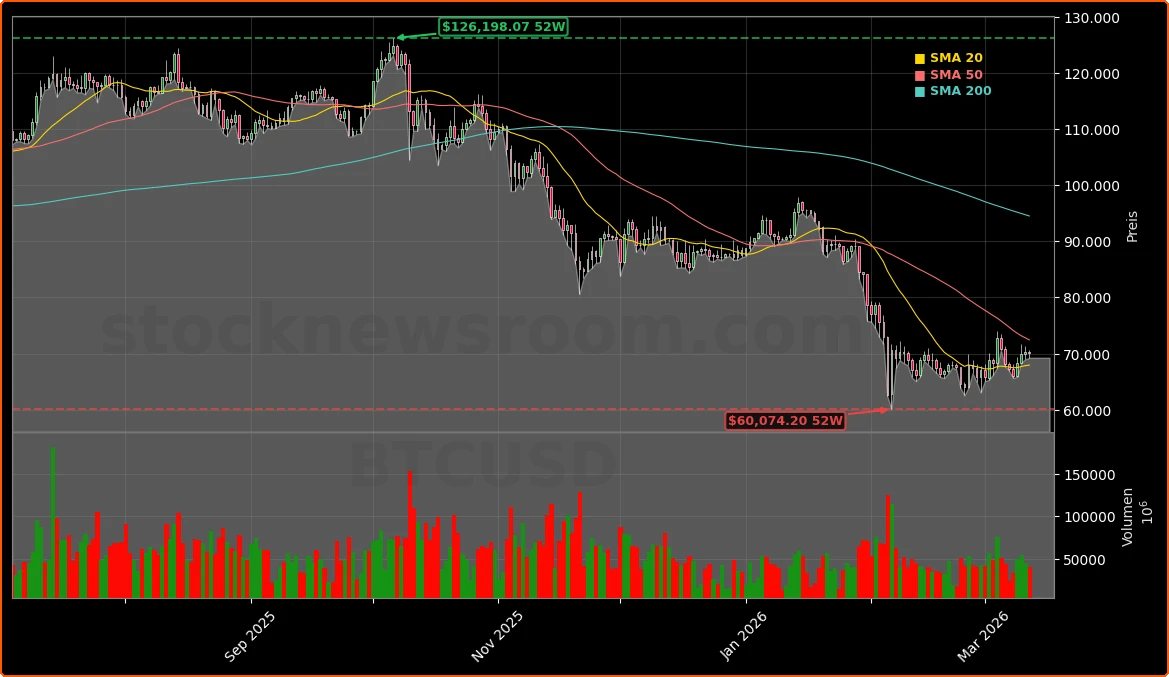
Bitcoin trades around $70,053.84, down about 0.9% from the previous close of $70,190.37, struggling to gain a foothold above the psychologically important $70,000–$72,000 band. On a technical basis, traders highlight resistance just above $72,000; a sustained break could open a path toward $80,000 in the near term, while support has repeatedly formed near $60,000. This sideways range is central to any Bitcoin Market Analysis right now: price action appears lethargic, but on-chain and sentiment data point to a classic bottoming phase rather than a blow‑off top.
The crypto Fear & Greed Index sits near 13 points, firmly in “extreme fear” territory. Historically, such readings have coincided with medium‑term lows rather than peaks, even though in the short run they often precede sharp, stop‑loss driven spikes below prior support. Some traders are explicitly betting on one more sweep under $60,000 before a V‑shaped rebound toward the $85,000–$100,000 area as leveraged positions are flushed out.
For U.S. investors comparing Bitcoin with the S&P 500 or NASDAQ, the asset has still delivered outsized performance over multi‑year horizons, despite drawdowns of 40% or more from recent highs. That asymmetry between long‑term returns and brutal short‑term volatility remains at the heart of any serious Bitcoin Market Analysis.
How do ETFs and institutions shape the Bitcoin Market Analysis?
Despite retail panic, spot Bitcoin ETFs continue to attract capital. In March alone, net inflows have already exceeded $500 million, with BlackRock reportedly controlling roughly two‑thirds of the ETF segment. This suggests large institutions are using the current fear-driven environment to accumulate exposure, effectively placing a partial floor under prices as long as inflows persist. For Wall Street allocators, this vehicle-based demand is as important as on‑chain metrics when evaluating Bitcoin Marktlage und geopolitische Risiken.
The contrast between institutional and retail behavior is stark. Retail investors have been exiting positions and trimming risk, spooked by headlines about a renewed “crypto winter” and the drawdown from the peak. By comparison, whales and funds are moving coins off exchanges into cold storage, a pattern that in past cycles preceded aggressive upside moves once selling pressure exhausted itself. The creation of a U.S. Strategic Bitcoin Reserve and growing ETF infrastructure are also cited by bulls as structural supports that did not exist in earlier bear markets.
Major Wall Street houses such as Goldman Sachs and Morgan Stanley have not issued fresh public price targets in recent days, but prior institutional research has framed ETF inflows as a key determinant of Bitcoin’s medium‑term fair value. The current positioning backdrop reinforces the idea that the market is in a redistribution phase rather than at the euphoric end of a cycle.
Scarcity shock: what does the 20 millionth coin mean?
This week, miners produced the 20 millionth Bitcoin. Out of the hard‑coded cap of 21 million coins, roughly 20 million are now in circulation, leaving just about 1 million to be mined over the next 115 years. That mechanical scarcity is one of Bitcoin’s core investment arguments and underpins comparisons to “digital gold” for U.S. portfolios seeking an alternative store of value.
The long-term supply story is stark. In 2010, it took around 152,000 Bitcoin to buy one kilogram of gold; in 2026, it takes roughly 1.5 Bitcoin. While such comparisons are simplified, they highlight how the market has repriced Bitcoin’s monetary properties relative to traditional safe‑haven assets. With central banks expanding balance sheets and fiat currencies facing ongoing debasement concerns, the fixed 21 million cap features prominently in any forward‑looking Bitcoin Market Analysis.
At the same time, critics emphasize structural issues: the reliance on continuous energy expenditure for network security and the absence of “tail emissions” once block rewards dwindle. They argue that, unlike equities in the S&P 500 or cash‑generating giants like Apple and NVIDIA, Bitcoin lacks intrinsic cash flow and therefore behaves more like a speculative collectible whose value rests purely on future demand.
How do war risk and U.S. politics feed into Bitcoin?
Geopolitical risks, particularly the conflict in the Middle East, have injected fresh volatility into global markets. On volatile Wall Street sessions, Bitcoin has recently traded in lockstep with other risk assets, dipping about 0.5% intraday when investors reassessed the potential duration and spillover effects of the conflict. Yet macro uncertainty can also benefit Bitcoin over longer horizons if capital rotates out of equities and into perceived hedges such as gold and digital assets.
U.S. policy is another wild card. The push in Washington to clarify crypto regulation via a so‑called “Clarity Act” and to position the U.S. as a crypto‑friendly jurisdiction could unleash a new wave of institutional demand if the rules tilt market‑friendly. Conversely, tighter classification of crypto in retirement vehicles like 401(k)s or harsher enforcement could dampen flows just as ETFs gain traction.
For American investors already exposed to high‑beta tech names such as Tesla or for those watching the AI‑driven rally in NVIDIA, Bitcoin offers a very different risk profile: no earnings, no dividends, but programmatic scarcity and historically explosive upside in post‑bear‑market recoveries. Balancing that optionality against Bitcoin Marktlage und geopolitische Risiken is the core portfolio challenge today.
Extreme fear has rarely marked the end of a Bitcoin cycle; more often, it has signaled that long-term capital is quietly moving in.
— Independent digital asset strategist based in New York
Conclusion
In conclusion, this Bitcoin Market Analysis suggests a market caught between fear‑driven selling and steady institutional accumulation, with scarcity dynamics amplified by the mining of the 20 millionth coin. For U.S. investors, Bitcoin remains a high‑volatility satellite position rather than a core S&P 500‑style holding, but one that could benefit disproportionately if ETF inflows persist and geopolitical stress keeps the search for alternative stores of value alive. The next decisive catalyst is likely to come from either a clear break of the $60,000–$72,000 range or a regulatory shift in Washington that unlocks fresh institutional demand.
Further Reading
- Crypto Fear & Greed Index (Alternative.me)
- Bitcoin Price and Market Cap (CoinMarketCap)
- Spot Bitcoin ETF Flows Dashboard (CoinDesk)
- Bitcoin Marktlage und geopolitische Risiken bei Yahoo Finance (Yahoo Finance)