
Is Bitcoin’s latest pullback just noise in a new ETF-driven era, or a warning that the “digital gold” story is changing?

How resilient is Bitcoin after the pullback?
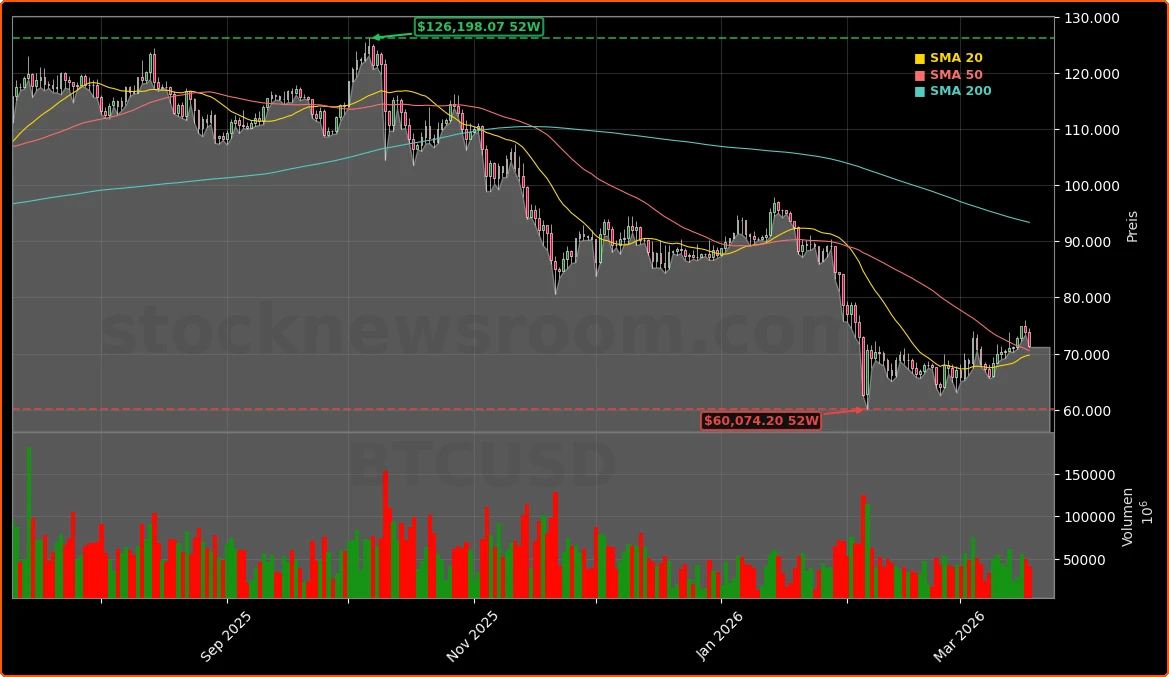
Bitcoin (BTC-USD) is trading near $71,382 on Wednesday afternoon ET, about 4% below yesterday’s close of $73,940 and off the week’s intraday spike above $75,000. Technically, BTC remains in a broad sideways range, with near-term support clustered around $71,800–$72,000 and resistance in the $74,500–$75,000 band. The latest Bitcoin Market Analysis suggests upside potential persists as long as these levels hold, but the parabolic phase of the rally has cooled.
On-chain data shows short-term holders, defined as wallets that acquired BTC in the last 155 days, aggressively realizing profits as price reclaimed and exceeded the $70,000 area. Realized profit for this group briefly surged to more than $18 million per hour on a 12‑hour moving-average basis, echoing a February pattern in which every push above $70,000 triggered selling that capped momentum. Sentiment has improved from “extreme fear” to “fear” on key crypto sentiment gauges, indicating modest optimism but far from the euphoria often seen near cycle tops.
From a U.S. portfolio perspective, BTC now behaves more like a high‑beta tech proxy on the NASDAQ than an uncorrelated hedge. That framing matters for investors who already have heavy exposure to mega caps like NVIDIA and Tesla, as adding Bitcoin may amplify risk rather than diversify it in the short run.
What role do spot ETFs and institutions play?
The ETF boom remains the dominant structural driver in this Bitcoin Market Analysis. Spot Bitcoin funds continue to report sizable net inflows, with roughly $700–$800 million entering over recent five‑day stretches despite price volatility. Large products tracking BTC, including vehicles backed by major asset managers, now sit alongside tech-heavy NASDAQ ETFs in many U.S. brokerage accounts, normalizing Bitcoin as an institutional asset.
Recent commentary from buy‑side strategists and research shops points out that ETF demand has changed the market’s plumbing: instead of retail-dominated spikes, Bitcoin is increasingly influenced by daily Wall Street order flow, similar to flows into broad index funds or sector ETFs. At the same time, specialized products like the Grayscale Bitcoin Mini Trust have shifted to more sophisticated benchmark methodologies to better track spot prices, underscoring institutional focus on execution quality and tracking error.
Several equity analysts frame BTC’s path less around the traditional “four‑year halving cycle” and more around macro conditions, liquidity, and institutional allocation trends. That view aligns Bitcoin with other long-duration, growth-sensitive assets such as big‑cap tech and even Apple, rather than with classic commodities.
Why is Bitcoin decoupling from gold?
One striking feature of the current Bitcoin Marktumfeld is a sharp, 2022‑style decoupling from gold. Correlation between BTC and the yellow metal has flipped deeply negative, near -0.9, meaning the two assets have recently moved in opposite directions. While Bitcoin surged toward fresh local highs above $74,000, gold softened, suggesting investors are rotating out of traditional bullion and into “digital gold.”
This negative correlation has emerged just as spot Bitcoin ETFs have opened a simple on-ramp for capital that once defaulted to gold-backed funds. Instead of splitting allocations between GLD-style vehicles and BTC, some institutions now appear comfortable emphasizing Bitcoin as the higher‑beta inflation and liquidity play. Historically, such correlation anomalies tend to be temporary, but the current pattern signals that BTC has seized the narrative lead in the safe‑haven debate, at least for now.
For diversified U.S. investors who already hold commodity exposure via broad ETFs or energy names competing for risk capital, such as Tesla in the EV space, the choice between adding more gold versus adding Bitcoin has become a central allocation question.
What does the new SEC–CFTC stance change?
A crucial backdrop to this Bitcoin Market Analysis is a fresh joint memorandum from the SEC and CFTC clarifying that major tokens including BTC, ETH, XRP, SOL and DOGE are to be treated as digital commodities rather than securities. This removes a key regulatory overhang that had long worried traditional institutions and compliance teams, effectively aligning Bitcoin with commodities oversight rather than the stricter securities regime.
The clarification should lower legal uncertainty for U.S. exchanges, custodians, and ETF sponsors, possibly accelerating product development and adoption across Wall Street platforms. It also reduces headline risk for listed companies with BTC on their balance sheets or in their treasuries, and for payment and fintech players building Bitcoin-related services. While no major U.S. bank has yet tied a rating change explicitly to the memo, the move broadly supports the more constructive stances already adopted by large research houses such as Goldman Sachs and Morgan Stanley on the digital-asset infrastructure theme.
Combined with resilient network fundamentals—high hashrate, robust node counts and solid on-chain transaction activity—the regulatory clarity strengthens the long-term investment case even as short-term price action remains choppy.