
Is Bitcoin’s latest surge a fleeting macro trade or the start of a structurally driven rally powered by ETFs and scarcity?
Is macro now the main driver in Bitcoin Market Analysis?
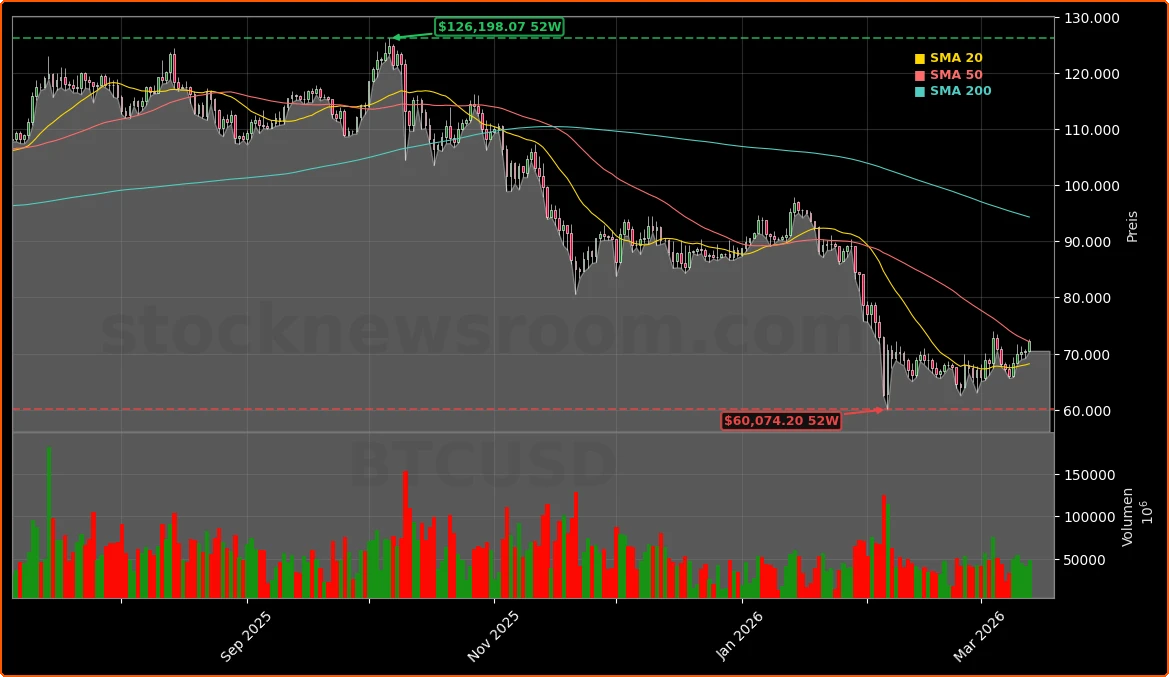
Bitcoin is once again trading like a macro-sensitive asset, with its latest leg higher unfolding against a backdrop of sticky inflation, a strong U.S. dollar and geopolitical stress. BTCUSD briefly pushed above $72,000 on Friday morning ET, extending gains from the prior close around $70,492 and adding roughly 2.6%. Technically, traders are watching a key breakout zone between $71,000 and $71,500, with resistance stacked in the $73,000 to $74,000 range and a short-term support band near $69,000. A sustained close above $74,000 is seen as the trigger for a fresh momentum wave, potentially targeting the $80,000 to $85,000 area, while pullbacks toward $65,000 or even $60,000 remain on the table in a risk-off reversal.
From a macro lens, this Bitcoin Market Analysis shows the asset has passed a new stress test. Despite fears that disrupted trade routes in the Middle East could fuel another inflation spike via higher oil prices, Bitcoin has avoided a broad liquidation. Since the onset of the Iran-related shock, BTCUSD has outperformed many major macro assets, including large segments of the bond market and parts of the S&P 500, signaling that risk appetite is wounded but not dead. At the same time, odds for a near-term Fed rate cut have collapsed, with market pricing showing less than a 1% chance of easing at the March 18 FOMC meeting, leaving Bitcoin competing directly with attractive yields in Treasuries.
How crucial are ETF flows and institutional demand?
The core narrative behind Bitcoin makrogetriebene Rally und ETF-Zuflüsse is the steady return of net inflows into U.S. spot Bitcoin ETFs. After a difficult February marked by multi-billion-dollar redemptions and the worst month since their launch, the products have logged three consecutive weeks of net inflows, the longest positive streak since July. Bloomberg data indicates roughly $529 million has moved into these vehicles over just the past few days, reinforcing Bitcoin’s status as an institutional-grade exposure rather than a purely retail-driven trade.
The ETF design matters for supply dynamics. Because these products are physically backed, issuers must acquire real Bitcoin, pulling coins off exchanges and tightening the float. Exchange balances have fallen to about 2.7 million BTC while total mined supply has pushed past 20 million coins, highlighting growing scarcity at a time when professional money is building positions. This structural squeeze helps explain why Bitcoin has been able to stabilize, even as broad equity indices like the NASDAQ and high-beta names such as Tesla and NVIDIA endure heavier swings on earnings revisions and rate fears.
Still, the institutional bid is not one-way. February saw approximately $3.5 billion in outflows from Bitcoin-linked products, while gold ETFs attracted around $16 billion, a reminder that, in an acute crisis, many allocators still treat Bitcoin as a risk-on asset rather than a classic safe haven. Yet the ownership pattern is shifting: larger players continue to accumulate on weakness while smaller investors have been net sellers, a divergence that many in the market regard as a constructive medium-term signal.
What role do regulation and banks play for Bitcoin?
The regulatory backdrop remains a double-edged sword in any serious Bitcoin Market Analysis. The Federal Reserve and U.S. regulators are moving ahead with rules that implement Basel Committee standards on how banks must treat digital assets. Under the Basel framework, Bitcoin receives a punitive 1,250% risk weight, effectively forcing banks to hold an equal amount of approved high-quality collateral, such as cash, gold or government bonds, against any Bitcoin exposure on their balance sheet. By contrast, those traditional instruments carry a 0% risk weight.
This treatment makes it costly for banks to offer balance-sheet-based Bitcoin services and underscores why many large U.S. institutions prefer ETF channels and derivatives over holding spot BTC directly. The classification is widely criticized in the industry as a category error that lumps Bitcoin with the highest-risk assets, but for now it limits the pace at which regulated lenders can enter the space. The flip side is that non-bank entities, including asset managers and crypto-native firms, are capturing most of the growth, reinforcing the role of ETFs and custodial platforms operated outside the traditional banking system.
How does Bitcoin stack up versus gold and big tech?
Compared with gold, Bitcoin’s performance in the recent war scare has been mixed. In the initial panic phase, capital flooded into physical gold and gold ETFs, while Bitcoin-linked funds saw redemptions. That episode dented the “digital gold” marketing pitch, at least in the very short term. However, as conditions stabilized, Bitcoin recovered quickly and now trades near the upper end of its recent range, while the metal has been more sideways. The divergence suggests that Bitcoin is gradually evolving into a hybrid asset: it can serve as a macro hedge in some scenarios but still behaves like a high-volatility risk asset when fear peaks.
Against the equity complex, Bitcoin’s resilience stands out. While megacaps like Apple and Tesla remain sensitive to earnings and regulatory headlines, Bitcoin has carved out its own path, helped by a clean technical structure where moving averages on the 4-hour and daily charts are turning higher. The $74,000 zone is widely viewed as a make-or-break level; a decisive break could trigger FOMO buying from both retail traders using leveraged certificates and professional desks seeking to catch the next momentum leg.
What are the key levels and risks for traders now?
Short-term traders are laser-focused on the $73,000 to $74,000 band, where repeated tests have so far failed to produce a sustained breakout. A daily close above this area could invite momentum funds and algorithmic strategies, potentially driving rapid moves toward $80,000 amid thinner weekend liquidity. On the downside, the $69,000 region is an important first line of defense, followed by deeper supports around $65,000 and $60,000, zones that many long-term investors see as attractive for incremental accumulation.
Bitcoin’s resilience in the face of geopolitical tension and a hawkish Fed backdrop shows that institutional demand via ETFs is increasingly setting the tone for this market.
— Laura Chen, Digital Asset Strategist at Hudson Square Capital
Conclusion
Weekend trading remains a double-edged sword. Lower liquidity on major venues can amplify volatility, creating the conditions for sharp squeezes in either direction. Leveraged products such as knockout certificates and margin futures can magnify gains but also carry a real risk of total loss if key levels are breached. For portfolio managers on Wall Street, the practical takeaway from this Bitcoin Market Analysis is that position sizing, diversification across asset classes and strict risk controls are essential as Bitcoin navigates a macro-driven regime shift.
Further Reading
- Bitcoin price jumps above $72,000 as ETF inflows return (Bloomberg)
- Basel Committee finalizes prudential treatment of cryptoasset exposures (Bank for International Settlements)
- Fed’s preferred inflation gauge and implications for risk assets (Reuters)
- Bitcoin makrogetriebene Rally und ETF-Zuflüsse bei Yahoo Finance (Yahoo Finance)