
Is Bitcoin quietly transforming from a speculative tech trade into a macro hedge as ETF inflows hit records amid global risk-off stress?

How resilient is Bitcoin in a risk-off backdrop?
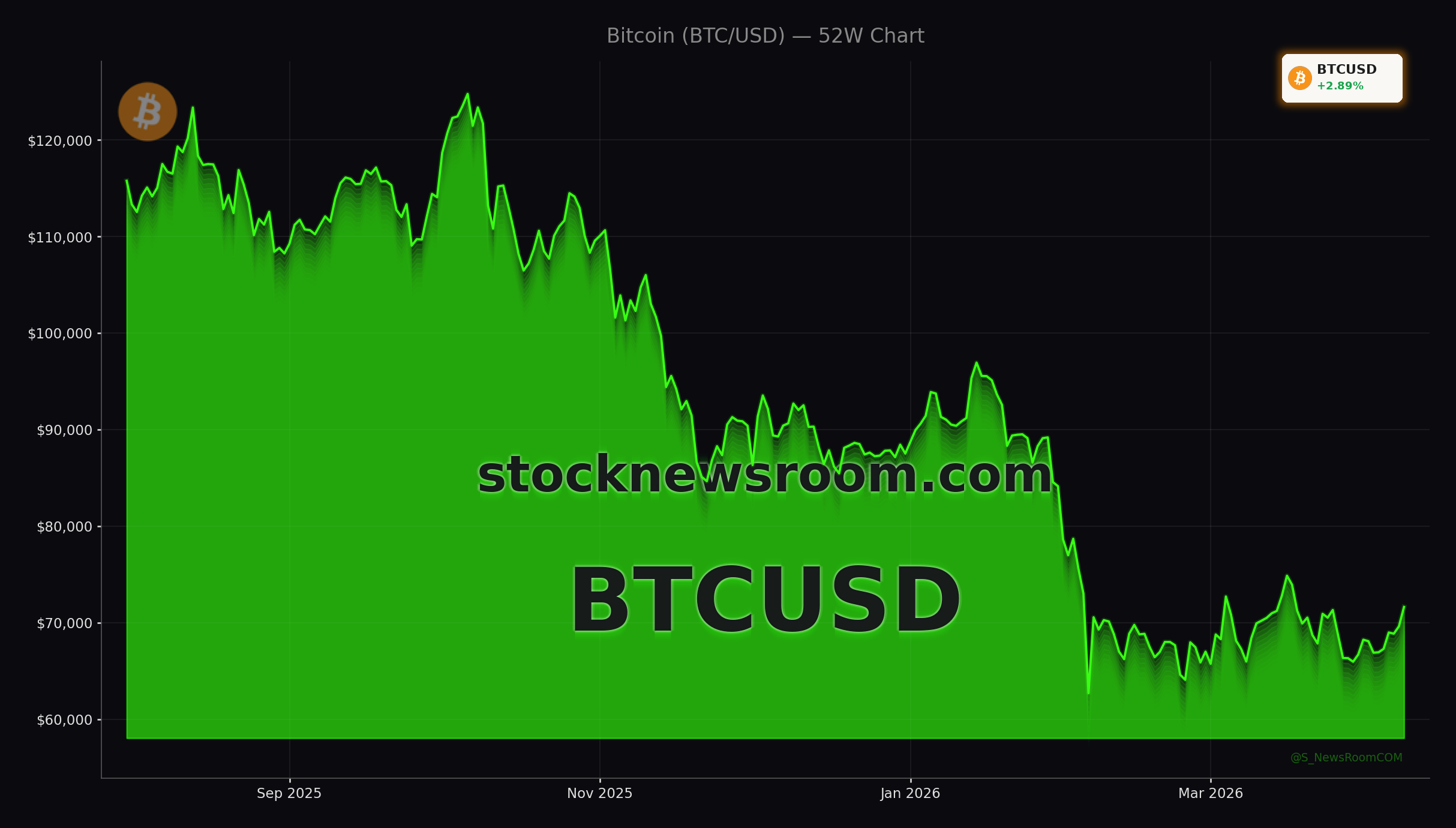
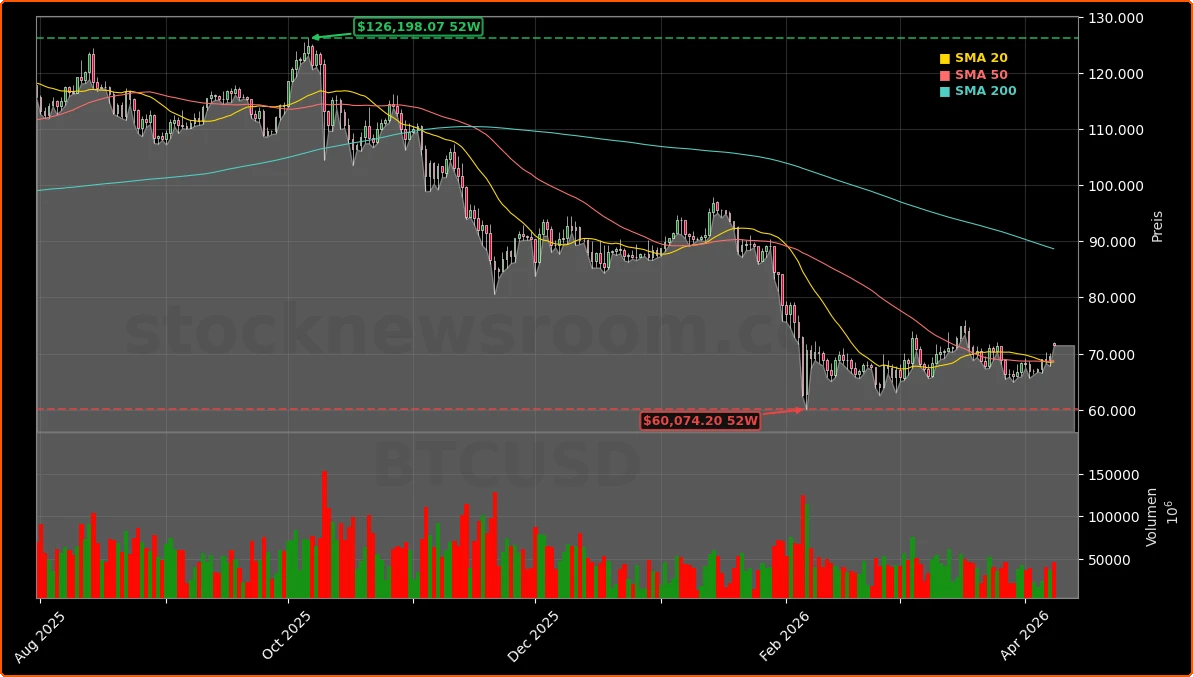
In the broader Bitcoin Makro- und Marktumfeld, the key surprise for Wall Street has been resilience. Despite persistent headlines around the Iran conflict, oil price worries and a prolonged stretch of extreme fear in crypto sentiment gauges, BTCUSD has held above $63,000 since early February and never revisited its yearly low near $60,000. Market data now show spot prices at about $71,500, roughly 3.97% higher than the previous close of $70,348, suggesting that buyers are willing to step in on dips even as traditional risk assets wobble.
On-chain and price-structure data indicate that $67,000 has emerged as a critical short-term pivot. Bitcoin has closed below that level on only a minority of trading days since February, even after a $403 million liquidation flush and repeated war-related shocks. Analysts warn, however, that if the Iran situation escalates and global investors need rapid liquidity, Bitcoin could be a source of cash, potentially pressuring prices toward prior February lows above $60,000.
Bitcoin Market Analysis and ETF demand
A central pillar of the current Bitcoin Market Analysis is the strength of U.S. spot ETF demand. U.S.-listed products saw one of their strongest sessions since the start of the Middle East conflict, with net inflows of about $471 million in a single day. Cumulatively, Bitcoin funds now hold roughly $56.4 billion in net inflows, highlighting how much institutional and advisor-led capital has moved into the asset since U.S. regulators approved spot products.
BlackRock’s iShares Bitcoin Trust has quickly become the dominant vehicle, with around $54.8 billion in net assets, outpacing rivals such as Fidelity’s fund. Over the past month, spot ETFs absorbed roughly 50,000 BTC, while corporate treasuries and listed vehicles added about 44,000 BTC. Those flows ended a four-month streak of net outflows and suggest that long-horizon investors, including U.S. wealth managers, are using volatility to build positions rather than exit.
At the same time, there has been meaningful activity in short Bitcoin products, which recently attracted about $16 million in inflows in a single week. That positioning underscores ongoing skepticism and provides fuel for squeezes if BTC continues to grind higher.
What are retail and long-term holders doing?
While day-to-day crypto trading volumes remain muted — some market participants even argue that “crypto trading is dead” — the underlying fundamentals point to steady accumulation. Retail investors in the U.S. and Europe appear to be favoring dollar-cost averaging and buying pullbacks rather than actively trading around short-term moves. Platforms with significant retail exposure report that customers remain believers in the long-term use case but are allocating their “trading capital” elsewhere, including high-beta tech names such as NVIDIA, Tesla and Apple.
Long-term on-chain wallets have stepped up accumulation. Holdings in these addresses jumped to nearly 290,000 BTC in early April, an increase of more than 80% over roughly two weeks. This cohort tends to sell less aggressively during corrections, creating a structural supply squeeze that supports the bull case. For U.S. portfolio builders, this shift toward committed holders may reduce downside beta relative to the NASDAQ during macro shocks, even if it doesn’t eliminate it.
Is Bitcoin acting more like gold or tech?
Another key angle in this Bitcoin Market Analysis is correlation. Recently, Bitcoin has traded more like a macro hedge, while gold has at times displayed the parabolic bursts historically associated with crypto. Fast-moving speculative capital that previously chased Bitcoin upside appears to have rotated into gold ETFs, yet Bitcoin has still outperformed gold, silver and several major equity indices since the latest Middle East tensions began around 34 trading days ago.
For investors debating the traditional 60/40 stocks-bonds mix, Bitcoin is increasingly being discussed as an alternative component on the “40” side, especially as stock-bond correlations have turned positive again. In that context, some U.S. advisors now compare Bitcoin’s role less to high-growth tech and more to a hybrid between gold and a risk asset, with position sizes adjusted accordingly.
Where could the next big move come from?
Technically, the market is at an inflection point. One widely followed scenario sees Bitcoin continuing higher into a resistance band around $78,000–$82,000, the area of a prior breakdown earlier in the year. A rejection there could trigger a deeper correction, with some bears sketching a path that briefly sweeps liquidity below $60,000 and, in a lower-probability case, tests the $40,000 area. That more extreme downside path is currently framed as a roughly 40% probability, given substantial on-chain support zones above $40,000 and a realized price near $54,000 that should act as a cushion.
Bitcoin’s scarcity is hard-coded, its demand is not — that combination is what keeps pulling institutional money back in, even when sentiment looks exhausted.— Independent digital asset strategist in New York
For altcoin traders, the timing of any such move matters. A swift, shallow pullback from current levels might free up capital to rotate into smaller tokens sooner, potentially sparking an “alt season.” A delayed sweep to lower levels, by contrast, would likely keep liquidity anchored in BTC and postpone any broad rotation across the crypto complex.