
Is Bitcoin evolving into a high‑beta macro asset just as ETFs surge, geopolitics flare and quantum risks creep closer?

Is macro now the main driver for Bitcoin?
From a top‑down perspective, the current Bitcoin Market Analysis starts with macro. Elevated oil prices above $100 per barrel and a higher 2026 inflation forecast of 2.7% from the Federal Reserve have pushed back expectations for near‑term rate cuts. That has left Wall Street in a classic risk‑off versus risk‑on tug of war, with the S&P 500 and NASDAQ oscillating as traders weigh tighter liquidity against still‑solid earnings from mega‑caps like NVIDIA, Apple and Tesla.
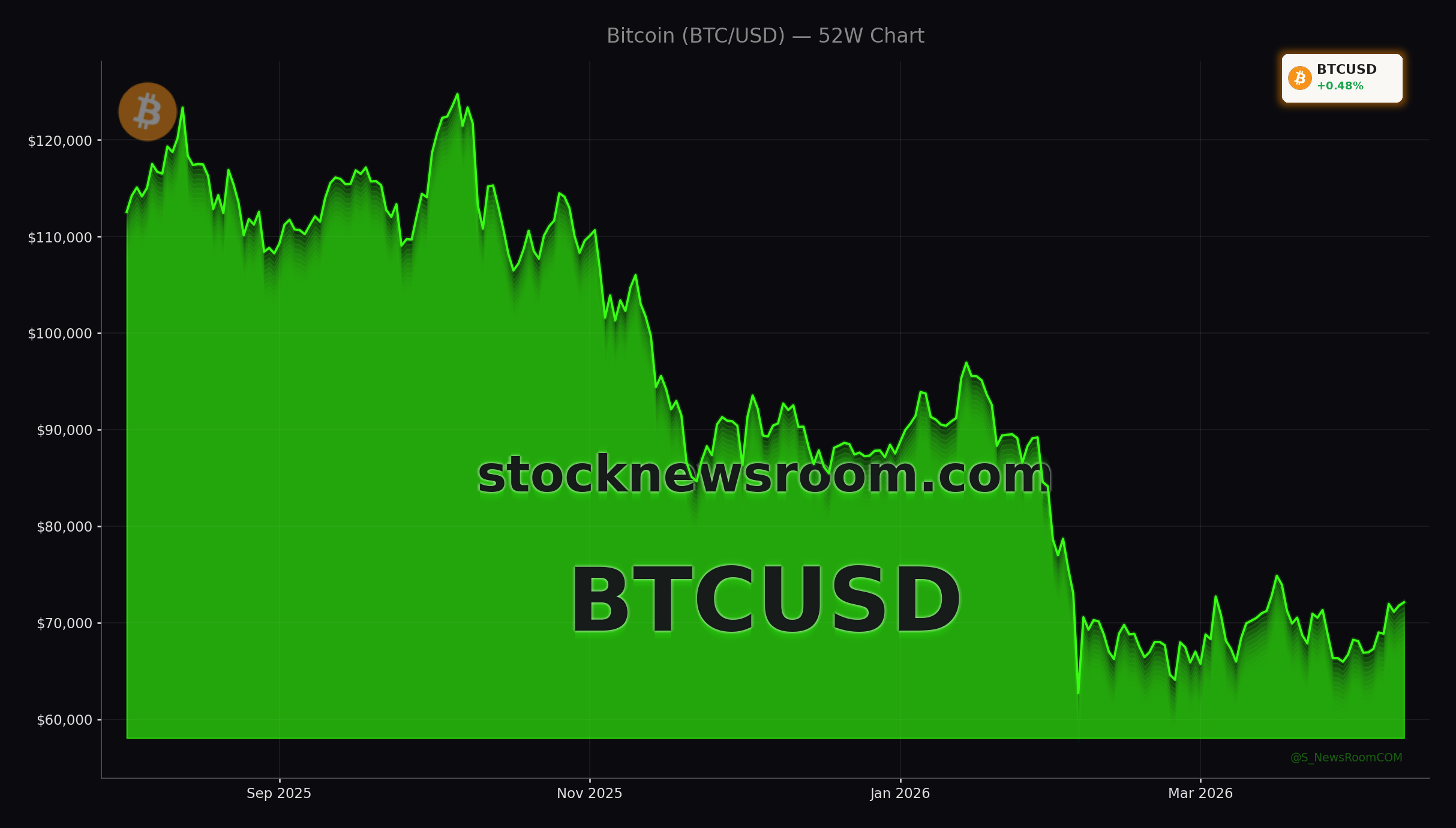
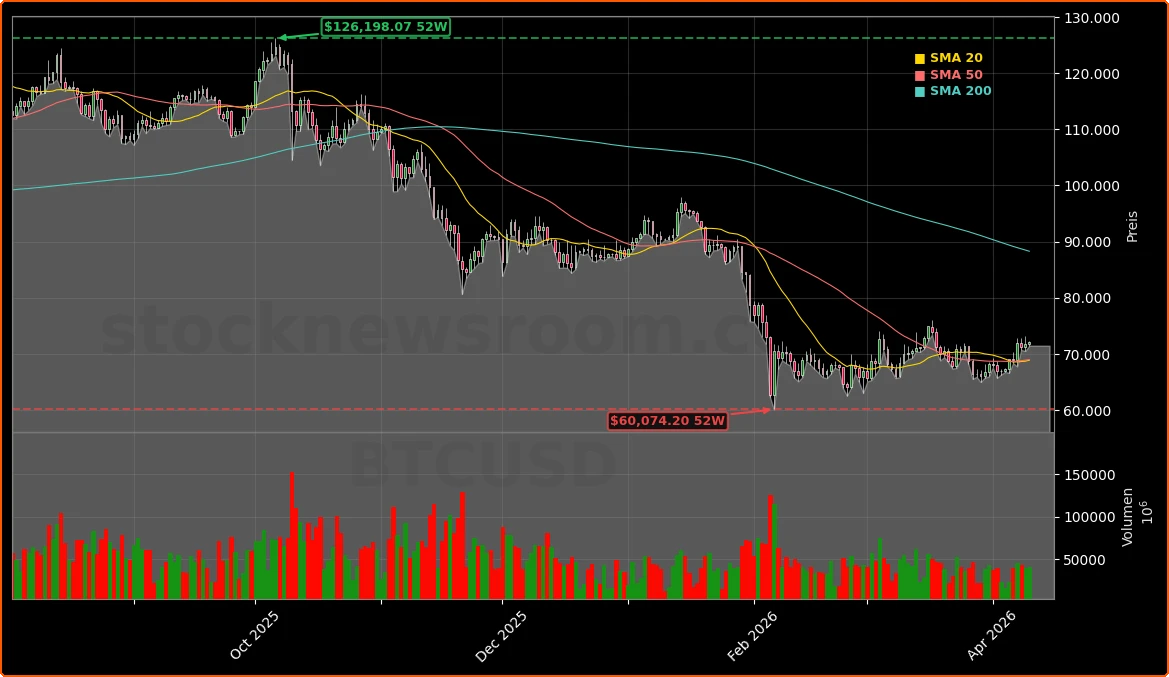
Historically, April has been a friendly month for BTC, with a median gain of just over 7% since 2013. But this year, geopolitical risk is doing more of the heavy lifting than on‑chain or cyclical factors. The ongoing US–Iran confrontation around the Strait of Hormuz has introduced a new layer of uncertainty. If ceasefire talks hold and oil retreats below $90, strategists see room for Bitcoin to challenge resistance in the $75,000–$80,000 band. If tensions flare again, a break below nearby support around $69,000 could accelerate liquidations and open the door to a deeper pullback toward the mid‑$60,000s, with some banks, including Standard Chartered, highlighting even $50,000 as a downside risk in a severe macro shock.
For US investors, this shifts Bitcoin’s role closer to a high‑beta macro asset than a purely idiosyncratic trade. BTC remains roughly four times more volatile than the S&P 500, and Bloomberg’s commodity strategist Mike McGlone has argued that the earlier ETF‑driven surge above $100,000 may have marked a “peak beta” phase rather than a stable new regime. Against that backdrop, risk budgeting and position sizing are taking center stage in institutional Bitcoin Market Analysis.
How does Morgan Stanley change the ETF game?
On the micro side, the launch of a new spot Bitcoin ETF by Morgan Stanley adds another heavyweight to the US product suite and underscores how deeply crypto has penetrated Wall Street. The bank’s vehicle competes directly with existing leaders such as BlackRock’s iShares Bitcoin Trust, with Morgan Stanley going on offense with a lower fee structure around 0.14% versus roughly 0.25% for some rivals.
Early flow data are notable: Morgan Stanley clients bought close to 450 BTC on day one, roughly in line with the network’s daily mining output. While that is small versus total ETF holdings accumulated since early 2024, it represents a fresh channel of demand from wealth‑management accounts that historically had limited access to spot Bitcoin. For US advisors running balanced portfolios that already include big tech names like NVIDIA and Apple, the ability to plug in a low‑fee, brand‑name Bitcoin ETF simplifies compliance and operational risk.
The competitive landscape is also evolving. As fees compress, the battle shifts to liquidity, tracking quality and distribution reach across platforms like Merrill, UBS and independent RIAs. Citigroup and Goldman Sachs have both highlighted the structural importance of spot ETFs for long‑term adoption, even as they caution that ETF inflows alone cannot offset a hostile macro backdrop. For now, the net effect of Morgan Stanley’s entry is to deepen the institutionalization trend and incrementally reduce the “career risk” of holding Bitcoin in multi‑asset mandates.
Bitcoin Market Analysis: how big is the Iran factor?
Geopolitics adds another twist. Iran has reportedly moved to charge transit fees for ships crossing the Strait of Hormuz in Bitcoin, targeting payments of about $2 million per vessel, or roughly 27–28 BTC at current prices. With a proposed daily cap of 10–15 ships, that would equate to more than 3,600 BTC per day, over eight times the current daily mining supply.
Even if actual volumes fall far short of that theoretical maximum, the signaling effect is powerful: a sanctioned state is openly leaning on Bitcoin to route around the dollar‑centric financial system. That feeds into a broader narrative of de‑dollarization, where energy exporters and importers increasingly contemplate non‑USD settlement, from cryptocurrencies to CNY. For US investors, this raises the prospect that Bitcoin could, at the margin, play a role similar to gold as a geopolitical hedge.
At the same time, not everyone on Wall Street is convinced. Bloomberg’s McGlone points out that since the US spot ETFs went live, gold has outperformed Bitcoin by a wide margin, rallying about 135% versus a much smaller gain for BTC. In his view, that divergence suggests capital may be migrating from speculative assets into traditional safe havens, a key consideration for asset allocators balancing gold, Treasuries, Bitcoin and high‑growth equities such as Tesla.
Could quantum computing disrupt the thesis?
Beyond the next quarter, quantum computing has emerged as a wildcard in any long‑horizon Bitcoin Market Analysis. Google researchers recently outlined a more efficient pathway to attacking elliptic‑curve cryptography, the backbone of Bitcoin’s current signature scheme, using far fewer qubits than previously assumed. Although practical attacks are still considered infeasible—today’s machines have hundreds to low thousands of unstable qubits, versus the millions of error‑corrected qubits likely required—the timeline estimates for meaningful progress have shifted forward toward the early 2030s.
In response, academic and industry researchers have proposed stopgap methods to make individual Bitcoin transactions quantum‑safe without altering the base protocol. One approach replaces the conventional signature check with a so‑called hash‑to‑signature puzzle, forcing the spender to brute‑force a valid‑looking signature in a way that offers no shortcut even for a quantum computer. This technique works today within Bitcoin’s existing scripting limits but is computationally expensive and impractical for everyday payments or second‑layer systems like the Lightning Network.
Experts such as StarkWare’s Eli Ben‑Sasson see this kind of scheme as a powerful emergency tool, while Bitcoin ESG analyst Daniel Batten notes that it does not solve the problem of exposed public keys and long‑dormant wallets—most famously the roughly 1 million BTC attributed to Satoshi Nakamoto. If a future quantum computer could target these older outputs, the sudden movement or theft of such coins might shock market confidence and undermine Bitcoin’s scarcity narrative.
Ultimately, most cryptographers still favor protocol‑level, post‑quantum signature upgrades as the long‑term answer, an area where US regulators and standards bodies like NIST are already active. For American investors with multi‑decade horizons—pension funds, endowments, family offices—the key takeaway is not imminent danger, but the need to monitor how quickly Bitcoin’s governance and developer community move toward quantum‑resistant primitives.
Bitcoin is evolving from a fringe speculation into a fully fledged macro asset, but that also means it now lives and dies by the same forces driving oil, rates and geopolitics.— Sam Daodu, Market Strategist
In summary, Bitcoin Market Analysis heading into mid‑April sits at the intersection of tighter macro conditions, deepening ETF penetration via Morgan Stanley and peers, novel geopolitical use cases, and a distant but real quantum overhang. For US‑based portfolios, Bitcoin increasingly behaves like a high‑beta macro and geopolitical trade rather than a niche side bet. The next catalysts to watch are any easing in the US–Iran conflict, progress on US digital‑asset legislation such as the CLARITY Act, and concrete roadmaps toward quantum‑safe upgrades—developments that will determine whether BTC’s next move is a breakout toward $80,000 or a reset toward lower, more sustainable levels.