
Is Bitcoin still a reliable risk barometer or has it quietly morphed into a leveraged tech trade with regulatory tailwinds?

Is Bitcoin still a barometer for risk?
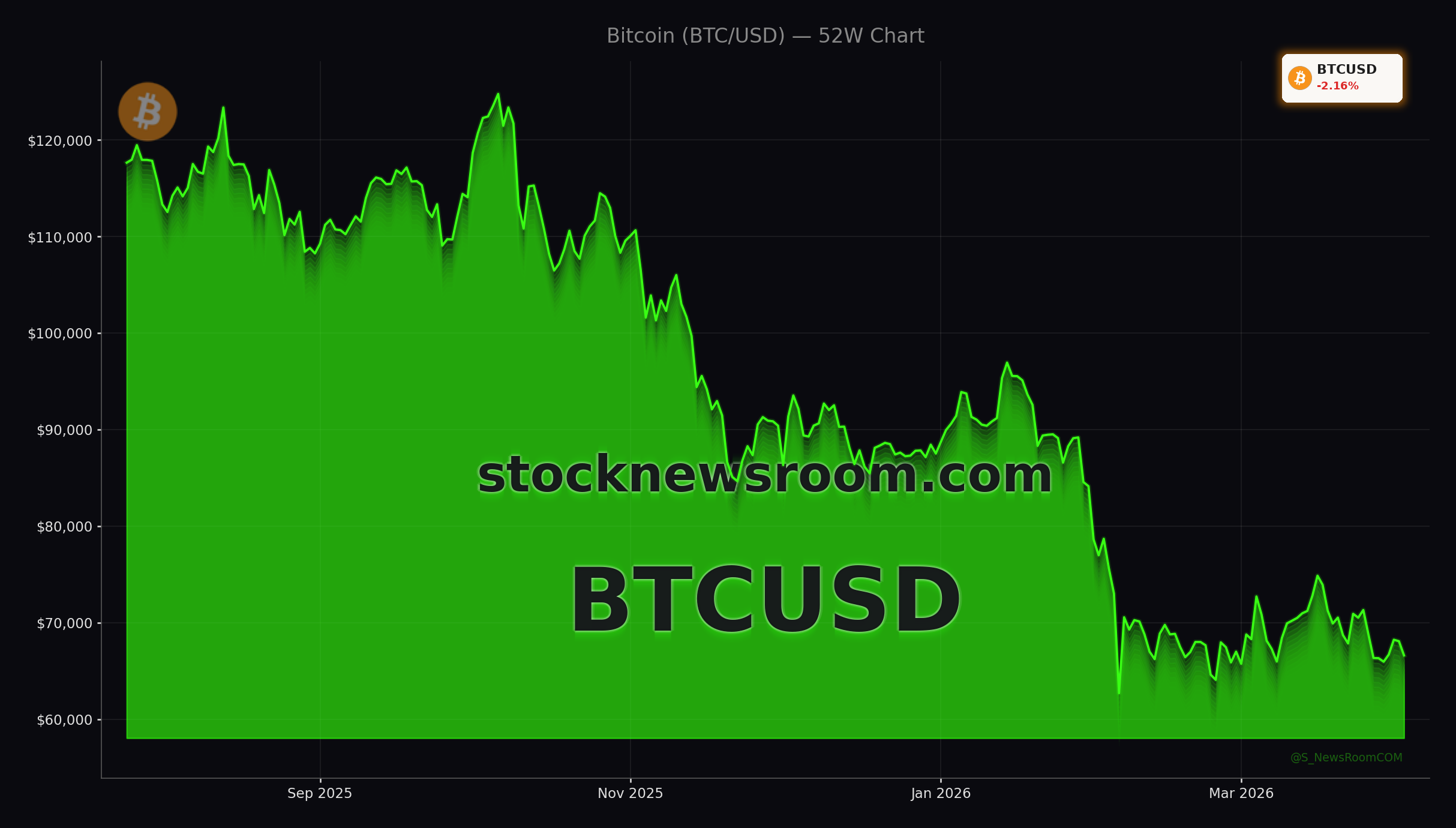
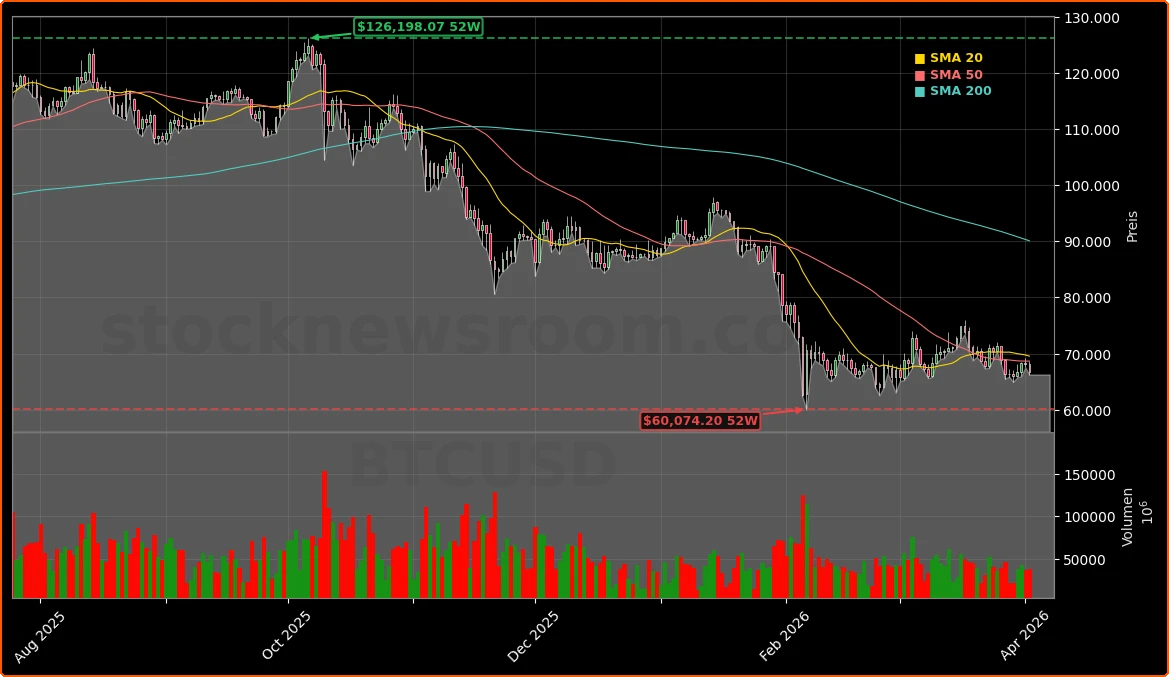
Bitcoin is down about 3.15% from yesterday’s close near $68,071, extending a pullback from the $69,000 area on April 1. Technically, BTCUSD has been oscillating in a broad $62,000–$72,000 corridor, with near‑term resistance now clustered between $67,800 and $68,500 and support building around $66,000 and $65,500. Traders report that as long as the $64,000–$65,000 zone holds, the current consolidation can still be framed as a base rather than a full‑blown trend reversal.
From a cross‑asset perspective, Bitcoin continues to trade like a high‑beta proxy on growth and tech. Correlations with software names and the S&P 500 have risen, and several portfolio managers now describe Bitcoin as a kind of “levered Nasdaq.” That pattern was visible in March: while volatility surged across equities, Bitcoin quietly pushed higher, a subtle but important signal that risk appetite beneath the surface had not completely evaporated.
At the same time, episodes of risk aversion tied to Middle East tensions and U.S. political headlines have led to repeated flights into the U.S. dollar and out of crypto. After a recent televised address by Donald Trump on the Iran conflict, Bitcoin dropped from just under $70,000 to around $66,500 as investors rotated into perceived safe havens in FX and away from speculative assets.
Bitcoin Market Analysis: what do charts signal now?
Short‑term technicians note that Bitcoin formed an interim base above $66,500 earlier this week, but failed to overcome the $68,800 region, which aligns with the 61.8% retracement of the downswing from roughly $72,000 to $65,000. Hourly momentum indicators such as the MACD have rolled back into bearish territory, while the RSI has slipped below the neutral 50 line, signaling fading upside momentum.
Key intraday levels now watched by traders include immediate resistance at $67,800 and $68,500 and a support ladder at $66,000, $65,750 and $65,500. A decisive break below $64,200 would likely embolden bears and could trigger a test of the lower band of the multi‑week range near $62,000. Conversely, a close back above $69,000 would revive talk of a run at the upper $72,000–$73,000 ceiling, although the market currently lacks a clear macro catalyst for such a breakout.
Veteran market observers such as Burton Malkiel, author of “A Random Walk Down Wall Street,” remain skeptical. He has warned that Bitcoin can move $1,000 in a single day in either direction and therefore should not be a core holding for most investors. Still, even many critics concede that the asset has matured into a distinct, if volatile, part of the global risk landscape.
How are U.S. portfolios using Bitcoin and Ethereum?
On Wall Street, the consensus among multi‑asset strategists is that Bitcoin Market Analysis argues for only modest exposure for most clients. Recommended allocations typically range from 1% to 2.5% of a diversified portfolio, often split between Bitcoin, Ethereum and sometimes Solana. Advisors stress the idea of “getting your toes wet” without taking on position sizes that could be ruinous in a sharp drawdown.
For younger investors with longer time horizons, some wealth managers are open to slightly higher weights, but they also point out that Bitcoin has largely lost its former status as a diversifier. With correlations to high‑growth tech and mega‑cap names such as NVIDIA, Tesla and Apple elevated, Bitcoin now behaves much more like a speculative growth asset than digital sovereign money isolated from Wall Street cycles.
Retail investors continue to accumulate via fractional purchases on U.S. exchanges such as Coinbase, buying in small dollar amounts rather than full coins. Meanwhile, crypto‑sensitive equities like Coinbase and Robinhood have struggled year‑to‑date, despite occasional relief rallies when Bitcoin and Ethereum catch a bid at the start of a new quarter.
Regulation, taxes and the 401(k) question
Regulatory developments are also reshaping the investment case for Bitcoin und Kryptowaehrungen. The U.S. Department of Labor has floated proposals that would make it easier for alternative assets, including crypto, to appear inside 401(k) retirement plans, likely first via target‑date funds. Any eventual green light would grant millions of Americans indirect exposure, though implementation is expected to be slow and tightly controlled.
On the tax side, the Internal Revenue Service has introduced Form 1099‑DA for digital assets, obliging brokers and exchanges to report crypto transactions above certain thresholds. Capital gains on Bitcoin are taxable regardless of size, and losses can be netted against other capital gains much like stocks. Additional changes to the reporting framework are scheduled for 2026, underscoring how seriously regulators now treat this roughly $2 trillion industry.
At the same time, rapid advances in artificial intelligence are fueling new fraud risks. Cheap generative tools can fabricate convincing identities and social‑media profiles, which are being used to promote everything from crypto scams to romance fraud, raising the bar for due diligence for retail buyers.
Can Bitcoin hedge geopolitics and dollar debasement?
Beyond trading desks, geopolitical strategists are increasingly factoring Bitcoin into sovereign risk debates. One active conversation centers on whether Taiwan should consider accumulating Bitcoin reserves alongside gold to hedge against a potential conflict with China, U.S. dollar debasement and disruptions to traditional payment rails. Because Bitcoin does not rely on physical transport, reserves could in theory remain accessible even if shipping routes were blocked or foreign‑held gold were frozen.
Such ideas remain controversial but highlight how Bitcoin Market Analysis is expanding from micro price action to macro strategy. In a world facing rising U.S. debt levels, loose monetary policy and the prospect of an AI‑driven boom‑and‑bust in tech earnings, some policymakers see digital assets as an additional tool to diversify away from pure dollar exposure. Bitcoin’s proponents argue that, paired with gold, it can offer a hedge against fiat debasement and provide a form of “geopolitical insurance” that also facilitates low‑friction cross‑border trade.
However, legitimate concerns around custody, liquidity and extreme volatility mean institutional adoption will depend heavily on specialized infrastructure and clear regulatory guidance.
Bitcoin has stopped being a true diversifier and now trades much more like a levered bet on growth and technology.— Burton Malkiel, author of “A Random Walk Down Wall Street”
In conclusion, this Bitcoin Market Analysis shows BTCUSD caught between its role as a speculative tech‑like asset, an emerging component of regulated portfolios and a potential macro hedge in a fraught geopolitical landscape. For U.S. investors, modest, risk‑aware allocations to Bitcoin und Kryptowaehrungen may make sense alongside traditional stocks and bonds, but not as a substitute. The next catalysts will likely come from regulation, interest‑rate expectations and geopolitical headlines, giving active investors ample opportunity to reassess positioning as the crypto market’s next chapter unfolds.