
Is macro panic hiding a Bitcoin bottom, or is the market sleepwalking into a brutal shakeout and potential short squeeze?

Is macro fear masking a Bitcoin bottom?
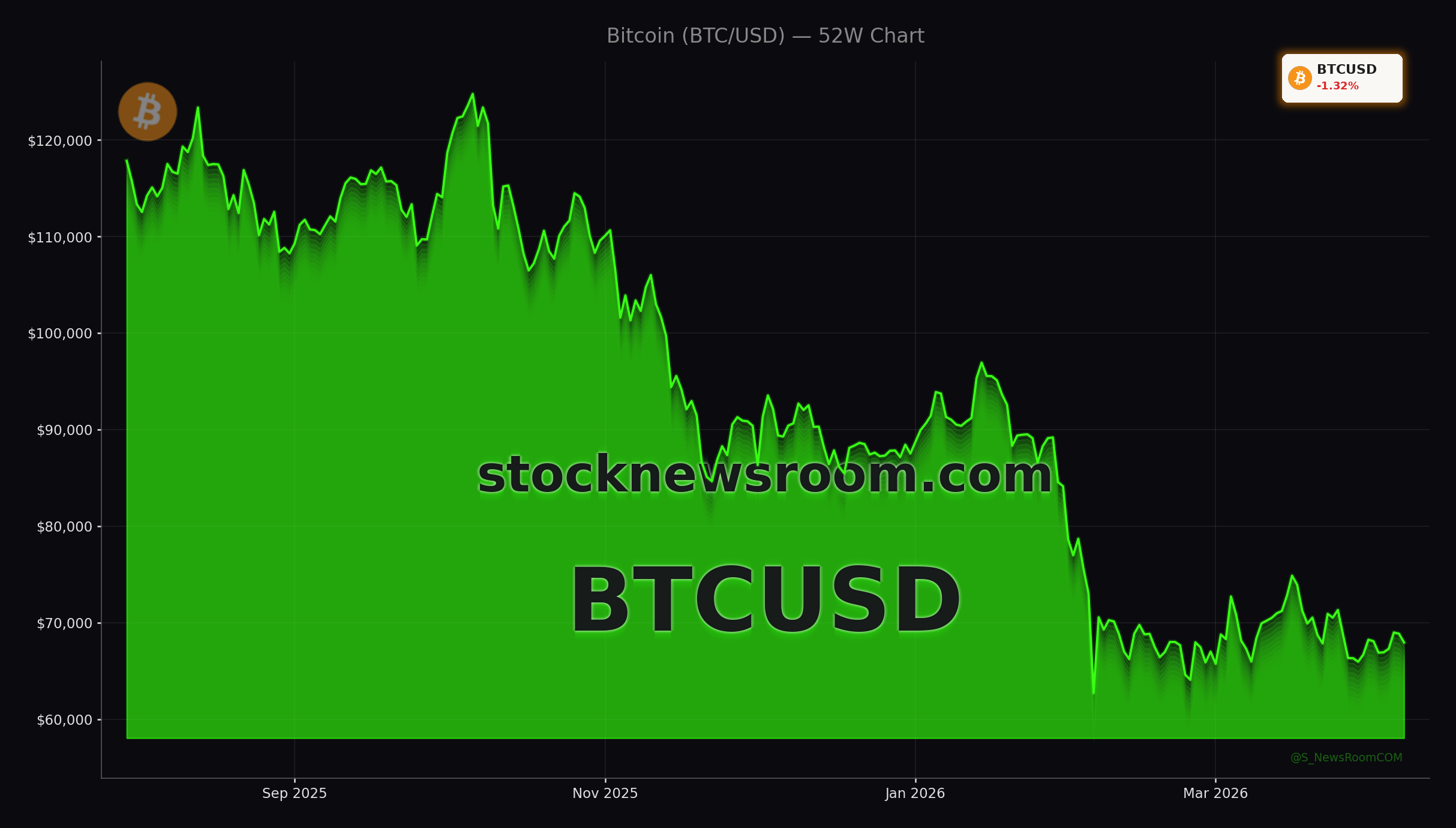
Geopolitics remain the dominant macro driver. Tensions between the U.S. and Iran have pushed oil back toward multi‑year highs and kept Treasury yields elevated, feeding a broadly risk‑off tone that weighs on cryptocurrencies and high‑beta tech names like NVIDIA and Tesla. Yet Bitcoin has been surprisingly resilient: despite five red months in a row before March, including several double‑digit declines, BTCUSD is roughly flat to slightly positive so far in April.
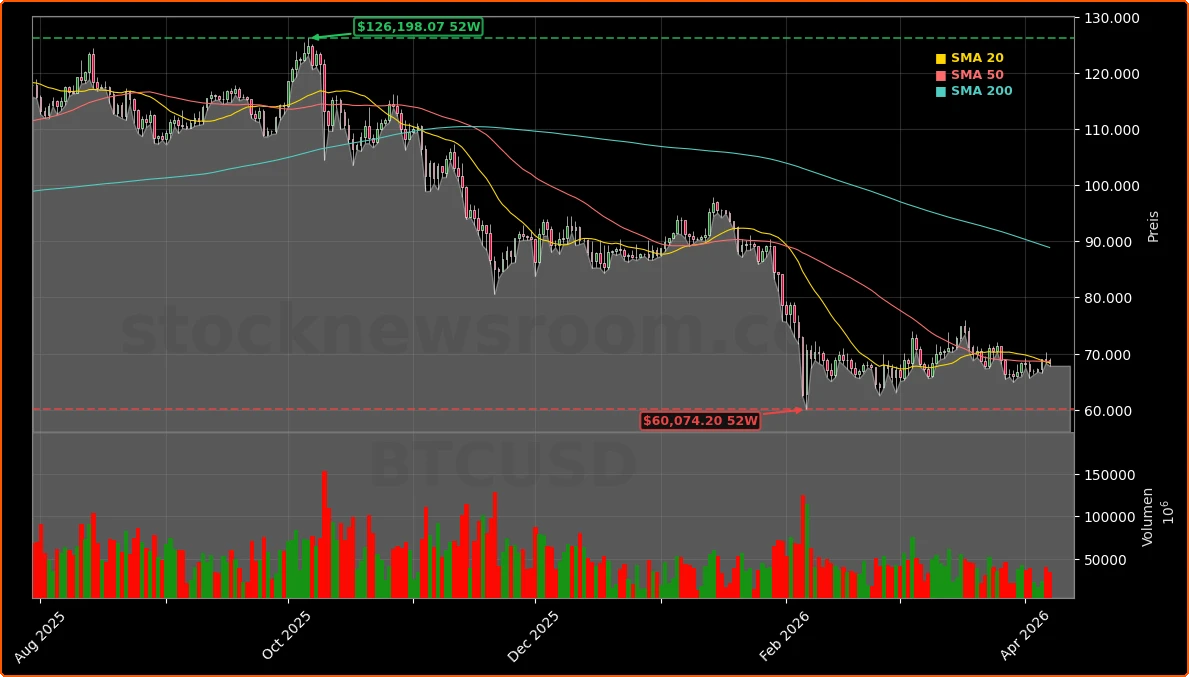
A key technical support sits near the 200‑week exponential moving average around $68,300, an area Bitcoin keeps retesting without breaking decisively lower. On a monthly chart, the MACD turned negative last fall, signaling the start of a cyclical bear phase, but the histogram is now showing signs of bottoming. If April closes with a strong green candle, technicians argue the histogram could flip from dark red to light red, confirming a base and the early stages of a new uptrend.
From a macro‑allocation perspective, Bitcoin has behaved more like gold lately, holding up as traditional risk assets wobble. Some institutional strategists see this as part of a broader rethink of the classic 60/40 stock‑bond portfolio, in which gold, Bitcoin and other alternatives play a larger role when equities and Treasuries move in tandem.
How fragile is sentiment under $70,000?
While price holds near support, sentiment has deteriorated sharply. Social data show bullish‑to‑bearish Bitcoin commentary at roughly 0.81 to 1.00, the weakest reading since late February. The Crypto Fear & Greed Index has slumped to 11, deep in the “extreme fear” zone that historically marks late‑stage capitulation rather than the start of a new downtrend.
This divergence between price stability and fragile mood is central to any serious Bitcoin Market Analysis. On‑chain metrics indicate Bitcoin is still trading well above its realized price around $54,000, suggesting many long‑term holders remain comfortably in profit. At the same time, profit‑taking has spiked: recent data show nearly three profit‑realizing transactions for every loss‑realizing transfer, a ratio that in prior cycles has often preceded local tops or at least short‑term consolidation phases.
For U.S. investors, this mixed backdrop argues for moderation. Bitcoin continues to languish just under the $70,000 resistance band and has failed six times since early February to hold above that level. The seventh attempt is in progress, but with macro headwinds and tax‑season selling before the April 15 U.S. “Tax Day,” volatility around current levels is likely to stay elevated.
Bitcoin Market Analysis: What do derivatives say?
The derivatives market paints a more directional picture. Roughly $6 billion in short positions are clustered near $72,500; if Bitcoin breaks through that level, forced liquidations could trigger a classic short squeeze and send prices sharply higher in a compressed time frame. By contrast, about $2 billion in long positions sit closer to $65,000, creating a pocket of downside liquidity if BTCUSD slips below near‑term support.
Order book data show robust buy interest in the $63,000–$66,000 zone, where dip‑buyers and longer‑horizon institutions appear willing to accumulate risk. That demand helped push Bitcoin back toward $70,000 after each recent pullback. However, sell pressure has been reasserting itself in the $71,000–$72,000 band, aligning with those concentrated shorts and reinforcing the importance of a clean breakout above that region.
Some macro‑oriented crypto strategists warn that a final shakeout is still possible. Their base case is a fast $10,000–$15,000 downdraft over the next six months, which would drag Bitcoin toward the $54,000 realized‑price area. That level also coincides with key cost‑basis support on several on‑chain valuation bands, making it a natural target if war‑driven oil inflation or renewed risk aversion hit digital assets again.
Could Morgan Stanley unlock the next demand wave?
While traders watch the Iran headlines, the structural story is shifting toward institutions. Morgan Stanley has filed to launch a spot Bitcoin ETF and reportedly plans to distribute it through a sales force of roughly 16,000 advisors. For U.S. wealth‑management clients who currently gain exposure mainly through listed vehicles like Grayscale or proxies in the S&P 500 and NASDAQ such as Apple and crypto‑linked equities, a mass‑market bank‑branded ETF could mark a significant new access point.
The timing may prove important. U.S. money‑market funds are sitting on about $8.2 trillion in cash. If regulatory clarity improves and geopolitical risk recedes, even a small rotation of that liquidity into crypto‑linked products could materially impact prices. In Washington, the proposed “Clarity Act” for digital assets is expected in April or May and is seen as critical for allowing U.S. banks to invest in Bitcoin in a fully compliant way. Without it, American institutions risk falling behind European and Asian peers already building crypto offerings.
At the same time, retail investors have been net sellers in Q1 2026, while funds, corporates and even some governments have accumulated, pointing to a quiet transfer of ownership from retail to professional hands. That shift could reduce volatility over time but also means rallies may be more institutional‑driven and less reliant on social‑media hype.
Markets may still have to weather one last shakeout, but the building institutional infrastructure and regulatory clarity are laying the groundwork for Bitcoin’s next major cycle.— Senior digital assets strategist at a U.S. investment firm
Another regulatory front to watch is the GENIUS Act debate in Washington, which would bar yield‑bearing stablecoins from passing interest income directly to consumers. Depending on the final wording, this could reshape how stablecoin issuers, DeFi protocols and traditional banks compete for deposits and yield, with second‑order effects for Bitcoin liquidity flows.