
Can the latest wave of Bitcoin Regulation, from spot ETFs to Fed access and new bills, really power a lasting macro rally?
Bitcoin as a macro asset: where does it stand now?
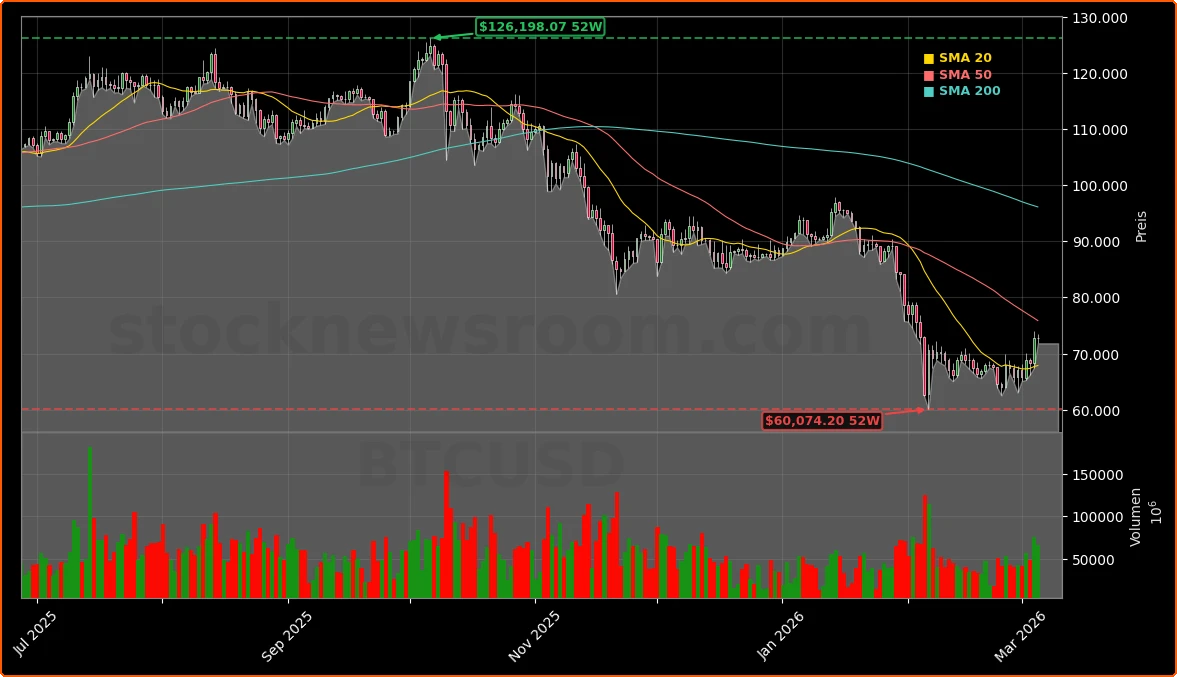
Bitcoin has staged a powerful rebound, climbing back above the psychologically important $70,000 mark and recently trading near $72,852, up roughly 2.5% on the day. After a five‑month correction that saw BTC drop close to 50% from last year’s peaks, the market is now testing whether this move is the start of a durable new leg higher or just another bear‑market rally. Volatility gauges such as the VIX have eased by about three points, signaling a broader risk‑on shift that extends from tech stocks on the NASDAQ to digital assets.
For Wall Street, the key change is that Bitcoin is no longer trading purely as a speculative tech proxy. In the latest upswing, BTC showed notable resilience even as traditional equity indices swung wildly on headlines about conflicts in the Middle East and tensions involving Iran. Flows into Bitcoin coincided with rising oil and gold prices, supporting the narrative of the token as a complementary macro hedge rather than a simple high‑beta risk asset. That has pushed a growing cohort of allocators to treat it as a distinct bucket within alternative assets rather than a side bet on growth stocks like NVIDIA or Tesla.
Still, the volatility profile remains extreme. Long‑term commentators point out that within one cycle Bitcoin can fall 50%–70% from peak to trough, even if the multi‑year trajectory remains positive. For portfolio construction, the current consensus among more aggressive global wealth managers is to cap crypto exposure at roughly 10%–20% of risk capital, with Bitcoin as the core holding and smaller allocations to majors like Ethereum. In practice, few traditional US 60/40 portfolios are anywhere near that level yet, which leaves room for incremental adoption if regulatory clarity continues to improve.
Bitcoin Regulation and US spot ETFs: are flows driving the rally?
The most visible transmission channel of Bitcoin Regulation into price right now is the US spot ETF complex. In just the last few days, spot products listed on US exchanges recorded around $860 million of net inflows, with one trading session alone seeing roughly $680 million. Over a five‑day stretch, the largest US Bitcoin spot ETF, sponsored by a leading asset manager frequently compared to Apple in terms of scale, attracted about $1.4 billion of fresh capital. Those flows are substantial even by S&P 500 ETF standards and signal that institutional and advisor‑led demand is not only intact but accelerating on price strength.
Technically, analysts describe a clean buy signal on daily charts, with upside potential being mapped toward the $82,000–$85,000 zone. That band coincides with the upper boundary of the consolidation range that began in mid‑summer. Between $77,000 and $78,000, several resistance levels cluster; a convincing break above them would support the view that a new impulse wave toward six‑figure territory is underway. On the downside, technicians are laser‑focused on the $50,000–$60,000 area as critical structural support. A sustained break below that range would likely confirm a longer bear‑market phase.
From a regulatory standpoint, the successful launch and subsequent normalization of spot ETFs have already changed the market’s plumbing. For US institutions bound by strict compliance regimes—pension funds, endowments, insurance companies—the ETF wrapper is easier to approve than direct custody of coins or exposure through offshore exchanges. That is one of the most tangible benefits of evolving Bitcoin Regulation: it channels previously sidelined institutional demand into transparent, on‑exchange vehicles that fit existing risk and audit frameworks.
This shift is not just about flows; it is about signaling. Each additional week of orderly ETF trading without major incidents weakens the argument that crypto exposure is inherently unmanageable for mainstream asset managers. It also reduces the dependence of US investors on crypto‑native firms and unregulated venues, which in turn may gradually compress the risk premium embedded in BTCUSD.
Kraken Financial and the Fed: what does a master account really change?
A second pillar of the current narrative is the decision by the Federal Reserve to grant Kraken Financial, the digital‑asset arm of the Kraken exchange, access to a master account in the Fed’s payment system. This is the first time a dedicated digital‑asset bank has been onboarded into the same core infrastructure traditionally reserved for commercial banks and select financial institutions.
In practical terms, a Fed master account allows Kraken Financial to settle dollar transactions directly on the Fed’s books, reducing dependence on correspondent banks and cutting frictions in moving capital between fiat and crypto rails. Strategically, it is a breakthrough for the industry. One of the most persistent criticisms of crypto from Wall Street risk officers has been the fragility of its banking access. Several high‑profile US crypto‑friendly banks failed or withdrew from the sector in previous years, raising concerns about operational continuity.
By integrating a regulated digital‑asset bank into the Federal Reserve’s core system, regulators send a nuanced but important signal: under the framework of evolving Bitcoin Regulation, certain crypto intermediaries can be treated as part of the official financial infrastructure provided they meet standards. That does not mean a blanket endorsement of the sector, but it does anchor the idea that crypto settlement and custody can coexist with Fed‑backed payment rails instead of sitting entirely in parallel.
For US investors, this matters less as a branding win for Kraken and more as a proof of concept. If one digital‑asset bank can secure that level of access, others may follow over time, with potential implications for how ETFs, brokers and even traditional wealth managers integrate crypto offerings. In combination with regulated ETFs on the front end, deeper access to Fed infrastructure on the back end could gradually make Bitcoin exposures feel as operationally robust as holding a large‑cap tech stock on the NYSE.
Clarity Act, stablecoins and the next wave of Bitcoin Regulation
Parallel to these institutional developments, the policy debate in Washington is increasingly focused on stablecoins and broader Bitcoin Regulation. Former President Donald Trump has voiced support for a new legislative push informally dubbed the “Clarity Act,” aimed primarily at creating a federal framework for dollar‑backed stablecoins. The political attention around this proposal has coincided with renewed interest in Bitcoin and other digital assets, not least because stablecoins are the main on‑ramp for real‑world payments on blockchains.
The logic is straightforward: a clear regime for issuing and backing stablecoins under US oversight could make them more acceptable to payment companies, banks and corporates. One prominent payments firm has already partnered with a major Indian IT services group to target about $1 billion of stablecoin settlement volume in 2026 alone, demonstrating how quickly the lines between trad‑fi and on‑chain finance are blurring. Bitcoin itself may not be the settlement asset in these systems, but it stands to benefit as the flagship collateral and store‑of‑value asset in the broader crypto ecosystem.
At the same time, the sector’s darker side remains under scrutiny. Investigative reporting on Tether and other stablecoins has uncovered disturbing instances where crypto rails have been abused to facilitate illicit activities, including human trafficking networks in Southeast Asia. These episodes are central to the tightening of Bitcoin Regulation globally: they provide political justification for stricter know‑your‑customer rules, sanctions enforcement and closer coordination between exchanges and law‑enforcement agencies.
For investors, the takeaway is nuanced. More stringent regulation may create short‑term headwinds for some tokens and business models, especially in offshore venues. But for Bitcoin, the largest and most transparent asset in the space, a regime that clamps down on fringe abuses while giving clarity to compliant institutions is likely net positive. It reduces reputational and regulatory tail risk, potentially paving the way for broader adoption by banks and asset managers that today shy away from anything associated with opaque stablecoin arrangements.
Geopolitics, “digital gold” and the global adoption puzzle
Bitcoin’s latest upswing has unfolded against a tense geopolitical backdrop. As conflicts in the Middle East escalated and oil prices climbed, flows on crypto exchanges showed notable capital moving out of exposed regions and into Bitcoin, often directly into hardware wallets. In those cases, BTC functioned less as a trading vehicle and more as a cross‑border store of value to hedge against inflation, currency depreciation and potential capital controls.
This behavior strengthens the narrative of Bitcoin as “digital gold,” but the comparison remains contested. Traditional gold, with a history measured in millennia, has outperformed Bitcoin over certain recent windows and has been more stable. In the last major drawdown, BTCUSD fell nearly 50% from its highs, whereas gold notched new records. For conservative allocators, that track record keeps gold as the primary safe haven, with Bitcoin as a higher‑beta complement rather than a replacement.
Yet adoption patterns outside the United States tell a different story. In Sub‑Saharan Africa, estimated crypto transaction volumes of more than $250 billion in 2024–2025—around 2% of regional GDP—suggest that digital assets are already embedded in everyday economic life. In economies with scarce access to US dollars and limited banking infrastructure, stablecoins and Bitcoin are used as tools for import payments, remittances and wealth preservation. This makes the region the world’s second‑largest crypto market by some measures, even though it lacks the Wall Street‑centric ETF infrastructure that dominates the US narrative.
For global investors in New York or London, these adoption pockets matter because they indicate a floor of organic, non‑speculative demand for Bitcoin and related assets. While regulatory changes in Washington or Brussels can move prices quickly, the long‑term thesis increasingly rests on the migration of financial transactions—payments, collateral, settlement—to public blockchains. The combination of Bitcoin Regulation that enables institutional access in developed markets and grassroots usage in emerging markets provides a dual engine for the asset’s long‑term relevance.
Positioning in a US portfolio: risk management and scenarios
Against this backdrop, how should US‑based investors think about Bitcoin in multi‑asset portfolios already exposed to high‑growth names like NVIDIA and Tesla on the NASDAQ and mega‑caps like Apple in the S&P 500? The current environment argues for a differentiated approach. Bitcoin has increasingly traded as a separate macro factor, sensitive to real yields, dollar liquidity and regulatory headlines, but less tightly coupled to single‑name tech earnings.
For long‑term allocators, a modest structural position—typically below 5% of total portfolio value for most balanced mandates—can be justified as a bet on the continued institutionalization of the asset class under clearer Bitcoin Regulation. That exposure can be implemented through US spot ETFs for ease of custody and compliance, with the option to add small tactical overlays via futures or structured products. For more aggressive traders, leverage via certificates and options remains popular, with some structures offering nearly 3x exposure to a 10%–15% underlying price move.
Scenario analysis is crucial. In a bullish case where ETF inflows remain strong, the Clarity Act or similar legislation passes with market‑friendly provisions, and macro conditions stay benign, Bitcoin could plausibly retest and break prior highs, with some optimistic technical roadmaps pointing toward six‑figure targets over the coming years. In a neutral scenario, BTC consolidates between $50,000 and $80,000 as regulation advances in fits and starts and risk appetite on Wall Street oscillates.
The bearish case centers on three risks: a sharp macro shock that forces rapid deleveraging across risk assets, a major regulatory setback (for example, severe restrictions on stablecoins or additional limits on bank‑crypto interactions), or a significant failure or scandal involving a large crypto intermediary. Any of these could trigger a renewed 50%–70% drawdown. That is why, despite the ongoing push toward normalization via Bitcoin Regulation, risk sizing and diversification remain more important than ever.
On balance, the market is currently leaning toward the optimistic end of the spectrum. ETF flows, Fed system integration through Kraken Financial and the policy debate around the Clarity Act form a coherent narrative of maturation. At the same time, episodes of abuse in parts of the stablecoin ecosystem underline why regulators are unlikely to take a hands‑off approach. Navigating this tension between freedom and oversight will shape Bitcoin’s path as much as traditional supply‑demand dynamics.
Conclusion
Investors who recognize that duality—embracing the structural tailwind from institutionalization while respecting the ever‑present downside volatility—are best positioned to benefit from Bitcoin’s evolution from fringe experiment to regulated macro asset.
Further Reading
- Federal Reserve Financial Services: About Master Accounts (Federal Reserve)
- Bitcoin as an Inflation Hedge? A Cross‑Country Analysis (International Monetary Fund)
- The Role of Crypto Assets in Emerging Markets (Bank for International Settlements)
- Bitcoin bei Yahoo Finance (Yahoo Finance)